Friday, March 29, 2013

Peregrine Falcon Courtship

We are starting to see courtship at a number of peregrine nests. Those of you who watched at last year might remember that the falcons were in full laying mode by the first week of April. The cold spring seems to have pushed nesting activities just a little farther back this year, since by the last week of March 2012 we already had peregrine eggs at three nests.

The falcons begin with ledge and cliff displays, bowing and calling loudly. The male brings gifts of food to the female, often engaging in acrobatic mid-air food transfers. As courtship progresses, the falcons build a scrape for their eggs, digging into the gravel with their breasts and pushing to create a scrape. The male may solicit the female by bowing and e-chupping. Finally, both falcons bow and e-chup over the scrape.

GSBDweller caught Travis bringing Michelle food on Tuesday. We'll be watching closely for courtship activities at Great Spirit Bluff.

Wednesday, March 27, 2013

Valmont Nest Failure


We are sorry to announce that the Valmont Great Horned Owl nest in Colorado has most likely failed. Snowflake began laying eggs on February 12, 2013, and incubated them through an unusually cold, snowy spring. Her eggs should have begun hatching around March 21, but we have seen no signs of hatch so far. She will most likely continue to sit on her eggs for another week or two before ceasing incubation altogether.

Like the Fort St. Vrain nest, this nest has a mixed history. The Valmont nest failed in 2010 when incubation was disrupted by a territorial battle. In 2009, another cold, snowy spring, Snowflake stopped incubating following a massive snowstorm. The nest also failed in 2007 following heavy snow, although the owls reclutched and hatched young later in April. We don't know for sure that the nest failed because of cold weather, but we've seen it happen here before.

The lives of wild birds are filled with challenges: weather, territorial battles, predators, and food supply all play a role in the success or failure of any given nest. Although Snowflake diligently incubated her eggs, it
appears there won't be any young at the Valmont nest this year. We will post if the owls reclutch.

Saturday, March 23, 2013

Barn Owl Hatch at Eaglecrest!


It appears the first barn owl egg have hatched at Eaglecrest this morning! Tess laid 7 eggs between 2/19 and 3/04. Assuming all of them hatch, we should have barn owl eggs hatching over the next 13 days. A video: http://youtu.be/n-AtdPhYRSA.

You can watch the nest at: http://www.ustream.tv/eaglecresthawks. I especially love to watch the owls at night, when the IR light does a wonderful job of illuminating the nest cavity.

We often try to determine when hatch happened. This can be difficult, since hatching is not an on/off event, but rather a process that occurs over a period of time, as this time-elapsed video of a barn owl egg hatching at Hawk Creek Wildlife Center shows: http://youtu.be/uPACjB14Nww

For more about eggs and egg hatching, read this blog post: http://raptorresource.blogspot.com/2012/03/we-are-getting-lot-of-questions-about.html

Congratulations, Tess!

Tuesday, March 19, 2013

About The New Nest

We are getting a lot of questions about the new nest. Here are a few answers.

Where is the new nest? 
The new nest is still within the eagles' original territory. It is about 300 feet/100 meters east of the original nest, located between the bike trail and Trout Creek by Siewers Spring Road. We ask that anyone who goes to see the nest stay on the trail or sidewalk and avoid trespassing on private property. While these eagles are fairly tolerant of humans, visits to the nest tree will disturb them. All of our photographs are taken at long range.

New nest on March 12, 2013. This photo was digiscoped from a
few hundred feet away. 
When did the eagles start working on the new nest? 
The eagles started working on the new nest in October. They kept us guessing for a long time, but we announced that they had adopted the new nest on February 15, 2013.

Why did the eagles build a new nest?
We don't know why the Decorah eagles built a new nest, but nest building is a very common thing for eagles to do. Several studies have indicated that roughly 45% of eagles build more than one nest on territory. Some eagles that build new nests experienced failure in their old nest, yet even eagles that have experienced reproductive success will build new nests. The old nest had begun tilting as it settled on to the branches, so possibly that had something to do with it, but we don't know for sure. For more on alternate nest building, follow this link. This Connecticut study also has some interesting information on alternate nest building.

How many eggs have the eagles laid?
We don't know, but it seems reasonable to assume three, since Mom has a history of laying three eggs.

When will the eggs hatch? 
We have to estimate a lay date based on the eagles' behavior and history. We believe she laid egg #1 on February 19th, so we are guessing hatch on about March 24th. We will announce hatch once we think we have it.

Where can I find Decorah eagle photographs and news?
The latest news will be posted on our facebook page. You can also follow this blog, although it isn't usually as up to date as facebook. Photos can be found on facebook or at our flickr page (look in the 'New Nest' set). All photos are courtesy Jim Womeldorf unless otherwise stated.

Are you putting up cameras at the new nest? 
We are still working out the details, but we hope to put up cameras this fall, once the eagles have concluded this year's season and the young have dispersed from the nest.

Friday, March 08, 2013

The Perch Project


Alliant Energy has begin installing the eagle protection perches in Decorah. The first three went up on the lines and poles to the southwest of the trout hatchery.

This photo shows two views of the perches. In general, avian electrocution happens when a bird makes a connection between ground and a live wire. Energy flows through the bird's body to ground. The perches built by Mr. Condon's class in Decorah are located above the power lines and Alliant added an insulative sleeve where the live wire passes under the perch. The sleeve is long enough that even a stretching eagle should not be able to connect with the wire.

We'd like to thank everyone involved for their work protecting the Decorah eagles, especially the D12 Memorial Group, Raptor Nation, Mr. Condon and his class, Decorah Building Supply, Alliant Energy, and Puget Sound Energy.

A few links:

Students building perches: http://youtu.be/7VPqY9LM3EE
(this video also does a good job of explaining electrocution and perch safety)

The D12 Memorial Group's story: http://raptorresource.blogspot.com/2012/11/bird-safe-power-poles.html

Perch blueprint: http://www.flickr.com/photos/68092929@N03/8203641600/

Friday, March 01, 2013

03/01/2013: Banding Birds, Part II: How We Band and Band Reporting

We are sometimes asked why we band birds. Banding birds provides an invaluable way to study their life histories and chart changes in bird populations, including changes in range, population numbers, and migratory behaviors. Bands do not hurt birds or impact their individual or reproductive success.

There are a number of different ways to band or mark birds. We use two leg bands on Peregrines: an aluminum leg band (currently silver in the midwest) on the right leg, and a multi-color band (currently black/red in the midwest) on the left leg.  Both bands are very light and fitted after the bird's leg is fully or very near adult size. The silver band contains a long number with a unique federal identifer assigned by the North American bird banding lab. The multi-colored band is an auxillary marker distributed regionally by the Raptor Center at the University of Minnesota. The numbers are larger and etched in a different color than the band, so they are easier to read.
Peregrine Falcon - Banded
Falcon 96/B, from the Dairyland Power Alma plant in Alma, WI. Photo by Roy Brown Photography.
In general, we band young peregrines taken from the nest by hand between 20-30 days of age, before they start flying. Banding can take anywhere from 15 minutes to an hour, depending on the site. Once we return the young falcons to the nest, their parents come back quickly - we have never witnessed a peregrine abandon young after banding. We used a pan dam trap to catch bald eagles D1 and D14 after they were on the wing. Other methods of trapping flying birds include mist nets, rocket nets, bal-chatri traps, or even hand catch depending on the size, weight, and wariness or aggressiveness of the bird in question.

Banding tools. Band colors may differ from year to year and
region to region.
One of the team usually holds the bird while someone else bands it. Both bands are fitted around the bird's legs before they are closed.  The aluminum band is closed with a pliers and the multi-color band with a pop-rivet gun: a technique developed by Charles (Chuck) Sindelar, who still bands with us and was instrumental in bald eagle recovery in Wisconsin. Since female birds of prey are larger than male birds of prey, females take slightly bigger bands. We sex peregrines by tarsus thickness and 'voice' (female birds have lower voices). Although male bands are smaller than female bands, we discovered that females banded as males aren't damaged when we trapped 'Husker', a 1998 fledge from the Woodman Tower in Nebraska. Husker, a female banded as a male, fledged 19 young between 2001 and 2007. Her slightly tighter bands didn't affect her legs or her ability to care and provide for her young.

When we band peregrines, we record the federal band number, the auxiliary band number, the bird's gender, the actual or approximate age of the bird, the site name, the site coordinates, the bird bander, and other notes (parent bands, overall bird health, any treatments given (such as Spartrix for Frounce), and so on). We report this information to the Bird Banding Lab (BBL) and the Midwest Peregrine Falcon Database, an online interactive database maintained by the Midwest Peregrine Project and the Raptor Center.

Banding birds provides an invaluable source of information, since the bird's life history can be looked up and shared with others. Our peregrines have been spotted on oil rigs in the Gulf of Mexico, in the Eastern United States (traveling cross-country from the midwest), in Nebraska (traveling cross-country from Rochester, New York), in Florida, in Canada, and in many locations in Minnesota, Iowa, and Wisconsin. You can report bands to the Bird Banding Lab by calling 1-800-327-2263 or going to their website at http://www.pwrc.usgs.gov/BBL/bblretrv/. If you have retrieved bands from a dead bird, you may keep them.  You will need to know:
  • What kind of band you are reporting. For a guide to bands, follow the link below...
  • http://www.pwrc.usgs.gov/BBL/homepage/bandmarkerexample.cfm 
  • How you obtained the band
  • The date you saw the band
  • Band or marker info. There is a pretty good guide to markers on the site. There are three possible leg positions for leg-banded birds. Pick the one you think is closest to what you saw. You won't get in trouble for flubbing the position. You'll also be asked for band colors and code 
  • The location of the banded bird
If the Bird Banding Lab has information on the bird, you'll be emailed a cool certificate that provides information about your bird. The bird bander will also be notified. We love notifications!

My first certificate of appreciation
We've banded Peregrines on power plant catwalks and in elevators, on rooftops, on the ground, and hanging from ropes. We've banded on calm sunny days and in howling near-gale force winds, racing down smokestacks and up cliffs just ahead of thunderstorms. Most thrillingly, we have witnessed 'banding season' go from one afternoon, when the Peregrine falcon was so highly endangered that only a handful were nesting in the midwest, to a month-long mad scramble to fit everyone in. Thanks to the efforts of bird banders, the return of the Peregrine falcon in the United States is perhaps the most documented population phenomena in natural history. We know the lineage, natal nests, life histories, and genetic make-up of the majority of Peregrines nesting in the United States today.

Watch this video for a look at Peregrine banding at Great Spirit Bluff near Dresbach, Minnesota.

Thursday, February 21, 2013

Barn Owls at Eaglecrest

The barn owls at Eaglecrest laid their first egg on 2/19/13. They are nesting in a hole in the tree just below the nest tray that the geese are using. The Countess (also called 'Tess) will most likely lay four to six small eggs that should begin hatching after roughly 33 days, or on March 24. Unlike the geese, barn owls are asynchronous layers - that is, they don't delay incubation to assure that all of the eggs hatch at roughly the same time. The eggs will hatch in  the order they were laid, and there may be an age difference of up to three weeks between the youngest and the oldest nestling. The young birds are brooded for about two weeks and fledge in 50 to 55 days.

Here is a look at egg #1

Barn owls are one of two living lineages of owls. Most owls are classified as Strigidae, or typical owls - a name that appears to have derived from the Greek word strix, meaning screecher. Barn owls are Tytonidae, derived from tyto, a word that means either owl or honored. I've already done a blog post on the features and adaptations that all owls share: facial disks, large forward facing eyes, 'soft' feathers, round heads, distinctive facial markings and/or ear tufts, talons and a 'hawk-like' beak. However, there are also some differences between the two.


Tytonidae have...
Heart-shaped faces
Large heads and long legs
Hunt at night
Are cavity nesters
No feathered ear tufts
Strigidae have...
Round faces
Smaller heads and shorter legs
Some kinds hunt during the day
Nest in a variety of ways and places
Feathered ear tufts

The heart-shaped facial disk of a barn owl has different directional properties than that of its round-faced cousins. If it were a microphone, we'd call it cardioid. The heart shape isolates sound sources and concentrates sound in front of the owl, obscuring sound from the sides and rear. Like its uneven ear holes, this helps it pinpoint prey. Its large head also means a larger facial disk with which to pick up sound. These specialized adaptations help barn owls hunt in very low light to complete darkness: a critical skill for barn owls, since many nocturnal animals curtail their activities to dens and burrows when the moon is full.

A barn owl's long, sparsely feathered legs help it catch mice, shrews, and voles in deep vegetation and underneath snow. Its third toe has a split talon that can be used as a comb. Perhaps their long legs aid in grooming, or help them avoid bites and scratches from prey. Or maybe tytonidae owls really like tall, long-legged mates. We know that dark spots on a female barn owl attract males - the larger and darker her spots, the more interested male owls get. Could long legs serve a similar function?

The lack of feathered tufts is also a mystery. Since some but not all Strigidae have ear tufts, I'm guessing - and this is a guess - that the common ancestor of all Tytonidae and all Strigidae did not have ear tufts (which are not at all related to ears or hearing). Therefore, the question should be 'why did some Strigidae develop ear tufts?'. Researchers have proposed camouflage, species recognition, and signaling under low-light conditions, but no one knows for sure. Barn owls are at the very low end of the avian acuity and contrast sensitivity spectrum. Perhaps they never developed ear tufts because they aren't likely to benefit from whatever visual cues, sexual attractiveness, or camouflage ear tufts provide to owls that have them.

Eaglecrest makes it possible for us to watch great horned owls and barn owls in the same territory. You can see why barn owls have been called 'ghost owls' and 'night owls' - their silent flight and vocalizations can seem a little eerie. They are very different from their louder, showier Strigidae cousins. Barn owls nest in cavities, returning to the same cavity year after year to lay eggs and raise young. Great horned owls commonly usurp the stick nests of other birds, while a barn owl makes a simple nest of her own regurgitated pellets, shredded with her feet and arranged into a cup. I'll be watching for more differences as they incubate eggs and raise young.

Barn owls are more effective than poison and traps at controlling rodent populations. If you have suitable habitat and are interesting in building a barn owl box, click here for directions from the Missouri Department of Conservation.

Things that helped me learn more about barn owls:


Wednesday, February 20, 2013

Canada Geese at EagleCrest

Check out the video: http://youtu.be/8hT_Cg551_0
The Canada Geese laid their first egg at Eaglecrest on February 19th between 5:05pm and 6:18pm PST. Mother goose Wilma won't begin full incubation until most of her eggs are laid, which helps assure that the young goslings are all at about the same stage of development. I don't want to guess at a hatching date right now, but this is roughly what nesting looked like last year:
  • 1st egg: February 26
  • 2nd egg: February 28
  • 3rd egg: March 1
  • 4th egg: March 4
  • 7th and last egg: March 10
  • Hatching: April 6th
  • Nest Leave Taking: April 7th 
If the geese follow the same pattern this year, we should see an egg roughly every two days, with full incubation beginning about the time the last egg is laid. Hatch should start 24-28 days later: last year took 27 days. The goslings will jump from the nest within about 24 hours of hatch. We'll be able to watch the family swimming in the pond, but they will not come back to the nest once they've left it. 

People expressed a lot of concern about these three things last year: 
  1. Mother goose isn't spending enough time on her eggs
  2. The goslings will starve when they hatch
  3. The goslings will die when they jump from the nest
So let's talk about them, shall we? 

Incubating the Eggs
Mother goose won't begin full incubation until around the time her last egg is laid. Embryonic growth and development is a fast-paced chemical process that requires heat. By delaying incubation, mother goose delays the onset of embryonic development  and assures the synchronous hatching of fertilized eggs. Synchronous (closely-timed) hatching is especially important in the case of Canada geese and similar birds, which leave the nest roughly 24 hours after hatching. Unhatched eggs or birds too young to follow their parents die. 

I used to think that eggs would die if birds stopped sitting on them for even brief periods of time. Not true! Embryos are less sensitive to cold than to heat, particularly before incubation has started, and few birds incubate continuously. Wilma will regulate the temperature of her eggs by varying the amount of time she sits on them, and the tightness of her sit. If the weather is warm and sunny, she may spend a great deal of time off the eggs. We also might see her cover the eggs with soft nesting material.

Feeding the Goslings
I'm going to drop some words on you readers. Canada geese are precocial - that is, the young are relatively mature and mobile from the moment they hatch. They are born with their eyes open and can swim, run, and jump shortly after leaving the egg. This is important, since precocial species are normally nidifugous, meaning they leave the nest shortly after birth or hatching. 

Just before hatching, the goslings will consume whatever yolk and albumen remains in their eggs. This provides enough food energy for the next 24 to 48 hours. Once they've jumped from the nest, their parents will lead them to water and protect them from predators. Wilma and Fred do not need to provide food in the nest, and the goslings will find food (mostly) on their own once they reach the water. 

Jump!
Roughly 24 hours after hatching, Wilma will leave the nest and the goslings will jump after her. While this seems scary, it is very normal for geese. Canada geese have been documented nesting on heron nests, osprey nests, cliffs, and man made structures. Nesting in high places helps protect eggs and very young babies from ground-bound predators including raccoon, coyotes, opossums, cats, and dogs.

The jump is over very quickly. Dad Fred will be waiting on the ground below to help protect his family. Wilma will fly down from the nest and honk for the goslings, who will quickly follow her out of the nest. Their  light weight and downy bodies will help protect them from injuries when they land on the soft grassy surface below the nest, and Eaglecrest staffer Ramblin' Raptor will also put out straw or grass to help cushion their landing. Once the goslings have landed, their parents will lead them directly to the pond, honking and hissing all the way.

To see just how fast the jump goes, watch this video from 2012:

I've often heard Bob say that birds wouldn't do it if it didn't work. Successful behaviors lead to more offspring to pass those traits on to. Geese that are good at synchronous incubation will have better offspring survival rates than those that aren't. Geese that nest high will lose fewer eggs and young to ground-based predators, offsetting potential losses caused by landing injuries. Whatever we might think as human watchers, Fred and Wilma are following a way of life that has produced more winners than loosers. Mama (goose) knows best.

Friday, February 15, 2013

Decorah Eagles Announcement

It appears that the Decorah eagles have chosen the new nest they started last fall for this year’s nesting season. If they were going to use the old nest, we should have seen them bringing in soft nesting materials and building a nest bowl for their eggs. While Bob observed them bouncing back and forth as late as the morning of February 13th, they appear to have a pronounced affinity for the new nest.

Although we haven't seen it in Decorah before, multiple nest building is a relatively commonplace activity: in most but not all instances bald eagles will have more than one nest in their breeding territory. According to Pat Schlaurbaum from the Iowa DNR: "Alternative nests are quite common for a species that exhibits compulsive nest building behavior. While many alternative nests are active immediately, there are instances where eagles relocate from the alternative nest and return to the original nest and vice versa."

While we are disappointed that the eagles have left the original nest, they are simply doing what eagles do. Pending approval and support from all landowners, we will install cameras near the new nest in the fall of 2013. Cameras at both nests will assure that the public will be able to follow these famous eagles.

The Raptor Resource Project has many other bird cams across the country. Our Bald Eagle Cam in Colorado has been operating for close to ten years and allows viewers to switch between two cameras. We also have Falcon Cams, Red-tailed Hawk Cams, a Vulture Cam, a Kestrel Cam, a Great Blue Heron Cam, and Owl Cams that can viewed fromwww.raptorresource.org. Click on ‘bird cams’ on the top of the page to view them. You can also get the latest news from our facebook page, read more about multiple nest building (and many other topics) on our blog athttp://raptorresource.blogspot.com/, or chat with other bird fans in our forum: http://www.raptorresource.org/forum/. We will update on the new nest on facebook as we are able.

We look forward to bringing to the Web a new species of eagle from another part of the planet. The Philippine Eagle is on the brink of extinction and we have been working with the Philippine Eagle Foundation to bring a live Philippine Eagle Cam to the world. We are hoping that we can use the power of the Web to both educate and initiate efforts to help save this species. This is everything that the Raptor Resource Project stands for.

Wednesday, February 06, 2013

02/06/13: Banding Birds, Part I: A Brief History

Falcon 72/N, a 2011 hatch from the Allen S. King plant .
I'll talk more about the band colors in our
next installment
We sometimes get asked why we band birds. Bird banding allows us to study the movement, survival, and behavior of the birds we band, and get life histories for at least some of the birds we watch. Bird banding has helped researchers gather information on mortality rates, dispersal patterns, migration, behavior, social structure, and seasonal and long-term population trends. It allows us to track individual peregrine falcons, giving us an intimate look at how a species behaves as it recovers, grows, and eventually reaches stasis with its environment. Without bird banding, we could not track the success of our cliff recovery program, know the history of any given site from year to year, or track the ebb and flow between urban and cliff-nesting populations. We would not know that female falcons tend to stay within 200 miles of their natal nests, that males tend to stay within 70 miles of their natal nest, and that Zeus, the male at Woodman Tower in Nebraska, was a real outlier (Zeus was released in Rochester, New York: a straight-line distance of 945 miles). The leg bands we use do not harm birds or adversely affect their survival rates.

Bird banding has a long and storied history. In 254 BC, Quintus Fabius Pictor recorded the use of birds as message carriers by the Romans. Pliny noted the use of birds as messengers in his Natural History, completed in 77 AD, and Marco Polo, writing on falconry in Asia between 1275 and 1295, stated: "Each bird belonging to the sovereign and the Barons has a tablet of silver on its feet, with its name and that of the owner inscribed so that wherever caught it can be returned to him."

Metal bird banding in Europe also began as a way for royal falconers to identify and recapture escaped or stolen birds. Recorded recaptures include a falcon owned by Henry IV, which escaped at Fontainebleau and was recovered in Malta, 1,350 miles away, and a Canary falcon owned by the Duke of Lerma, which flew from Anadalusia to the island of Teneriffe, a distance of 750 miles. At some point, royalty began banding other birds on their royal forests and hunting land, including blue birds, herons, ducks, buzzards, swifts, and storks. Methods included collars, leg rings, and plates.

Although many sovereigns and scholars were enthusiastic about marking birds, systematic bird banding as a means of studying bird populations didn't begin in Europe until 1899, when a Danish schoolteacher named Hans Christian Mortensen began putting aluminum rings on starlings, storks, ducks, and larger birds of prey, inscribing them with his name and address in the hope they would be returned. Although the practice was somewhat controversial, Mortensen received so many interesting returns that others quickly followed. By 1909, ornithologists and enthusiasts were banding birds for study in East Prussia, Ireland, England, Hungary, and France.

In addition to Cole and Audubon, other important names in early American bird banding include Dr. Paul Bartsch, who began tagging black-crowned night herons in 1902, P. A. Taverner, who furnished 200 hand-made aluminum bands to his correspondents, Jack Miner, who began banding in 1909 and tagged his 20,000 goose in 1939, and Dr. John B Watson, who conducted the first American homing experiment, also in 1909.
James Audubon is widely acknowledged as the first bird bander in the Americas, but it was ornithologist Leon J.  Cole who introduced the concept of scientific, systematic bird banding on this side of the globe. Early bird banding efforts were personal and haphazard: individuals and groups used their own private markers, IDs, and tagging methods. As Harold Wood reports in A History of Bird Banding: "A Duck Hawk (note: Peregrine falcon) was found at  Cape Canaveral, near Palm Beach, Florida, December 10, 1888, with a tin cap-box attached to its neck by a wire and bearing a message within dated October 10, 1888." An enthusiast had trapped the Peregrine and released it from the Frying Pan Shoals Lightship off Cape Fear, slightly less than 200 miles from the place where it was found. A more dramatic example was found on a mallard duck shot in North Carolina in January 1910, which read "Have Faith in God! Write Jack Miner, Kingsville, Ont." Standardized tags had yet to be developed.

Cole and other bird banders recognized the importance of organizing to better share data and compare practices. In November 1908, Cole presented a paper titled "The Tagging of Wild Birds as a Means of Studying their Movements" to the American Ornithologists Union.  In December 1909, the AOU organized the American Bird Banding Association, which consisted of President Cole and 34 charter members. The group researched banding methods in six different European organizations, eventually settling on the style of band recommended by 'Country Life' of London. The group distributed 4,173 bands to 44 persons. 800 of those bands were used on 73 species of birds. Modern bird banding had begun. A few milestones:
  • In the early 1900s, concern over declining numbers of some birds, including waterfowl and passenger pigeons, lead to an international agreement to manage migratory birds. The Migratory Bird Convention was signed by Canada and the United States in 1916.
  • 1920: Under the leadership of Fredrick Lincoln, the US Bureau of Biological Survey takes on overseeing the Migratory Bird Convention and coordinating banding activities in North America. The Bird Banding Laboratory (USA) and the Canadian Bird Banding Office manage permits, supply bands and keep records. Data on all birds banded in North America is kept in Washington, D.C. Between 1920 and 1946, Lincoln organized the banding office, developed numbering schemes and record keeping procedures, recruited banders, established standards, fostered international cooperation, and promoted banding as a tool in scientific research and management. 
  • 1936: Mexico joins the Migratory Bird Convention.
  • 2002: The 100th year of scientific bird banding is celebrated. Some species, like the passenger pigeon, are gone forever. But others, like the bald eagle and peregrine falcon, are well on their way to recovery after nearly becoming extinct in the latter half of the 20th century 
  • 2011: More than 64 million birds have been banded in the United States and Canada, according to records received by the BBL. About 3.5 million of these bands have been recovered and reported back. On average, about 1.2 million birds are banded every year.
Look for the next banding blog on Tuesday, February 12. I'll talk about the specifics of what we do and how to read and report bands.

Things that helped me research and learn a little more about bird banding:

Tuesday, February 05, 2013

Where are the Decorah Eagles going to nest?

Mom and Dad on February 5th
We are getting this question on a very regular basis and we still don't have an answer. Initially, they were dividing their time fairly equally between the two nests, spending about 50% of total nest time in or near each nest. They went through a brief flurry of activity at the original nest towards the end of January, which made us think they might be using the original nest after all. However, much of the activity at the original nest has subsided and we've seen them spending a little more time at the new nest. They also haven't started bringing many soft nesting materials into the nest yet, something we thought should be in full swing by now. 

Having said that, we aren't ready to concede the original nest. They've been making visits on and off, and we haven't yet observed them bringing soft nesting material into yonder nest. We're trying to watch them just a little bit closer, since soft nesting materials might tell us one way or another. We'll keep you posted, and please let us know if you see anything. 

In the meantime, here's a video highlight of a visit to the original nest on 02/05/13: http://www.ustream.tv/recorded/29053339/highlight/322844. You can also see it on our youtube channel at http://youtu.be/FcxOk2ndlgE. Enjoy!

Thursday, January 31, 2013

Owls (Strigiformes)

While we wait to see what Mom and Dad Decorah are going to do, I thought I'd write a blog to celebrate owls. I collected this information from a number of sources, but I especially want to acknowledge the Owl Pages for their help. Owl Pages also has a facebook page. See the bottom of the page for all of my sources.

Owls are a large and diverse group of mainly nocturnal birds. Over 200 species  are distributed among 27 genera worldwide, ranging in size from the tiny Elf Owl (weighing as little as 31 grams or one ounce) to the massive Eurasian Eagle Owl and Blakiston's Fish Owl (weighing as much as 4.5 kilograms or ten pounds). Despite differences in size, wingspan, color, plumage patterns, and habitat, owls share some common characteristics, including:
  • Facial disks
  • Large forward facing eyes  
  • 'Soft' feathers
  • Round heads, distinctive facial markings and/or ear tufts
  • Talons and a 'hawk-like' beak.
Owls have a number of adaptations that help them survive and thrive after dark, including highly specialized hearing, vision, and plumage.

Hearing
Although owls are renowned for their ability to see at night, their highly specialized hearing plays a crucial part in helping them catch prey in low light and under heavy snow cover.

A sound localization map. The owl's medulla maps sounds to a three
dimensional space that allows owls to locate even hidden prey with a high
degree of accuracy. See bottom of page for image credit. 
Ear tufts are not ears. An owl's ears are located on the sides of its head, under the feathers of its facial disk. The owl's facial disk, which splits into left and right sides down the middle of its face, acts as a sort of parabolic microphone, funneling sound into the ear on 'its' side of the owl's head. In addition to magnifying sound, an owl's facial disk helps provide directional hearing. An owl can move its facial disk feathers to change the disk's shape, guiding more sound into one ear than the other. Some owls can establish left/right prey directionality based on differences in sound wave arrival times just 30 millionths of a second apart.

Directional hearing doesn't end with the owl's facial disk. Many owls have asymmetrically set ear holes - that is, one ear opening is higher than the other - which helps them determine the vertical location of their prey. In this case, sound waves arrive in either the upper or lower ear first, establishing the prey's vertical location. The combination of x and y-axis locations are believed to create a three-dimensional mental image of the space where the sound source is located, enabling the owl to strike even hidden prey with a high degree of accuracy.

Picture this:

An owl perched in a bare oak tree hears a mouse rustling under snow in a wintry nighttime forest. The sound reaches her right ear slightly faster than her left ear, so she knows which direction the rustling is coming from. She turns her head until the sound reaches both of her ears at the same time, signaling that the mouse is right in front of her. Now she knows the general location of her prey, but she needs to pinpoint its location more accurately in the darkness. 

Sound reaches the owl's lower ear hole first, which tells her that the mouse is below her line of sight. She dips her head until she hears the sound equally in both ears. Her prey is deep in the snow. She launches into the air, flying silently thanks to her highly specialized feathers. 

Talons
Barred Owl with Prey. Photo by By NaturesPhotoAdventures (Own work)
See bottom of page for full attribution.
Owls have four sharp, curved talons specialized for sensing, catching, and killing prey. In addition to special filoplume feathers that help some species of owls sense when they've made contact - a useful adaptation for hunting in the dark - the underside of an owl's foot is covered in a rough, frictional surface that helps owls grasp and hold prey. Many owls live in cold weather, and feathered or 'booted' feet also protect them against the cold and bites or scratches from their prey.

Like many birds of prey, an owl's feet appear massive in comparison with the rest of its body. When perching, two talons are directed forward and two behind. A flexible joint allows three talons to swivel forward during flight. When striking, owls spread their talons wide in a rough oval shape, increasing their chance of success.

Once they've made contact with prey, owls knead and crush it with their large, powerful feet, using their sharp, hooked beaks to grip and tear tissue.

About two feet from her target, she brings her feet forward, spreads her talons, and strikes.  Success!  The mouse can't escape her rough feet and sharp, curving talons. She quickly dispatches it, crushing it and wolfing it down head first. 

Vision
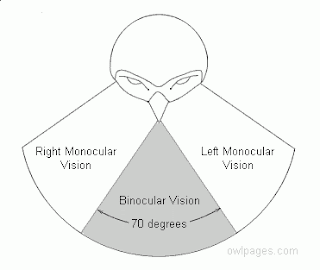
An owl's field of vision. Image used permission of
The Owl Pages. Check them out - it's a great site!
Owls have very large eyes, accounting for one to five percent of total body weight depending on the species.  Like many predatory animals, their eyes face forward, increasing the range of binocular vision. Binocular vision, or seeing an object with both eyes at once, makes depth perception possible and aids owls in everything from capturing fleeing prey to accurately landing on a branch in the middle of the night. According to the Owl Pages, the field of view for an owl is about 110 degrees, with about 70 degrees being binocular vision.

Like many nocturnal animals, owls have tubular eyes and an abundance of rod cells, which are excellent at collecting light but don't see color well. Consequently, owls have monochromatic vision and cannot roll or move their eyes within their sockets, but must swivel their heads to visualize their surroundings. The swiveling radius of the owl’s head is around 270°, so it can see behind itself without turning around.

However, owls don't see well in the dark just because their large eyes are good at gathering light. Their fixed tubular eyes give them a long axial eye length - that is, there is an unusually long distance between the cornea and the retina, called the Posterial Nodal Distance or PND. The longer the axial length of the eye and PND, the larger the image projected onto the retina. The owl's larger retina also has room for a lot of photoreceptors, giving it heightened visual acuity since each photoreceptor processes a smaller portion of the image. In short, an owl's long, tubular eye projects a large image over a large, dense field of photoreceptors, enabling it to see detail and depth even in very low light conditions.

Finished with her mouse, the owl flies back to her favorite perch. A human might not see the branch and would be unable to judge depth and distance in the darkness, but her highly specialized eyes can see clearly even at night. As she approaches it, she raises her body into a nearly upright position and flares her wings to slow down. With feet outstretched, she has enough momentum to keep moving forward until her rough feet grasp the perch. She hears something in the distance and swivels her head to look at it. 

Feathers and Markings
Comb or fringe-like structures on the edge of an owl's
primary feather. By Kersti (Own work). See bottom
of page for full attribution.
Many birds have stiff primary or flight feathers, but owls have a special comb-like or fringe-like leading edge that helps them fly almost completely silently.

When birds fly, air rushes over their wings, creating lift and turbulence. The stiff edge of a normal bird's wing produces a larger area of turbulence, which makes a whooshing noise. However, the comb-like soft edge of an owl's wing breaks down the turbulence and muffles the sound of air rushing over the wing surface.  The lack of owl-related flight noise helps owls hear prey while keeping prey from hearing their approach.

The plumage of owls is generally cryptic - that is, the colors and patterns of their feathers camouflage them.  For example, Snowy Owls live in the tundra and are primarily white, while Great Horned Owls live in the woods and are brown, grey, and white. Changes in cryptic patterns can even be seen within species inhabiting different ranges: Great Horned Owls that live in birch forests tend to be a little lighter than those that live in darker oak or maple forests.

Although cryptic plumage aids camouflage, many owl species have facial and head markings: face masks, ear tufts, and brightly colored irises. Wikipedia states that these markings are more common in species inhabiting open habitats and are thought to be used to signal other owls under low light conditions.  Other people have suggested that, like cryptic patterns, tufts and facial markings serve to camouflage owls.

The owl lifts off her branch. Sub-nivean voles and mice flare briefly in her awareness as they scrabble beneath the snow. Her directional hearing, acute vision, muffled flight, powerful talons, sharp beak, and cryptic plumage make her a formidable  predator as she flies silently through the dark woods to her nest. 

We have four owl cams to watch:
We're getting brief glimpses of Snowflake and Dan, the female and male at Valmont, and the Great Horned Owls at EagleCrest have been observed mating:

Eggs should begin to appear in our nests in the next week or three. The earliest date they've appeared at Valmont is February 8th (in 2008) and the latest is February 25th (2007). We hope you enjoy watching them!

Things that helped me learn about this topic:

Image credits
  • Medulla map: Solis, Michele M, and Perkel, David J(Jan 2006) Neuroethology. In: eLS. John Wiley & Sons Ltd, Chichester. http://www.els.net [doi: 10.1038/npg.els.0003380]
  • Owl feather: By Kersti (Own work) [GFDL (http://www.gnu.org/copyleft/fdl.html), CC-BY-SA-3.0 (http://creativecommons.org/licenses/by-sa/3.0/) or CC-BY-SA-2.5-2.0-1.0 (http://creativecommons.org/licenses/by-sa/2.5-2.0-1.0)], via Wikimedia Commons
  • Barred Owl: By NaturesPhotoAdventures (Own work) [CC-BY-SA-3.0 (http://creativecommons.org/licenses/by-sa/3.0) or GFDL (http://www.gnu.org/copyleft/fdl.html)], via Wikimedia Commons
  • Owl Vision: The Owl Pages: http://www.owlpages.com/articles.php?section=owl+physiology&title=vision

Sunday, January 27, 2013

What Cameras Do You Use?

We get this question a lot - on facebook, via email, in person, and in chat. Unfortunately, the answer is fairly complicated since we've used different cameras at different times and locations. I can't recommend any one camera model, but I can provide some general information about cameras and streaming technology to aid research. In general, we use a PTZ camera and controller, microphone, and computer to capture, process, and unicast video stream to a service provider, who broadcasts it across the internet. To do this, you need to consider...
  • Do you have all necessary permits and do you understand the animal you are camming? Permit issues regarding wildlife and cabling may differ from state to state. Make sure you understand your state's process so you aren't inadvertently breaking the law. Make sure you understand your subject so you know when it is and isn't safe to install camera equipment. What will your subject tolerate in terms of camera size and placement? When can you go to the nest, burrow, or what have you without scaring your subject away? 
  • Does your installation have electricity and internet connectivity? If you need wireless and/or solar, talk to this company: http://www.sunsurveillance.com/. We've done one wireless installation so far, but most of our installations are wired. 
  • What challenges will your camera face? Ice, rain, cold, bugs, poop, and entrails can all damage cameras and impact the view. Depending on the time of the year, you may not be able to access and fix your cameras, so they better be up to the environment and placed where your subjects can't damage them through picking at them, pooping on them, or hitting them with prey. We use weather-hardy PTZ and bullet cams certified to below-zero temperatures. We are also very careful about protecting cables and interfaces from weather, ice, insects, squirrels, and mechanical damage. 
  • You've got the camera. How are you going to get your stream to the internet? We use a standard PC, capture card, and encoder to unicast our stream to Ustream, who broadcasts the stream across the internet. Research streaming-video providers and see what they recommend - some of them, like Ustream, provide lists of certified equipment and offer their own encoders. Not all video cards work with all encoders (especially older cards) so research this carefully before buying equipment. This page (from Ustream) provides some information on their platform: http://www.ustream.tv/platform. You should also consider PC versus streaming appliance if you don't already have a PC waiting in the wings. 
  • How fast is your internet access? You need to know the speed of the internet connection you can get prior to making some of your decisions. If you have a fast line - say, a T1 - you have different (better) streaming options than you will with a slower line.  
As much as we love watching birds, the health and safety of our subjects is always our primary concern. That's why we decided not to cam the Yonder nest in Decorah - however we might feel about the new nest, the eagles are doing a very natural thing and we don't want to risk frightening them away. Bob has been a falconer for 46 years and has a great deal of experience with birds of prey. I think it is wonderful that so many people are interested in watching and sharing wildlife, but I can't stress the important of knowing and respecting your subjects enough. A few links to aid research:
  • Ustream: our streaming video provider
  • 2MCCTV: our camera provider
  • Sun Surveillance: wireless and solar cameras
  • Xsplit: our software encoder
  • Trying to migrate an analog system to IP (network) video? Check out the EVE hardware encoder. In addition to encoding it also upscales 525 very nicely.

Monday, January 14, 2013

What happened to SNOW1?


By Kay Neumann, Executive Director SOAR – Saving Our Avian Resources

Just like the other 13 snowy owls that SOAR worked with in 2012, SNOW1 came in starving. Seven of the 14 owls died before they got to SOAR’s facility. Five more died despite our best efforts at rehydrating, warming, and trying to reverse their severe starvation. Most had lost half their body weight. Two owls made it through. One of these had a dislocated elbow and cannot fly. He is now an ambassador for his kind as a SOAR education bird. One female, SNOW1, made it to release. This is her story.
SOAR education snowy and SNOW1 share some together in rehab

SNOW1 was rescued from a farm field by Wright County Conservation Board staff in January 2012 and conservation board volunteers, the Rector family, drove her down to SOAR. She weighed 2.5 pounds. Female snowy owls should weigh between 4 and 4.5 pounds.  She was kept warm (we do not want starving birds to have to spend any of their precious energy trying to keep warm), tube fed high calorie fluids, and slowly force fed easily digestible solid food. She was able to bounce back and started eating on her own! After a month in intensive care she was moved to a medium-sized flight pen to stretch her wings. As you can imagine, she was fairly weak and it took another good six weeks for her to get her muscles back into shape. At this point the snowy migration was over and with a few feather imperfections we decided to intermew (let her molt) here at SOAR. Then several folks worked on a plan to be able to monitor her after release.

SNOW1 gets flight practice with her transmitter on.
Bob Anderson, Raptor Resource Project, and Brett Mandernack, Eagle Valley Nature Preserve, stepped up to provide a transmitter and the expertise to gather and monitor the location data. SNOW1 made a quick trip to Decorah to have the transmitter attached with a backpack type of harness. She spent more time in SOAR’s 100-foot flight area to develop muscle and make sure the transmitter was comfortable and not interfering with any of her activities. She also had live prey practice and made easy work of this, when other food wasn’t provided.

We needed to decide when and where to release her. We consulted several experienced rehabilitators and thought that taking her further north and waiting for fall, when other snowys would be moving back in would be a good plan. Minnesota DNR agreed to allow transport to their state for release. As we were preparing to do this, snowy owls began arriving in Iowa. A look at habitat areas in western Iowa showed several large wetland and grassland areas that should hold good numbers of small mammal prey items.

SNOW1 was banded, thanks to the Iowa Department of Natural Resources (Iowa DNR), and ready for release. Matt Wetrich with Carroll County Conservation Board and Paul Roisen with Iowa Ornithologist Union released her at Woodbury County Conservation Board’s Owego Wetlands. She flew beautifully and was back in the wild. It was very exciting to get the first data locations to find that she had moved several miles north, then back south, in all traveling over 30 miles to finally spend a week in and around Onawa, IA.

Paul Roisen captured this photo of SNOW1 atop a utility pole on 6 December
Before she left the Woodbury County area, Paul Roisen was able to locate SNOW1 and get a wonderful photo. She was perched on a power pole and looking in command of the situation after about a week in the wild. Then a report came from the Iowa Ornithologists Union birdline of a Snowy along Interstate 29 near Onawa. Fearing she had been hit by a car, Wildlife Lodge and Clinic volunteers were dispatched from Sioux City to try to find her and bring her in. Even with a good visual report and our transmitter data, they could not find her. An Iowa Department of Transportation staff person joined in the search and reported picking up a dead, unbanded snowy owl just a few miles north of Onawa on Interstate 29 a day or two earlier. This was not good news. Snowys were choosing to use the area, but were not fairing well. Iowa DNR biologist, Doug Chafa, stationed near Onawa, joined in the search and got a visual on her spending time in the cloverleaf interchange between Interstate 29 and Iowa Highway 175! Not the spot I would have chosen for her, but she was flying, perching and preening. She was on her own.

We had several more transmitter locations for her around the Onawa area, which seemed to be good small mammal habitat; old hayfields, mowed filter strips, and stream buffers. Then after three weeks in the wild, no movement was detected from her transmitter and we feared the worst. As it would happen, Helen Harvey, a falconer from Sioux City, was en-route near Onawa. She made a thorough walking search of the area of SNOW1’s last signal with no luck. SNOW1 must be out of sight somewhere. Dean, Ray, and Warren from the Siouxland Metal Detecting and Archeology Club volunteered an afternoon with their equipment for a high-tech search with Helen. They found her thin body under the snow. She had not survived well in Iowa. Necropsy (animal autopsy) confirmed that she was not shot, did not have any broken bones, no aspergillosis, her stomach was empty and she had no body fat.

As with most good research, this has answered one question and brought many others to mind. Could we have done something differently? Somehow better prepared her to survive in the wild? Chosen a different release location or a different time of year? As with all of our wild patients we did the very best we could with SNOW1 for her to have a good second chance at being wild.

From band return data we know that many of our released birds survive well. A red-tailed hawk was recovered eight years after release, just seven miles from her release site. An arctic-phase great horned owl that was released in Carroll County in December was recovered more than six months later in Northern North Dakota. A bald eagle was picked up in Mills County with a fractured humerus that was repaired and released in Carroll County. This eagle was found three years after release, she had flown over 100 miles back to Mills County.

Is the landscape (habitat) in Iowa so different from the tundra that snowy owls cannot figure out how to catch prey that is different from the normal diet of lemmings and arctic voles? If the snowy owls were released in March, closer to the time they should be returning north, and released near the Canadian border, would they have better survival? Perhaps the snowy owls that come this far south are not good candidates to contribute to the wild population and should not be released?

The technology to track birds after release is amazing. Even though we all wanted SNOW1 to have a successful winter and migrate back to the arctic to nest, her information will be invaluable to help with future snowy owl rehabilitation. Snowy owls are a very interesting species and may be impacted by climate change. Knowledge about their movements and survival could be an important indicator of what may be happening in the arctic. Stay tuned, we may make plans for SNOW2.

I am always amazed at how many people are willing to help wildlife in distress; it warms my heart and helps me to keep going even when things don’t work out as we would have hoped. A big thank you to everyone who helped with SNOW1’s rescue, recovery, release, and monitoring! She definitely left an impact on many people.

Monday, January 07, 2013

Which Nest Will the Decorah Eagles Use?

I'll give the short answer first: we don't know yet, and we probably won't know for another two to four weeks. Having said that, there are some things we can all watch for. They include:
  • Mom and Dad at the tree. They do seem to have been making more visits to the Y-branch and environs lately.
  • Mom and Dad visiting the original nest.
  • Mom and Dad working on the original nest. We're especially watching for soft nesting materials such as grass and cornstalks.
I visited some older videos to take a look at Mom, Dad, and the nest in 2012 and 2011. Last winter was unusually warm, and the eagles began their nest-building earlier than in 2011. While the eagles were bringing in sticks quite regularly, softer nesting materials didn't begin appearing until sometime between January 11 and January 26, as shown by these two videos:
The winter of 2011 was more comparable to this winter: colder and snowier! Again, the eagles brought in sticks fairly early on, but soft nesting materials really didn't begin to appear until January 21st, as these two videos show.
By 2/9/11, the bowl was mostly built, as shown here: http://youtu.be/ddgd6350xpc. We'd certainly like to know what the eagles plan to do, but as usual, they will tell us in their own time. If we start seeing a lot of visits to the nest, we'll train the default camera view on it. You are welcome to view old videos on our youtube channel as we wait to see what the eagles do: http://www.youtube.com/user/ries96

Tuesday, December 11, 2012

2012 Annual Report

Our annual report is now available online. The report discusses 2012, talks about 2013, and contains plenty of information and observations from the sites we monitor and band at. Enjoy! 

http://www.raptorresource.org/pdf/annual_report_2012.pdf

Thursday, November 29, 2012

11/27/12: D14 Announcement

We are sorry to announce that Bob Anderson found D14 dead yesterday near Rockford, Iowa. D14, a 2012 hatch year bald eagle from Decorah, Iowa, was electrocuted after landing or trying to land on a power pole. Bob immediately notified the utility company. D14's body will be sent to the National Eagle Repository, where his feathers and other parts will be distributed for use in Native American religious ceremonies. Bob and Brett Mandernack did a close exam
ination of D14's body. He was healthy and butterball fat. There were no signs of wear from the transmitter or backpack.

How common is electrocution? A federal study done in the 1990s identified impact injuries, poisoning, gunshot, and electrocution as the top four sources of bald eagle mortality. We haven't seen it in Decorah until this year, but D14's transmitter was the only reason we were able to follow him after he left the nest. New poles commonly have bird safety devices since bird electrocutions are not only tragic, but can cause fires and power supply disruptions. However, many old poles remain and safety devices don't always work. It's been known since the 1920s that power lines and poles can present a danger to birds. As Bald eagle (and presumably other large bird) populations expand, more electrocutions may happen.

D12, a sibling of D14, was electrocuted earlier this year. A group calling themselves The Memorial for D12 Facebook Group (aka The Raptor Nation) responded by working with Alliant Energy, Puget Sound Energy, Decorah High School, and Decorah Building Supply to develop and fit bird-safe perches for the hatchery. I have a blog post and links about that here:http://raptorresource.blogspot.com/2012/11/bird-safe-power-poles.html.

If you'd like to initiate a perch project in your area, please talk with your local power company. The following links provide wonderful sources of information:

Avian Power Line Interaction Committee: http://www.aplic.org/
D12 Memorial Group story: http://raptorresource.blogspot.com/2012/11/bird-safe-power-poles.html
Avian Protection Devices: http://www.srpnet.com/environment/aviandiagram.aspx
D12 Perches: http://www.flickr.com/photos/68092929@N03/8203641600/

All raptors - all wild animals - face myriad dangers in their lives. It is easy to forget that watching and tracking them doesn't protect them. We'll miss following D14.

Monday, November 26, 2012

Bird Safe Power Poles

Adult Eagles on Perch
This post is about a group inspired by the electrocution of eaglet D12 in the summer of 2012. The Memorial for D12 Facebook Group/The Raptor Nation worked with Alliant Energy, Puget Sound Energy, Decorah
 High School, and Decorah Building Supply to make and install safe perches at the hatchery. In their own words: 

"After the death of Decorah Eaglet D12 by electrocution, D12 Memorial Facebook Group/The Raptor Nation member Ruth Mitchell came up with an idea. Her vision was to build perches to make the electric poles in the hatchery area safer for the Decorah Eagles. Becky Burland agreed to explore the possibility and do the footwork in Decorah.

From the beginning, Alliant Energy's Shawna Sailor was very interested in the project. She realized the magnitude of the loss of D12 as the first known tragedy at the DE nest. Shawna and Alliant engineer Dennis Dye worked diligently to learn about perches and Alliant's ability to use them along with their existing equipment.

Mel Walters of Puget Sound Energy was instrumental in educating us about perches and how Alliant might design a perch to meet their specifications. Puget Sound Energy is a leader in the industry in making electricity safer for raptors and other wildlife. Mel explained that they have 1000 eagle nests in their area and they are always working to increase safety for the area raptors. Along with perches, they also use bird guards and perching deterrent strategies. We were lucky to have Mel share his experience and knowledge with us.

Part of Ruth Mitchell's vision was to have local students build the perches. It was hard to imagine Alliant allowing students to be a part of this specialized collaboration, but Becky talked with John Condon, the Industrial Tech teacher at Decorah High School. He was excited to participate in a project that would help teach students the basics of reading a blueprint and executing its construction. John was also confident that the students could meet Alliant's quality assurance expectations. A previous class made the eagle bike rack that was installed at the hatchery in 2012.

Representatives of Alliant Energy, Decorah High School and The Raptor Nation met recently to finalize the Perch Project. Alliant Energy is donating all the hardware and installation labor, Decorah High School students are donating the labor of building twenty perches, and Decorah Building Supply donated 50% of the lumber needed for the perches.

John Condon of Decorah High School reports the class will start building the perches sometime between Thanksgiving and Christmas. Alliant will install seven perches on the hatchery poles that Bob Anderson of the Raptor Resource Project identified as most important for protection. They will use the other thirteen perches as popular bird poles are identified."

The Raptor Resource Project thanks The Raptor Nation/D12 Memorial Facebook Group, Alliant Energy, Puget Sound Energy, Decorah High School, and Decorah Building Supply for their hard work on behalf of the Decorah Eagles. We'll keep you posted on the installation. Follow the link below for a look at the perch blueprint.

http://www.flickr.com/photos/68092929@N03/8203641600/

Friday, October 26, 2012

The Decorah Eagles Have Surprised Us With A New Nest!

Mom and Dad are surprising us again.  We have noticed in recent weeks that they seem to be building an alternate nest in the neighborhood.  This is not unusual for bald eagles, but it is new for Decorah.


The two bald eagle nests in the photograph above are located roughly 500 feet away from one of Minnesota's busiest interstate highways. The nest at the left was the first nest built by the resident bald eagles, who raised at least eight clutches before deciding to build a new nest in the same tree. I watched them raise young in the lower nest last year, observing in fits and starts as I drove by or sat immobilized in traffic. But I wasn't able to watch them build their new alternate nest, located above and to the right of the original nest, so I'm not sure exactly when they started.  I've seen eagles sitting in and perching by the alternate nest this fall, and I'm pretty sure the female will lay eggs in it come late winter.

Bald eagles build the largest nests of any North  American bird (Stalmaster 1987). So why would they invest the time and energy to build a new nest when the old one remains perfectly serviceable as far as we can tell?  Several hypotheses have been proposed to explain it:
  • Alternate nests may serve as 'insurance'. If the occupied nest is destroyed or rendered unusable, the eagles can quickly occupy the alternate without having to build a new nest.
  • Changing nests from year to year helps the eagles avoid parasites and 'nest mates' who are attracted by the food the eagles bring in. Shifting nests from year to year may help the eagles avoid parasitism.
  • The additional nests may be a way of marking territory. They warn other breeding pairs away and demonstrate fitness on the part of resident adults.
  • Eagles like to build nests.
Although we haven't seen it in Decorah before, multiple nest building is a relatively common activity: in most but not all instances bald eagles will have more than one nest in their breeding territory. In one study of 924 territories, eagles were found to have an average of 1.5 nests in their breeding area. In another study of 318 territories, 45% of eagles had two nests or more (Stalmaster, 1987). Eagle nests can be classified as active (shows or showed evidence of breeding by bald eagles during the current or most recent nesting season), alternate (intact or partially intact and used by bald eagles at any time during the past five nesting seasons, but was not used during the current or most recent nesting season), or abandoned (inactive through six or more consecutive nesting seasons). It takes six years for a nest to go from 'alternate' to 'abandoned', since last year's alternate nest might become this year's occupied nest. Why? Only the eagles know for sure.
It is interesting to us that, like the bald eagles in Lino Lakes, the Decorah eagles occupied a single nest for several years before beginning an  alternate. The new nest in their territory is located nearer the trout hatchery, roughly 300-500 feet from their current nest near the woodshed. We don't know at this point which nest they will occupy next spring. Bob did find a dead buck beneath the foot of the 'alternate' tree, which could have played a role in their decision to choose this particular location. But we don't know that for sure.
Here's a peek at the alternate nest (photo by Jim Womeldorf):

To recap:
  • Bald eagles commonly build multiple nests on their nesting territory.
  • Mom and Dad have started construction of an alternate nest about 300-500 feet from their current location.
  • We will not do anything that might influence them to abandon construction of this nest, including camera installation or nest invasion. We cannot and will not disturb them: building multiple nests is part of eagle life. The health and welfare of the eagle family is more important than the nest they choose or our desire to watch them on camera. We'll miss following them, but it is exciting to see them building a new nest! Once again, Mom and Dad are giving us new insights into the lives of bald eagles.

If the eagles do adopt the new nest:
  • We will provide photographs and updates from the ground.
  • We will consider putting a camera in it next year, in early fall.
A few things to ponder: 
  • Is the length of time a mature pair stays on territory correlated with the construction of alternate nests? Five or six years would be plenty of time for parasites and 'nest mates' to become problematic, or at least annoying.
  • Is the length of the bond between the pair a factor? More experienced (older) Bald eagles seem to be better at parenting in many ways. Would a more experienced pair be more likely to build an alternate nest for insurance?
  • Does the actual or perceived encroachment of other adult eagles play a role? If other eagles are present, resident eagles might feel a little more compelled to mark territory.
We would really like Mom and Dad to use the nest they have occupied for so long, but we cannot and will not interfere if they decide to use the new nest. As we said in an earlier post on intervention, their lives are a gift we have been privileged to share. We can only hope we'll get another chance in 2013.
Stay tuned and we'll keep everyone updated as the situation develops!

Things that helped me write and learn about this:
  • Book: The Bald Eagle. Mark Stalmaster, 1987. This is a wonderful book, and the eagle illustrations are charming.
  • Book: The Bald Eagle: Gerrard and Bortolotti. Another great book.
  • Green Value Nursery, Hugo, MN. Thanks for letting me park and walk across your land to get photos of the Lino nest. I'll buy flowers from you next spring!
    http://www.greenvaluenursery.com/
Note: I got an email from Nancie Klebba in Lino Lakes. She says:

I spoke with a few people on the board that live on the lake and the City's environmental coordinator and they believe the nest has been on Peltier since about 1993 or 1994.

Marty the environmental coordinator said he would check back to see if he could find the exact date.  He  also said the old nest has not been used the last few years.

Thanks, Nancy!