Showing posts with label Decorah. Show all posts

Friday, December 29, 2017

A trip down memory lane: Favorites from 2017, Decorah Edition!

It's time for a look back at 2017! We asked the mods for some favorite moments from Decorah and Decorah North. We'll feature Decorah today and Decorah North tomorrow. We hope you enjoy a trip down memory lane! 2017 marked the 9th year that Mom and Dad have nested together in a cottonwood tree! They produced fourteen eaglets at N1, nine eaglets at N2, and five eaglets at N2B, the nest we started for them in August of 2015. We don't know how old Dad is, but he is older than Mom, who turned fourteen this year.

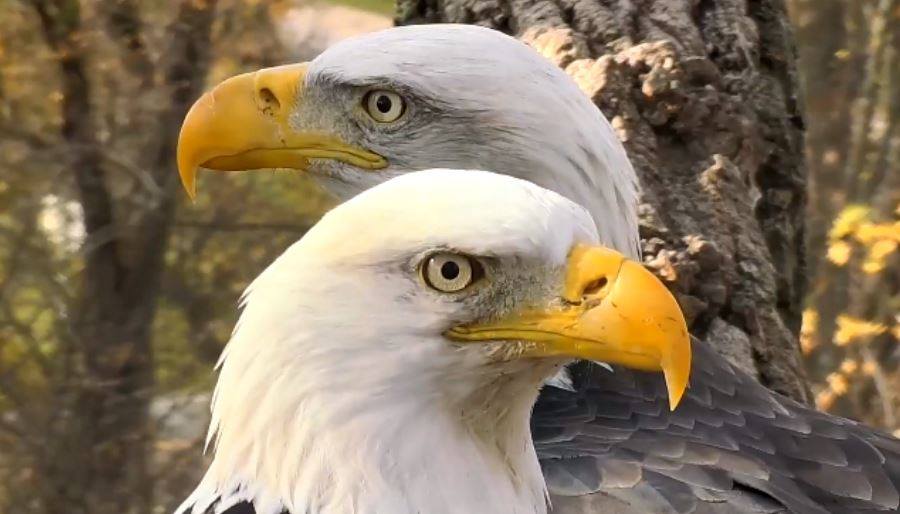
Mom back, Dad front
We'll start with the eaglets. All of the eaglets were somebody's favorite! You liked (or were distressed by) D26's fierce behavior and insistence on being first to the dinner table, especially in the first few weeks. You cheered for D28 when he bonked back at the older and larger D26, and groaned, worried, or emailed when D27 took the brunt of D26's bonkings. While any given eaglet was someone's favorite, many of you were captivated by D27! Whether she was screeing for food, acting the Diva, lounging about in the nest, or beginning her first tentative explorations during fledge, you watched her, compared to her to D1, and weren't especially surprised to find out that it was a she once Brett, John, and company fitted her for a transmitter! Jfrancl wrote:

"One of my favorite memories from the 2017 season was watching D27's behaviors as she grew and how different she was from D26 and D28. She seemed to follow the pattern I have often read about on eaglet gender behavior and growth patterns.  In my mind I knew she had to be female!" You can continue to follow D27 here: https://www.raptorresource.org/learning-tools/eagle-map/

JFrancl also mentioned: "Three eggs and three hatches, again! D28 attempting to eat its first meal on hatch day! Tandem feedings. Giggling at the Tree Amigos! Observing all three throughout the season and guessing genders based on behaviors. The hatchery cam. Watching all participating classroom students excited to learn about eagles! Working closely with John, Amy, the Ustream chat room mods and the Facebook mods in helping to continue Bob's mission. Once again, watching Mom and Dad's attentiveness and devotion to their young. Last but not least, a great After the Fledge Celebration!" I thought this video of a feeding from April 4th was a lot of fun. Remember D28's dark head? https://youtu.be/dCEA2bmxxeo. And it was a greatATF! We all loved seeing Mr. Decorah (widely believed to be D20 from 2014): https://youtu.be/6qdfIFaodYM. Our mods gave everyone a nice goodbye, too: https://youtu.be/ja6zI3BARfM.

D26, D28, and D27 (I think) on April 08, 2017
Since everyone loves hatch and first glimpse videos, I included them as well:
Glogdog wrote: "One of my favorite videos that sticks in my mind this season was on 1/2/17 when Dad brings in a long stick and gets stuck between 2 trees in mid-air. Mom realizes it and steps up to help bring it down! I also liked the times that Mom and Dad protected the eaglets during bad weather."
Mom and Dad working together as a team to protect the eaglets on April 3rd, 2017 
Tulsa Ducati: "Lightning show!" Tulsa joined the ranks of our videomakers this year and we featured many of her videos. One of her favorites was the incredible storm that rolled in on June 28. https://youtu.be/NioY3r87S_I

Faith: "A tandem evening feeding". This video was also one of my favorites. Mom and Dad feed the eaglets together on the evening of April 2nd. https://youtu.be/F44Z9aQ2gS0

Mom and Dad tandem feeding on April 2nd, 2017
Oregonian: "D27 gets back to nest!" I had completely forgotten about this, so I really appreciated the reminder! Oregonian wrote: "Without a doubt watching D27 work her way back to the nest after she tumbled out. I was riveted watching her figure how to get back.https://youtu.be/DB7KW-huwsI

Pyrmum wrote: "My favorite moments are when Dad is feeding the eaglets and he keeps looking around to see if Mom is on her way to kick him off the nest. I get a real kick out of it!" All of us get a kick out of Mom and Dad's antics! I was not able to find a specific video for this behavior (although I remember it), so I substituted another favorite - Mom gently nudging Dad off the nest! https://youtu.be/7hzb2hrzbzc

Robin Brumm had several favorites!
  • 4-3-17 "When both parents were trying to protect the eaglets from the rain. Dad didn't want to leave, but finally Mom pushed him out. When he got up, I believe he knocked D27 on her back, so she was laying their with her little feet flailing, lol!" https://youtu.be/7hzb2hrzbzc
  • 4-13-17 "...And you can't forget when D26 went for a little ride on the clump of grass mom was trying to pull out of the nest cup!https://youtu.be/7tXua2nBQ6I
  • 5-6-17 "Not that it was a favorite, but it was memorable when Mom got knocked off the skywalk by the owl." https://youtu.be/JFYCYLvHvVE
  • 7-16-17 "All three juvies hanging out in N1 and the Y branch." (This was also a favorite of mine): https://youtu.be/8wPjIp3Lqak
Fledged eaglet, 07/01/17. I'm sure Robin knows eggsaxctly who this is!
I had a number of favorites, but these really stood out for me!
  • Lunch feeding - close zoom and wide angle: https://youtu.be/JeGhVefSoIM. I loved the view of all three eaglets and this is one of the first times we saw D28 show its fierce! While D27 submitted to D26's bonking behavior, D28 tended to bonk back.
  • Incredible portrait close-ups of D26 and D27 - close zoom. I mentioned I was a sucker for the downy stage, right? https://youtu.be/jnCpx-fR8zQ. In the same vein - Dad allows nestlings out to enjoy warm day: https://youtu.be/7qxy8fpAabo.
  • D26 attacking corn husk: https://youtu.be/HVBRde5g4uc. Lol - show us how it's done, D26!
  • Three-way mantle: https://youtu.be/eBe_IOL9lTM. All three eaglets show off their excellent grasp of eaglet table manners. The winner takes all!
Judging by readership, your five favorite blogs in 2017 were:
  • Endangered Species Act Under Threat From Congress (13,511)
    The Act itself hasn't been overturned, but Congress consistently introduced bills and amendments to weaken it, including five that we blogged about here. All of them passed committee and Congress didn't adjourn this year, so those bills may still move forward in 2018.  In late December, the Trump administration declared that they would not be enforcing the Migratory Bird Act.
  • Eagle Eyes! (6233)
    This was fun to write about. I'm a little jealous of bald eagle eyes - human eyes don't see as well or in as many colors!
  • What's inside those bald eagle eggs? (4954)
    This blog discussed embryonic development inside the egg. Some of you really liked it...but some of you were totally weirded out by the illustrations of embryonic stages! Remember to set your clocks for 72 hours once an egg is laid. At that point, the developing eaglet's heart starts beating!
  • Message from the Director (4587)
    You wanted to know what John had to say! 
  • Eaglet growth and development, week two (4523)
    This was the most popular of three development blogs. We talked about the stages of development in all three of our nests, as well as the general structure of eaglet development. We'll do more of these next year!
Have a very happy new year and thanks for watching with us in 2017! We're looking forward to watching with you again in 2018 - and don't forget to check out our new ads-free Decorah Eagles stream at https://www.raptorresource.org/birdcams/decorah-eagles/.

Dad Decorah

Thursday, August 03, 2017

What's On The Menu at Decorah North Nest? A guest blog by Sherri Elliott


Dad brings in the two-for-one suckerfish special!
It's been a bountiful season for The North's in the quantity of prey hauled home and caught on camera.  A total of 449 meals delivered this year vs 163 meals in all of the last season.

32 meals were enjoyed just by Mr and Mrs North during nestorations and before the first egg was laid,  409 meals delivered to the nest from first egg laid to fledge, and another 8 "picnics in the pasture" post fledge dropped to the fledglings.  That's quite a bounty!  Also noteworthy is the true partnership in procuring the provisions by the parents to provide for their peeps.  Last year it seemed that Mrs. North was more proficient than Mr. North in fishing, hunting, parceling out, or pilfering protein but this year the tally was almost 50/50 with Mrs. North bringing in 231 meals and Mr. North delivering 210 meals to the nest.  The North's seem to practice 'field dressing' prey by breaking down larger animals and bringing in pieces or sections of their protein, but each delivery was counted as a meal. It's almost impossible to determine via long distance food drops the division of duty for the picnic meals, so those 8 meals are tallied as unidentified protein brought by an unidentified parent.

The earlier egg lay this season (more in line with hatchery Decorah Eagles) allowed Mr. and Mrs. North to take advantage of the abundant fish runs of trout and suckers as well as filleted discards from the friendly landowners, more than doubling their haul to 246 fish this year vs 109 fish last year. Special applause to Mr. North on 4-12 for his 2 sucker fish delivery in a one-foot talon hold; and the new record on 5-13 of 9 fish in one day with 8 caught by Mr and 1 from Mrs. North.   Other notable deliveries were 4 fawn heads, and other assorted deliveries of deer legs and quarters;  Mrs. North's preference for 'cowghetti' (stringy cow placenta); and 2 turtles.

What we learned this year is what excellent providers the parents are in purveying provisions for the pantree, and while not a lot is stockpiled like we see at the hatchery nest to the south, the remains are picked clean and dutifully taken to the dump when done.  Both parents took an active role in feeding their offspring and there were several instances where Mr. North would have taken more of a share in feeding if not for Mrs. North's teakettle that she'd be in charge. This may have happened last year but the new microphone at the nest amplified the vocals that we have come to know as common by Mom Decorah, and it was interesting to add to our observations.

Here's the full list of menu items in whole or part.
  • Feathered: Birds (6), Chicken and parts (4), Coot (2), Duck (1), Gosling (2), Grouse or Pheasant (3), Turkey or Goose (1).
  • Fins: Trout (144), Sucker (44) Fish pieces (58)
  • Fur: Deer - Heads (4) and Legs or sections (12), Groundhog or Muskrat (2), Opossum (2), Rabbit (8), Raccoon and pieces (11), Squirrel (6) 
  • Reptiles: Turtles (2)
  • Rodents:  Field Mice or Voles (4)
  • Misc: Cow Placenta (37), Mystery Meat or Unidentified Food Objects (48), Animal legs/feet (4), Pink/Red Innards (24), Bony Meat (12)

Wednesday, April 26, 2017

Eaglet Growth and Development: Week Four

Top to bottom:
Decorah N2B, Decorah North,
Xcel Fort St. Vrain
Most of our eaglets are in their fourth week of life: 26, 25, and 22 days old at N2B in Decorah, 27 and 26 days old at the Decorah North nest, and 31 and 29 days old at the Xcel Energy Fort St. Vrain nest. Over the past 16 days, we've seen eaglet footpads and legs growing and turning yellow, talons darkening from taupe to black, grey thermal down replacing white natal down, and pinfeathers emerging from eaglet wingtips. The eaglets have started coughing up pellets, playing 'house' (moving grasses and other nesting material around), and taking their first steps towards self-feeding (https://youtu.be/IPkJ6kgYFHs). As their vision, coordination, and strength have improved, the eaglets have expanded nest explorations and started to track events outside their nests, although they also spend a lot time sleeping off big meals and cuddling or even hiding under piles of grass in the cooler, wetter weather at both Iowa nests.

Several watchers have asked if the eaglets are going to fledge soon given their size.  No - as hard as it is to believe, we still have roughly 50 days until fledge at both Decorah nests and 45'ish days until fledge at Fort St. Vrain! Eagles grow very rapidly in their first thirty-five to forty days of life, gaining weight and building bones, muscles, tissue, and features like tarsi, footpads, toes, and claws. But during an eagle's fifth week of life (28 to 35 days), feather growth starts to overtake structural growth. Pinfeathers grow from eaglet wings, tails, and backs; beak, leg, and footpad growth all slow; and wing growth speeds up. So what can we look forward to in the coming week? Remember, the eaglets we are watching range from 22 days (D28 is just starting its fourth week) through 31 days (FSV34 is about halfway through its fifth week).
  • The eaglets should start standing on their feet. This will change nest exploration and poop-shoots. Look out below!
  • Natal down mohawks will vanish and dark deck feather growth will accelerate. Look for the eaglets' feather 'cloaks' to start filling in.
  • Still enclosed in their keratin sheaths, eaglet pinfeathers will grow longer. 
  • We may be treated to the beginning of wingercizing sessions! Once the eaglets can stand, they can really begin exploring their wings. 
By the end of their fourth week, the eaglets could be standing. By the end of their fifth week, they will be standing and could be starting to walk. I have no doubt that many of us will be mouse-clicking, shoeing, and blowing to get inquisitive eaglets back into the center of the nest as they widen their explorations and begin broadening their horizons! We will also see changes in behavior. Although the eaglets continue to compete for food, baby bonking has mostly ceased. This always makes me wonder what functions it serves. We know bonking strengthens muscles, aids coordination, and helps improve eyesight. Does food competition lead to greater food intake, helping to fuel an eaglet's rapid growth? Does it lay the ground for future social interaction, which includes plenty of body language, vocalization, and dominant/submissive interaction? Does it give parents information about an eaglet's overall heath, or help prompt provisioning? Or is it simply replaced by a new suite of physical behaviors as the eaglets begin to explore the nest and enter the next phase of nestling life? Bonking may have ended, but the eaglets are starting to play with sticks, move towards a full stand, and expand their explorations of the nest.

While we've been making guesses at gender, the weight of the two sexes begins to separate as females gain weight faster than males.  Sex takes over from age as a size determinant around 50-60 days. But cameras can be tricky and clutches can have large males and small females or be all one sex, making ID impossible without measurements or a genetic test. We'll have a lot of fun seeing if size conforms to our observations based on what we have seen of beak size, commissure extension, and other traits, and I can hardly wait for food tearing and wingercizing!


The general stages of eagle development are:

Stage 1 - Structural growth. In their first thirty-five to forty days of life, eagles grow very rapidly, gaining weight and building bones, muscles, tissue, and features like tarsi, footpads, toes, and claws. This phase of development slows down about halfway through an eaglet's time in the nest, even though individual features might continue some level of growth.

Stage 2 - Feather and flight-related growth. Eagles grow four sets of feathers - natal down inside the egg, thermal down, juvenile feathers, and adult feathers. Thermal down starts growing at about ten days, juvenile deck feathers at about 20-23 days and juvenile flight feathers at about 27 days, but feather growth doesn't overtake structural growth until thirty-five to forty days after hatch. Flight muscles also begin growing as eaglets wingercize, flap, hover, and eventually branch and fledge.

Stage 3 - Neurological Coordination. Eagle watchers know how ungainly eaglets can seem! As they grow, they become more adept at controlling beaks, legs, wings, and feet. They learn to stand on their own feet, tear food, self-feed, and flap their wings, going from cute but clumsy clown clompers to graceful young eaglets poised at the edge of fledge.

So where is our cortical homunculus in weeks 3-4? I'd tend to think that legs, feet, and wings are accelerating in importance this week, leading important behaviors like standing, tearing, and flapping! I also wonder what impressions are being made now that they are beginning to pay attention to the outside world. The nest and eagles always have more to teach us!

Things that helped me write this blog, with a few considerations:

Monday, April 10, 2017

Eaglet Growth and Development, Week Two

It is April 10 as I write this, and our eaglets are growing rapidly! In Decorah, D26 is 10 days old, D27 is 9 days old and D28 is 6 days old. At Decorah North, DN4 and DN5 are 12 and 11 days old. And at Fort St. Vrain, FSV34 and FSV35 are 15 and 13 days old.

D26. See the earhole?
In their second week of development, the eaglets will gain roughly two pounds between their 7th and 14th day of life. They will experience rapid growth in features like beaks, culmens, and footpads, start replacing their white natal down with thicker grey thermal down, and begin exploring the nest. Although they aren't yet standing on their toes, they are able to sit up - way up! - for feeding and shuffle around on their metatarsi. Their eyes are wide open and fit more comfortably in their eyesockets, features like brow ridges are beginning to appear, and their legs and footpads are yellow, not pink. Gary Bortolotti wrote that bald eagles might gain more weight per day than any other north American bird, although the majority of their weight gain occurs within the first 30-40 days. This rapid weight growth is fueled by their nutrient-rich diet of meat. Over the past week or so, we watched the eaglets chow down on fish, roe (fish eggs), rabbit, squirrel, unidentified birds, and prairie dog. Poop is beginning to streak the poopcasso tree and crib rails as the eaglets become more proficient at shooting poop out of the nestbowl. While babylet battling hasn't entirely subsided, it has become less intense as pecking orders are established and eaglet crops are repeatedly stuffed until they look ready to burst!

Ma provides shade for FSV34 and FSV35
The Fort St. Vrain eaglets are the oldest of the group. Watcher Donna Young wrote that "We have two eaglets that are already quite adventurous. They are moving about the big nest. One climbed up onto the fence rails yesterday, but found its way down too. It may become a true Colorado mountaineer!" This is in line with past years at Fort St. Vrain, where a large nest and warm temperatures seem to lead to earlier wandering. Cold is a challenge to eaglets under 10-15 days of age, but so is heat! With little ability to control body temperature and no way to lose heat except by panting, the eaglets did their best to retire to what little shade tree limbs and the nest itself offered. Ma FSV also provided shade for the eaglets by moving from one to the other and standing between them and the sun.

In the week to come, we can expect (continued) rapid growth in footpads, talons, and legs. Beak growth will rapidly slow as the eaglets' beaks approach adult size and we may see dark juvenile feathers start to sprout from their grey down. Overall weight and height gain will continue, most likely reaching their steepest curves some time this week. By the end of their second week of life, our little bobbleheads at Decorah, Decorah North and Fort St. Vrain will be almost a foot tall! Enjoy eaglet earholes and egg teeth while you still can - their earholes will soon be covered by down and their egg teeth are wearing away.

Let's talk a little bit about 'parenting styles'. Last year, watchers observed that Dad North was less involved in feeding his eaglets directly, although he participated in a lot of bucket brigade feedings. The North eagles didn't tend to stockpile prey and food often seemed scarce at the North nest. Given the differences between Dad Decorah and Dad North, some watchers speculated that Dad North was on his first round of eaglets. While we didn't weigh in on that discussion, we have seen changes this year. The North's nesting chronology moved ahead by almost one month to match that of the Decorah eagles. While Dad North still offers the bucket brigade from time to time, he is participating in more tandem feedings with Mom North. When feeding solo, Dad North often offers food to both eaglets, picks up dropped food and re-offers it, and removes grass from their beaks. Food seems plentiful compared to last year, with fish after fish coming into the nest for DN4 and DN5. Using feeding and food availability as benchmarks, Dad North has undeniably become more skilled at some aspects of eagle parenting. Like flying, parenting is instinctual - but proficiency is learned.

Tandem feeding, Dad and Mom North. Dad North (at left) is feeding DN5. Mom is feeding DN4
As John pointed out, food availability in the nest reflects food availability on the ground. In late March, suckers are spawning, trout are actively feeding on emerging and hatching insects, rabbits and other mammals are leaving their winter dens and grounds (often with young in tow), and flocks of birds are migrating through the area. This rush of food comes at the perfect time for newly hatched eaglets - something Mom and Dad North appear to be taking full advantage of this year! The Fort St. Vrain nest is also piled high with prey, including prairie dog. If the weather stays warm, we might see turtles join the list as streams and smaller water holes shrink. Look for turtle plastrons at the bottom of the Fort St. Vrain nest!

The general stages of eagle development are:
  • Stage 1 - Structural growth. In their first thirty-five to forty days of life, eagles grow very rapidly, gaining weight and building bones, muscles, tissue, and features like tarsi, footpads, toes, and claws. This phase of development slows down about halfway through an eaglet's time in the nest, even though individual features might continue some level of growth. 
  • Stage 2 - Feather and flight-related growth. Eagles grow four sets of feathers - natal down inside the egg, thermal down, juvenile feathers, and adult feathers. Thermal down starts growing at about ten days, juvenile deck feathers at about 20-23 days and juvenile flight feathers at about 27 days, but feather growth doesn't overtake structural growth until thirty-five to forty days after hatch. Flight muscles also begin growing as eaglets wingercize, flap, hover, and eventually branch and fledge. 
  • Stage 3 - Neurological Coordination. Eagle watchers know how ungainly eaglets can seem! As they grow, they become more adept at controlling beaks, legs, wings, and feet. They learn to stand on their own feet, tear food, self-feed, and flap their wings, going from cute but clumsy clown clompers to graceful young eaglets poised at the edge of fledge. 
 I'm not sure how familiar many of you are with the cortical homunculus, an image-based tool that maps tactility. While useful and extremely cool, most cortical homunculii are static - that is, they reflect just one phase (usually adult) of an organism's life. But an eaglet's cortical homunculus will differ from an adult's as body parts and associated skills are gained and neural pathways developed. Our eaglets' brains and bodies are rapidly growing and changing as they gain the skills they need for life outside the egg! I'd tend to think that visual acuity suddenly 'lit up' this week, leading changes in coordination as the eaglets began sitting up and moving around.

Things that helped me write this blog, with a few considerations:

Tuesday, May 10, 2016

What is going on at the Decorah North Nest?

What is going on at Decorah North? The oldest eaglet, DN1, is displaying far more aggression than we are used to towards its siblings. It is upsetting to human watchers, especially since little DN3 takes much of DN1's biting, yanking, and twisting. However, we have also seen DN1 and even DN3 attack DN2. In most cases, the aggressive behavior ceases once the target submits, but we have seen biting and bonking continue past submission at least twice.

Why is this happening?
We don't know. Food certainly seems to be part of the puzzle, since we've often seen the eaglets act aggressively towards one another as they establish a feeding-related pecking order. However, we've also seen aggression break out in circumstances seemingly unrelated to food. For example, DN3 attacked DN2 at around 2pm this afternoon, giving it multiple bites, yanks and twists before DN2 submitted. The eaglets had all been fed well earlier today, so why the aggression? Perhaps differences in age and size also contribute to aggression. I would tend to believe that aggressive behavior is hard to stop once it starts, and I'm very curious whether we will see the drop-off in aggression here that we have seen in Decorah.

While siblicide is rare, aggressive behavior is common. It ranges from the relatively mild aggression seen in Decorah and at Fort St. Vrain to the biting, twisting, and yanking seen at Decorah North, Southwest Florida, and several other nests. I think this looks odd and frightening at least in part because Decorah has tended to lack extreme aggression. But Decorah and Fort St. Vrain could very well be outliers when it comes to eagle behavior. At this point, only the eagles know for sure.

Is DN3 growing normally?
It is very tough to tell with nothing but the two 'Cropzillas' to compare it to. DN3 is growing in thermal down to replace natal down, has gotten larger relative to the other two (seemingly overnight!), and is growing footpads. What we've been able to see of its beak has indicated a fairly regular size and shape in accordance with eaglet growth curves, and its talons are appropriately changing to black.

DN3 is just moving into the steepest part of its growth curve. The next five to seven days will give us a look at whether or not it is growing normally. We'll also look for developmental changes like nest wandering, attempting to stand, and tracking Mom and Dad outside the nest. DN3 has already been observed doing some of those things on warm days and we should see them more often as its thermal down grows in.

Is DN2 growing normally?
Yes, DN2 is growing and behaving normally.

Will DN3 survive?
DN3 is strong, gets fed, participates in nest aggression, and submits appropriately. The eaglets tend to fight with their beaks instead of their talons and, while the aggression looks frightening, DN3 hasn't been badly injured. It is rapidly growing in thermal down, which will help protect it from cold weather and aid nest exploration. Fighting is very hard to watch, but generally rare when one compares the time spent fighting with the time spent laying around the nest and eating.

There are no guarantees, but siblicide is uncommon and DN3 is much stronger than it seems. It often comes back with its own beaking, displaying its own fierceness, or can be seen afterward cuddling up to a former aggressor. We are hopeful it will survive and even thrive as it grows...but again, there are no guarantees with wildlife.

Will you intervene?
Absolutely not. We might consider interfering if the situation were human-caused, but these behaviors are completely normal from an eagle perspective. If we rescued every eaglet we were concerned about, there would be no wild eaglets left to watch. It is very important to keep eaglet behavior in perspective. For the most part, the parents have acted according to our expectations: feeding, interacting, brooding, and in general caring for their family. While the eaglets fight with one another, they spend more time cuddling, eating, and sleeping. While the fighting is upsetting to watchers, none of it is out of line or outside the parameters of normal eagle behavior.

In summary, the worst may happen but we are not giving up on DN3. The next five to seven days will tell us a lot more about its growth. It looks like we are starting to get pinfeathers on DN1, which means its growth will start slowing as feathers take over. While we have never seen this level of aggressive interaction in Decorah, eagles have survived it at other nests. We remain hopeful.

Kay from SOAR also provided some feedback after she was approached about the situation. She agrees that the situation "looks" terrible but that at this developmental stage of the eaglets they don't have a huge amount of strength in their beak.  Right now, those beaks are something like pointy salad tongs. Hopefully all three eaglets will grow well and this will not be a concern for much longer.  


Tuesday, May 03, 2016

Decorah North: DN1, DN3, and today on the nest

Watchers of the Decorah North Nest got quite a shock today after DN1 went after DN3 with a ferocity we haven't seen at any of the bald eagle nests we watch. It looked liked this:
  • Mom North lands on the nest, chasing away a sparrow that was stealing straw from the nest. DN1 and DN2 are huddled together at about 7:00 on the left side of the nest, while DN3 is laying at about 4:00 on the right side of the nest.
  • Both eaglets rise to a sitting position.
  • DN1 dominates DN2, pecking and pulling on DN2's left wing. DN2 submits and DN1 stops.
  • DN1 shoots poop, staying at roughly 7:00..
  • DN3 sits up and walks over to the turkey wing at about 3:00, where it appears to be look up at Mom. Keep in mind that the eaglets are walking on their tarsi, not their feet.
  • DN1 walks from 7:00 to 3:00 and begins a dominance interaction with DN3. In addition to pecking, DN1 bites and pulls on DN3, who submits. 
  • As DN3 submits, it rolls against DN1, scraping DN1 with its talons in what appears to be an accident.
  • DN1 resumes the dominance interaction, pulling and biting at DN3's wing and body and flipping DN3 over. DN3 remains in a submissive posture.
  • DN1 pulls DN3 up by the 'scruff' of its neck four times
  • Mom North, who has been watching the entire interaction, walks over and looks at DN1.
  • DN1 ceases the interaction, although we don't know to what degree Mom North interfered with it. Was DN1 ready to quit given the lack of a response from DN3, or did Mom's arrival distract DN1?


Following this event and subsequent battles, the ugly specter of siblicide - one sibling killing another - leapt to everyone's mind. So how common is siblicide in bald eagles? Sources disagree, with some referring to it as relatively common (University of Nebraska, American Eagle Foundation) and others calling it fairly rare (Hornsby). It hasn't yet occurred at any of our cams - not in Decorah (since 2008), not at Decorah North (since 2016), not in Fort St. Vrain (since 2003), and not during the one year we were able to watch Eagle Valley (2013). Our nests have different parenting 'styles', levels of food availability, surrounding environments, and nest invaders, but to date all eaglet fatalities have been caused by hypothermia, predators, and suspected disease. Why did DN1 take after DN3 and (to a lesser degree) DN2 today? We don't know, but as tough as it was to watch, it wasn't especially prolonged and didn't lead to death.

People also worried about a lack of food deliveries to the nest. While we don't know why parents don't pile up the pantree here as they do in Decorah, birds of prey (even young ones) can go a long time between meals. The eaglets remain healthy, alert, and pooping, which tells us that their digestive systems are working just fine. They are moving around the nest, interacting with one another and with parents, and showing interest in their surroundings. I'm sure they would like a meal, but they aren't starving yet and won't be for some time.

Several people referred to Dad and Mom as 'bad' parents. Again, different nests have different parenting styles, but eagles don't divide neatly into human narratives of good and bad behavior. It is a warm day, the young don't need brooding, and either Mom or Dad have been perched nearby much of the day. They are taking care of their young as they see fit, and we know from studies on human-raised birds that young birds have very different needs than young humans.

We've also been asked if we will rescue DN3. Absolutely not. We might consider interfering if the situation were human-caused, but what happened today was completely normal from an eagle perspective. If we rescued every eaglet we were concerned about, there would be no wild eaglets left to watch. It is very important to keep today in perspective. This is one of the first days we have seen a lot of concern about Decorah North. For the most part, the parents have acted according to our expectations: feeding, interacting, brooding, and in general caring for their family. It is also the first day - the first time - we have seen that level of aggressive interaction in one of the bald eagle nests we watch. But none of it was out of line or outside the parameters of normal eagle behavior. If eaglets died after a warm day with just one meal, we wouldn't have eagles to admire and worry about.

In 2011, a follower sent me a lovely watercolor painting of the fledglings at the Decorah nest. It said "You are braver than you believe, stronger than you seem, and smarter than you know." It remains a favorite artwork of mine and I often think of it when I am concerned about the eagles. As anthropomorphic as the painting may be, eagles are truly stronger than we think and often smarter than we know. As much as we love them, they are only their own and what we saw today was simply part of the way they live their lives.

Note: Hornsby follower gzebear compiled observations from 147 nests checked in an 8 year period and found only a 2% incidence of siblicde in hatches of 2, and 3.8% in hatches with 3. Follow the link to read gze's data, references, and additional comments from contributors to the thread. I think it might be time to revisit the whole subject of three-egg versus two-egg clutches. How common is one versus another? Are there regional differences? Is it an inheritable trait? Do we have more three egg clutches than we used to? It's off-topic here, but I subject that interests me quite a bit.

Wednesday, April 13, 2016

Eaglet Growth and Development: Week Two

D24 and D25: 04/04/16
D24 and D25: 04/12/16

D24 is 15 days old today, while D25 turns 13 days old. The week-old difference between these two photos is striking. In their second week of development, the eaglets grew larger, gaining roughly two pounds between April 4th and April 12th. They experienced rapid growth in features like beaks, culmens, and footpads, replaced their white natal down with thicker grey thermal down, and began exploring the nest. Although they aren't yet standing on their toes, they are able to sit up - way up! - for feeding and shuffle around on their metatarsi.  Their eyes are wide open and fit more comfortably in their eyesockets, features like brow ridges are beginning to appear, and their legs and footpads are yellow, not pink. 

Gary Bortolotti wrote that bald eagles might gain more weight per day than any other north American bird, although the majority of their weight gain occurs within the first 30-40 days. This rapid weight growth is fueled by their nutrient-rich diet of meat. Over the past week or so, we watched the eaglets chow down on fish, roe (fish eggs), venison (aborted fetal deer), rabbit, squirrel, something that might have been a muskrat, waterfowl, and several other birds. D24 became proficient enough at shooting poop to christen the Poopcasso tree on April 5th, while both eaglets got in plenty of tussling and bonking play, alternately hitting, submitting, and quitting to cuddle in the nest cup, grow, and wait for more food to arrive.

Watchers have been asking why the Fort St. Vrain eaglets began wandering the nest so much earlier than the Decorah eaglets. While we don't know for sure, we suspect that temperature played an important role. Fort St. Vrain experienced unusually warm temperatures in late March and early April, and the leaves hadn't unfurled to provide shade for the nest. Cold is a challenge to eaglets under 10-15 days of age, but so is heat! With little ability to control body temperature and no way to lose heat except by panting, the eaglets did their best to retire to what little shade tree limbs and the nest itself offered. Once in the shade, they sprawled out as much as they could. Mom did her best to provide shade for the eaglets, moving from one to another and standing between them and the sun.  As alarming as it was to viewers, Mom's ploy worked and we didn't see quite as much wandering, at least for a few days, after the weather cooled down. 

In the week to come, we can expect (continued) rapid growth in footpads, talons, and legs. Beak growth will rapidly slow as the eaglets' beaks approach adult size and we may see dark juvenile feathers start to sprout from their grey down. Overall weight and height gain will continue, most  likely reaching their steepest curves some time this week. By the end of the week, our little bobbleheads at Decorah and Fort St. Vrain will be almost a foot tall, while the eggs at Decorah North should begin hatching! 

Watchers have observed that different nests seem to have different 'parenting' styles: i.e., Dad may be more present at one nest than another, food may come in more or less regularly, and eaglets might spend more time alone. Many things influence nest life, including weather, temperature, food availability, predators, and the presence of other adult, sub-adult, and juvenile bald eagles. While eaglet growth and development occurs along a fairly predictable trajectory, local conditions can change the timing of events - something we've seen in Decorah, Fort St. Vrain, and the year we watched Eagle Valley. We are looking forward to hatch at Decorah North!


The general stages of eagle development are:

Stage 1 - Structural growth. In their first thirty-five to forty days of life, eagles grow very rapidly, gaining weight and building bones, muscles, tissue, and features like tarsi, footpads, toes, and claws. This phase of development slows down about halfway through an eaglet's time in the nest, even though individual features might continue some level of growth.

Stage 2 - Feather and flight-related growth. Eagles grow four sets of feathers - natal down inside the egg, thermal down, juvenile feathers, and adult feathers. Thermal down starts growing at about ten days, juvenile deck feathers at about 20-23 days and juvenile flight feathers at about 27 days, but feather growth doesn't overtake structural growth until thirty-five to forty days after hatch. Flight muscles also begin growing as eaglets wingercize, flap, hover, and eventually branch and fledge.

Stage 3 - Neurological Coordination. Eagle watchers know how ungainly eaglets can seem! As they grow, they become more adept at controlling beaks, legs, wings, and feet. They learn to stand on their own feet, tear food, self-feed, and flap their wings, going from cute but clumsy clown clompers to graceful young eaglets poised at the edge of fledge.

I'm not sure how familiar many of you are with the cortical homunculus, an image-based tool that maps tactility. We discussed it very briefly in this blog and I'll include links below. While useful and extremely cool, most cortical homunculii are static - that is, they reflect just one phase (usually adult) of an organism's life. But an eaglet's cortical homunculus will differ from an adult's as body parts and associated skills are gained and neural pathways developed. Our eaglets' brains and bodies are rapidly growing and changing as they gain the skills they need for life outside the egg! I'd tend to think that visual acuity suddenly 'lit up' this week, leading changes in coordination as the eaglets began sitting up and moving around.

Things that helped me write this blog, with a few considerations:

Friday, July 10, 2015

After The Fledge Weekend!

The eagles have fledged, but we haven't stopped having fun! Come to our After The Fledge party in Decorah, Iowa, from July 16 through July 19. Thanks to apex sponsor Ustream and the Decorah Chamber of Commerce for their support!

To register for the weekend, go here: https://goo.gl/MSmQ3T
For our forum thread on the event, go here: http://goo.gl/pUH3I1

Information

Thursday, July 16: Meet and greet at the opera house in Decorah's Hotel Winneshiek (map: https://goo.gl/SfJaFf).
  • 5pm to 8pm: Enjoy drinks and snacks while you meet moderators and other eagle lovers. We'll have some souvenirs for sale and fun surprises for everyone!
Friday, July 17: Kayaking, scavenger hunt, and volunteering with the Humane Society!
  • Kayaking, 1:00-3:30pm. Scott Iverson has planned a wonderful kayaking trip on the Upper Iowa in the Bluffton area about 15 miles north of Decorah. The scenery is spectacular and the paddling is great! For more information, follow this link.
  • 1-4pm: Volunteer at the Humane Society of Northeast Iowa. Details TBA.
  • Scavenger hunt, all day: The Decorah Chamber of Commerce has sponsored a scavenger hunt through downtown Decorah. Explore the area while racking up badges and competing for prizes! 
Saturday, July 18: Biking, talks, scavenger hunt, and dinner
  • Biking, 9:00am. Hit Decorah's lovely paved bicycle trail with Jim Womeldorf and several Ustream chat mods. We begin meeting at 9:00 and hope to leave at 10am. See you on the trail! 
  • Talks, 2PM: Valders Hall, Luther College. Printable map: http://www.luther.edu/campus/assets/campus_map_8.20.10.pdf.
    Google map: https://goo.gl/LKHavm
    Bob Anderson will introduce talks by Neil and Laura Rettig (Philippine Eagles) and Brett Mandernack (Bald Eagle tracking in the midwest). Neil and Laura will also bring their harpy eagle Cal. 
  • Dinner, 5:30pm. Hatchery. We are serving delicious Iowa pork, chicken, and corn. Don't eat meat? We also have a wonderful vegetarian option! 
  • Scavenger hunt, all day: The Decorah Chamber of Commerce has sponsored a scavenger hunt through downtown Decorah. Explore the area while racking up badges and competing for prizes! 
Sunday, July 19: Volunteer at the Humane Society of Northeast Iowa
  • 10am - 1pm, details TBA. 
Friday - Sunday
  • Tours of the fish hatchery (bring quarters to feed the fish!)
  • 6am'ish: Coffee and pastry at the hatchery
We hope to see you there! 


Wednesday, July 09, 2014

EWOT's Electrocution

Yesterday at about 10:45, Decorah fledgling EWOT was electrocuted on a high voltage power line roughly ½ mile from the mulch pile that both fledglings have been spending most of their time on. It was reported to us late in the afternoon. We collected and examined him, returning to the site of the electrocution to gather more information once that was done. Here is what we know.

The line was a 96 Kilovolt transmission line owned by ITC Holdings (http://www.itc-holdings.com/). In general, electrical delivery can be divided into two types: transmission and distribution. High-voltage transmission lines carry electricity over long distances from power plants or grids to substations. The poles or towers are physically larger and taller than those that support lower-voltage distribution lines and don’t support anything except electrical lines. Distribution lines carry electricity from substations to consumers and are supported by what most of us probably think of as utility or power poles. Utility poles are often made of wood and, unlike transmission lines, may also carry telephone and cable wires or support street lights.

ITC is able to detect fluctuations and other anomalies on their lines. When they sensed an anomaly, they sent a field technician out to investigate. He found and collected EWOT, and turned him over to the Iowa Department of Natural Resources. They saw the transmitter and called Bob to let him know that an eaglet had been electrocuted.

When we first got word of another electrocuted eaglet, we assumed it had contacted a standard utility pole. According to Refining Estimates of Bird Collision and Electrocution Mortality at Power Lines in the United States, electrocutions occur primarily at distribution lines, while collisions occur at both distribution and transmission lines. That’s certainly been our experience, since every eagle we’ve picked up has been found at the base of a distribution line. I pictured a standard wooden utility pole as we glumly drove over for our field investigation. I was surprised to instead find a high-power line between a field and a hill. We hiked out and took a look at the scene. We weren’t able to find scorch or singe marks on the pole or insulators, and the eaglet’s body was not at the base of the pole, as we’ve seen elsewhere, but under the lines three to four feet from the pole.

An examination of the eaglet’s body revealed singeing and burning around his elbow and feet. Electrocution can’t happen unless a bird’s body creates a circuit between ground and voltage, or different voltage phases, allowing energy to flow from high to low. Sitting on a wire won’t harm a bird, since it doesn’t create a circuit. But he closed a circuit with his wing and one foot, creating the flow that killed him.

In addition to singeing, the eaglet’s wing had extensive tissue damage and some severing. Although it seemed unlikely, we needed to know whether the transmitter had somehow created or closed the circuit that led to his electrocution. A quick look at the transmitter showed no damage, scorching, or discoloring. We cut the straps and removed it from EWOT’s body. The straps were intact and there was no scorching, singeing, or burning under the straps or backpack pad. Finally, we made sure the receiver could detect the transmitter. The transmitter was functioning normally, so we concluded it hadn’t been part of our eaglet’s electrocution.

Bob contacted ITC this morning. The biologist he spoke with told him that they hadn’t seen an electrocution on a high kilovolt line in the three years he’d worked for ITC. Having said that, they reported the electrocution to the U.S. Fish and Wildlife Service and the Avian Power Line Interaction Committee, and they are assessing steps that can be taken to prevent another electrocution or collision.

What we think
The pole was up to code and we haven’t had any problems at a transmission line before, so we suspect the electrocution was a terrible accident. Other electrocutions and near-misses in Decorah involved distribution poles with wonderful perching spots near the hatchery, where the eagles regularly hunt, fly, and hang out.  The transmission pole provides a bad perching spot overlooking a poor hunting ground bordered by trees. Although electrocution was clearly the cause of death, we suspect that EWOT might have collided with a wire and dropped, contacting other wires or the pole before dropping to the ground. Death was very quick.

Where do we go from here?
We don’t know whether ITC will install diverters or a similar non-collision technology over one death. Companies tend to set priorities based in large part on collisions, electrocutions, and known migration/movement paths. Reporting is key and we are very glad the company didn’t choose to sweep the electrocution under the rug.  
Bob talked to ITC this morning. If there are any more deaths, the company will report them to us, the DNR, and the USFWS.  Neither D1, D14, or Four have spent any time near the high voltage line, but if Four or D1 start hanging out, we’ll make ITC and everyone else aware of it.

Why can’t you build safe perches?
Alliant Energy, the D12 Memorial Group, the Decorah High School, and Decorah Building supply were able to make the distribution poles at the hatchery safer through insulation and safe perches. However, we’re not sure this was a perching problem and we can’t encourage perching on high voltage transmission lines since they are too dangerous. If protection is installed, it will probably be in the form of diverters that make it easy for birds, including eagles, to see the power lines.

What can we do?
Our wonderful fans want to know what they can do to make power lines safe. A few suggestions:
  • ·      Does your power company have an Avian Protection Plan? Click here for more information: http://www.aplic.org/APPs.php. Birds aren’t the only issue, either – my electrical cooperative is upgrading equipment because of squirrels! Talk to your company and find out what they have in place.
  • ·       Report electrocuted animals to your power company and wildlife agency. If your power company shrugs it off, document the problem and talk to your state’s regulatory agency. It’s my experience that most utility companies are very responsive to electrocutions. They kill animals, destroy equipment, can start fires, and are expensive.
  • ·      Learn more about the issue. A few good places to start:

While we can’t protect transmission lines with safe perches, most of our electrocutions have been on distribution lines. This seems like a good time to share the story of the D12 Memorial Group’s work with making distribution poles safer. 
We are really dismayed by the electrocution of another eagle but believe we can do better in the future. We’ll continue working with power companies to improve outcomes for birds of prey and we’ll certainly let you know what happens here. In the meantime, please feel free to share your stories of improvement and recovery with us. 

Thursday, July 03, 2014

What's up with Four (or why aren't you calling the Decorah eaglets "Dx" anymore)?

For the last couple of days, the most commonly asked question on facebook has been something along the lines of "Why are you calling D19 or EWT Four now?" We've also been asked if that means this year's fledglings are going to be referred to as D2, D3, and D4, and what this means for any other birds we've transmitted. I'll start with a recap of our EEE's:
  • Four, fka EWT or Eaglet With Transmitter, was first spotted on a road near Decorah roughly a week after fledge began. After a call from police, Bob brought her to his mews for examination and observation and fitted her with a transmitter. She has been rescued twice -- once in a corn field and another time when she was wedged against some woven wire fencing on the ground. She was the one who was relocated to the mulch pile to be with her brother EWOT/Indy. Beak depth and hallux claw measurements taken at the time we fitted the transmitter indicated that she was a female eagle. 
  • EWOT, or Eaglet Without Transmitter (aka Indy), has never been picked up and moved elsewhere. It was found at the city mulch piles about 1 mile from the nest. Bob and Brett trapped him on July 4th, attached a transmitter, and renamed him Indy. Sadly, Indy was found electrocuted on July 8th: http://goo.gl/0vjcy0
  • SOAR or Mr. SOAR is the eaglet who had surgery at the rehab facility of the same name (Saving Our Avian Raptors). SOAR (the eaglet) is recuperating and we get almost daily updates of his progress. Kay at SOAR and veterinarian Dr. Dirks believe that SOAR is a male eagle based on his size and weight. 
So why the name change? As looks and defining features change, (especially after fledge), Bob preferred to have new nomenclature established since we cannot be 100% sure of IDs. "Four" is the last number of Four's transmitter ID and WOT (Without Transmitter) was an obvious and easily identifying feature (or lack thereof) that could be used to differentiate between the two. After we attached a transmitter to EWOT, Bob and Brett renamed him Indy, short for Independence, because he was captured on the 4th of July. We don't have any plans to change the pre-fledge nomenclature of D + N, so as far as I know we'll start with D21 next year. 


I'm going to close with a quote by William Shakespeare, which seems appropriate both for its subject matter and the Bard's great fondness for falconry metaphors: "What's in a name? That which we call a rose by any other name would smell as sweet." Fly on, fledglings! You are such stuff as dreams are made on!


Citations

BA1, personal communication and information about Shakespeare's falconry metaphors.
http://www.raptorresource.org/

SE1, personal communication and facebook responses.
https://www.facebook.com/pages/Raptor-Resource-Project/103786266324668?ref_type=bookmark


TW1, personal communication and Ustream responses.
http://www.ustream.tv/decoraheagles


Wednesday, July 02, 2014

Your Top Thirteen Questions For SOAR and Dr. Dirks

Last week we asked Decorah watchers for their questions about the Decorah fledging that went to SOAR. Thanks to Kay and Dr. Dirks for answering them. Next week we'll ask for questions from Bob and Brett about development and fledge, so stay tuned!

Where will the eaglet be released?
This is a big leap to the end – IF he is able to be released… I think it would be an excellent idea to release him in the NE Iowa area. The exact location will depend a lot on the time of year. We will definitely be too late/too much time will have passed to expect that the Parents would take over any care or guidance. When the time comes we will do some consulting with our eagle experts (Bob and Brett) and find a spot where there is not a current eagle territory – just to avoid any conflicts there – usually the juvies are pretty safe. The big thing will be HABITAT – a good spot for scavenging and fishing. As we know from eagles with transmitters, eagles can travel long distances in short amounts of time. If he is able to be released, he will go wherever he wants to go. 

How do you determine where to release the birds you find, especially if they have been held for a while?
Again – good habitat is what we look for so the birds will not have to work too hard for food. We also look at time of year and weather. Winter is hard for everyone so we hold most birds late November through to early spring for release. Along with the quality appropriate habitat type, we look for travel corridors such as a river. If we release in a resident bird’s territory, which we try very hard not to do, the released bird can easily move to a new spot through the corridor habitat. 

What do you feed your eagles?
We need to mimic the things that they would be eating in the wild the best we can. This helps them to recognize what we are offering as food and is also completely nutritious. We try to give variety. Our eagles really seem to like carp – rough fish that most human anglers do not like to eat – so this helps us with donations of this type of fish. We salvage road killed deer – this meat is rich and dark – lots of vitamins and iron. We have a friend that provides some grown chickens and rabbits.

We start with hand-feeding our extremely ill patients. As they recover, they will eventually take food on their own.

The eaglet looks comfortable with humans. Does it try to bite or how does it react to handling?
A good question. Biting is involved when we need to handle him, so we have big gloves and we handle him carefully yet firmly. Overall comfort is an important part of our care. 
Most of the time our intensive care or ICU patients are in carry crates so we can limit movement. Like humans in ICU units, these birds have severe, often life-threatening injuries or conditions. We provide climate control and make sure that food and water bowls can be seen and are accessible. We also need to be able to easily administer medication and capture our patients to change bandages and perform other necessary tasks.  Of course as they feel better, they want out! When they are ready we have larger flight areas they move into for exercise pre-release. 

This little eaglet would not sit still in a crate. So he is in our small ICU room, which gives him a bit more room to move around. He is quite comfy there right now. 

What is the ICU and what does it look like?
Intensive Care is basically two large rooms and one smaller one that we heat and cool. Check SOAR’s web page for photos of SOAR facilities, including flight areas: www.soarraptors.org

How does the eaglet learn to fly and hunt absent parents?
If they are physically able to fly, they will fly. While skill is learned on the wing, flying and hunting are instinctual. SOAR has a 100 X 20 foot flight area for our eagles. After bone healing is complete, which could take approximately eight weeks or more, our patient will spend time in this large flight area with our other eagles. We have Spirit and Liberty, a bonded pair of non-releaseable education bald eagles that have fostered two different eagle chicks so far in their own large enclosure. He will not need to be fed, but they can model socialization, vocalizations, and eagle behavior. He is well past the age when he would imprint on humans, so we have no worries there. He is not going to like us no matter what!

It's my understanding that bald eagles can present unique challenges in housing and handling. If so, can you elaborate a little?
They are big and powerful. So housing requires large spaces. Handling requires experience and protective gear, including gloves, goggles, and a heavy coat. 

What particular challenges do you anticipate during the Decorah eaglet's rehab, both short term and long term?
We have crossed several hurdles. He survived his initial injuries. His fracture was not compound (bones sticking out of the skin) and was not too severe to surgically stabilize. He went through a successful major surgery. He’ll be on antibiotics to prevent infection and the next step is eating on his own. 

After about three weeks of healing, we will head back to Dr. Dirks for another x-ray to determine the amount of healing and whether or not we can remove the pin. If we can, he’ll have another three to four weeks of limited movement, but no flight attempts yet, since we need to make sure everything is solidly healed. After that, he’ll need physical therapy to get muscles into shape, and of course he’ll need to grow a tail back and we don’t know how long that will take. We will have to see how it goes/grows! 

What percentage of eagles make a full recovery and can be released back into the wild after an injury like this?
We don’t have an answer for that off the top of our heads.  We’ll have a better prognosis at the three week check up.

What is the gender of this eagle?
Judging by size, Dr. Dirks and I both think it is a male. 

Will P's recognize it and care for it or will it just be another eagle to them now?
He is in for a quite long recovery period. He will be with us too long for the parents to be in the mode of caregiving and he will be too old to need them. I don’t know if they will be able to recognize him or not.

How much of the hunting skills are learned vs instinct?
Instinct gets them started hunting and experience hones skill, since there are rewards for doing certain things and disappointment for doing others. 

Do you feel that the break in his/her humerus was due to the owl attack? 
This break is way up in the shoulder area – there is a lot of muscle around the bones there. Owls look big – but they are big puff balls – mostly fluffy feathers. These eaglets out-weigh owls by a lot.  There were no puncture wounds near the break area. I don’t think owls could have done this. Dr. Dirks and I discussed this a bit. This break would take quite a bit of trauma – like being hit by a car. But we just have no way to know for sure what happened. His feathers were grown in well enough to glide/fly from the nest, so it is doubtful leaving the nest would have resulted in this type of break either. [Amy's note: Bob made a similar observation after handling "Four", the fledgling formerly known as EWT. He also confirmed that the eaglets were developed enough to fly].


Wednesday, June 25, 2014

3rd Decorah Eaglet Found?

We've confirmed a fledgling eagle without a transmitter a little over one mile from the nest. While we can't know for sure, we are quite hopeful that this is our missing eaglet, especially when we compare the data with D14, who was tracked in almost the same location on 6/27/12. We'll be watching to see if the eaglet comes back to N2, appears in N1, or is seen over at the fish hatchery. In the meantime, please stay back and give the eaglet plenty of room if you see it on the ground. Bob reported that the eagle was flying very proficiently this morning.

The NWZ just got a little larger! Thanks to Frank Ermel for the tip and photo. We aren't trying to ID this eaglet at all right now - we've got our hands full just keeping track of everything that's going on. We hope to have an ID post for everyone later today or sometime tomorrow.

A link to D14's late June/early July map for comparison: http://www.raptorresource.org/maps/pdf_maps/761-Map-07-05-12.pdf


Wednesday, April 30, 2014

Decorah: Why is Mom Being So Mean to Dad?

We’ve had several questions and comments about Mom’s behavior lately. Why is Mom mad at Dad? Why is Mom so demanding? Why is Mom so mean? While I can find snippets of behavior that would seem loving to human observers – shared incubation duty, mutual nest control, and Dad feeding Mom, to name a few – both adults are going through hormonal changes and their behavior reflects that.

Daylight length, or photoperiod, strongly influences hormone production in birds. In the northern hemisphere, our story begins shortly after the winter solstice in December. As daylight length increases, a cascade of hormones causes birds’ gonads to swell, increasing the production of testosterone in males and progesterone (plus a small amount of testosterone) in females. Testosterone is associated with aggression, territoriality, courtship, nest-building and, in males, testicular development and spermatogenesis, while progesterone, the “pregnancy hormone”, induces egg production in females.

Mom and Dad share incubation duties, so both of them experience another hormonal change once incubation begins. Production of prolactin, a hormone that induces incubation and stimulates brood patch development, rises sharply, while testosterone and progesterone production rapidly decrease. Opioid peptides help stimulate prolactin production, which may be another reason that normally active birds suddenly want to spend the entire day sitting on eggs.

So in the first part of their reproductive cycle, Mom and Dad’s interactions with one another and their young are mediated by hormones that stimulate courtship, mating, territoriality, egg-laying, and lethargy. We humans are moved by their relationship with one another and their tender devotion to their offspring. It’s hard not to see hearts everywhere – I know I did! – as Mom pursues Dad around the nest, Dad brings food gifts to Mom, and both eagles work together to keep their eggs safe from all the extremes Iowa’s winter and early spring can bring.

And then they start shaking the prolactin off.

If the eagles’ earlier behavior added up to love, it’s hard not to see this as its opposite. Mom suddenly seems mean, snappy, or demanding to some watchers. Dad still loves his offspring but seems more distant. In this narrative, our eagle couple is drifting apart – or maybe Mom’s behavior will cause Dad to reject her for a less snappy, more appreciative mate. While compelling to human watchers, this scenario isn’t true.

So what is happening to our eagles? It isn't eagle divorce, but it isn't entirely our imagination, either. As their gonads begin shrinking, they decrease courtship and pair bonding behaviors. As prolactin ebbs, their metabolisms speed up, they become more physically active, their body fat drops slightly, and they probably become hungrier. Mom’s whistling ‘tea-kettle’ makes its first appearance as vocalizations change, although it still stimulates food delivery and/or an appearance by Dad. What we interpret as a falling out is simply a pair of mature, active bald eagles beginning to resume the non-reproductive phase of their lives. To paraphrase Scott Weidensaul, sex hormones pull many strings in a bird’s body. We are seeing that in Decorah right now.


Things that helped me write this post:


Did you know? 

In humans, females are xx (homogametic) and males are xy (heterogametic). But in birds, females are zw (heterogametic) and males are zz (homogametic). Unlike humans, female birds determine the gender of their offspring. http://en.wikipedia.org/wiki/ZW_sex-determination_system