Showing posts with label growth. Show all posts

Tuesday, April 26, 2016

Eaglet Growth and Development: Week Four


D24 and D25, April 25, 2016

D24 is 28 days old today, while D25 turns 26 days old. At this point, feather growth is starting to overtake structural growth as the eaglets approach the half-way point in the nest. Pinfeathers emerged this week, growing at an astonishing rate as they poked out from their keratin sheaths along the edge of the eaglets' wings. Feathers also started to emerge along their backs - the 'cloak' - and sprout from their tails. As beak, leg, and footpad growth began to slow, wing growth sped up, leaving the eaglets with noticeably longer, larger wings by the end of week four.

We also saw changes in behavior. Although the eaglets will continue to compete for food, baby bonking has ceased. This always makes me wonder what functions it serves. We know it strengthens muscles, aids coordination, and helps improve eyesight. Does food competition lead to greater food intake, helping to fuel an eaglet's rapid growth? Does it lay the ground for future social interaction, which includes plenty of body language, vocalization, and dominant/submissive interaction? Does it give parents information about an eaglet's overall heath, or help prompt provisioning? Or is it simply replaced by a new suite of physical behaviors as the eaglets begin to explore the nest and enter the next phase of nestling life? Bonking may have ended, but the eaglets are starting to play with sticks, move towards a full stand, and expand their explorations of the nest. They've also begun noticing the area around the nest, tracking with Mom and Dad as the adults pay attention to the outside world.

So what can we expect to see in week five? Watch for an explosion of dark feathers, leading to an evenly mottled grey and white appearance some time in the next week. The eaglets will begin standing and walking, leading to many mouse clicks as we try to shoo them back to the center of the nest! We may see them begin to tear their own food and we will get to see them 'play house' as they begin moving sticks around themselves and with Mom and Dad. If past years are any judge, Mom and Dad will give them plenty of materials to work with as they pile up the crib rails with larger, heavier sticks!

We've talked a lot about physical changes. We are also entering a period of rapid developmental changes as the eaglets acquire new skills and grow feathers. The eaglets will play cooperatively and competitively, learn to stand, walk, and tear food, and begin moving their wings. Following the appearance of Mom's teakettle whistle, I'm waiting for baby vocalizations to turn into juvenile screes for food! I'm looking forward to watching D24 and D25 move into the next phase of their lives as feather growth takes over from body growth and greater mobility leads to changes in behavior.

The general stages of eagle development are:

Stage 1 - Structural growth. In their first thirty-five to forty days of life, eagles grow very rapidly, gaining weight and building bones, muscles, tissue, and features like tarsi, footpads, toes, and claws. This phase of development slows down about halfway through an eaglet's time in the nest, even though individual features might continue some level of growth.

Stage 2 - Feather and flight-related growth. Eagles grow four sets of feathers - natal down inside the egg, thermal down, juvenile feathers, and adult feathers. Thermal down starts growing at about ten days, juvenile deck feathers at about 20-23 days and juvenile flight feathers at about 27 days, but feather growth doesn't overtake structural growth until thirty-five to forty days after hatch. Flight muscles also begin growing as eaglets wingercize, flap, hover, and eventually branch and fledge.

Stage 3 - Neurological Coordination. Eagle watchers know how ungainly eaglets can seem! As they grow, they become more adept at controlling beaks, legs, wings, and feet. They learn to stand on their own feet, tear food, self-feed, and flap their wings, going from cute but clumsy clown clompers to graceful young eaglets poised at the edge of fledge.

So where is our cortical homunculus in weeks 4-5? I'd tend to think that legs, feet, and wings are accelerating in importance this week, leading important behaviors like standing, tearing, and flapping! I also wonder what impressions are being made now that they are beginning to pay attention to the outside world and have moved from playing with grass to nibbling at larger, heavier sticks. The nest and eagles always have more to teach us!

Things that helped me write this blog, with a few considerations:


Friday, April 01, 2016

Eaglet Growth and Development: Week One

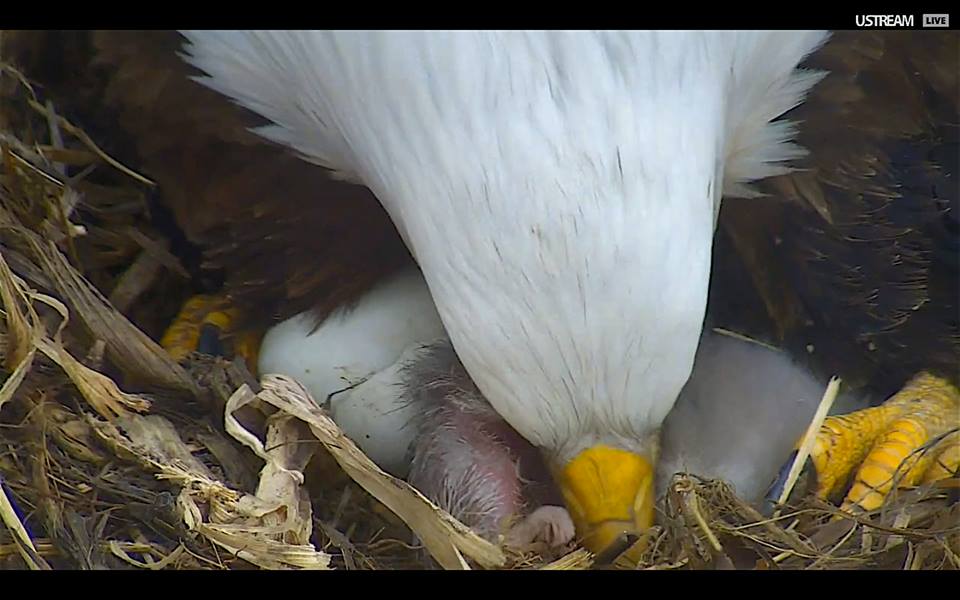
Newly hatched D25, March 31st 2016
D24 is three days old today, sibling D25 is not quite a day old as I write, and D26 is still inside the egg. What can we expect in the first week of watching?

Weight Gain!
Like humans and other animals, growing nestlings have developmental milestones. The eaglets spend roughly the first week of their life gaining weight. They aren't able to thermoregulate yet, so depending on the weather and temperature, they may spend a lot of time under Mom and Dad. We'll see them eat, sleep, scuffle, and grow stronger as they interact with one another.  They will go from roughly 3.2 ounces - about the weight of 18 nickels - to roughly 16 ounces or one pound, increasing their weight five times over in just seven days.

Many structural features, including foot pads, tarsi, and hallux claws, won't start rapid growth until 10-15 days after hatch. But the hatchlings' mid-toes and culmen - the dorsal ridge of the upper mandible - are already growing longer! Food is the root of all else besides, so it isn't surprising that the culmen achieves maximum growth in the first ten days. I suspect that the mid-toe aids balance, a crucial element of sitting up and exploring the nest. While our eaglets won't truly stand on their feet until they are roughly four weeks old, they will begin to shuffle around the nest on their tarsi long before that.

Enjoy the downy bobbleheads this week! By next week, they will already be growing their longer 'wooly' second or thermal down and alternately worrying and thrilling us with their interactions and sojourns around N2B.


The general stages of eagle development are:

Stage 1 - Structural growth. In their first thirty-five to forty days of life, eagles grow very rapidly, gaining weight and building bones, muscles, tissue, and features like tarsi, footpads, toes, and claws. This phase of development slows down about halfway through an eaglet's time in the nest, even though individual features might continue some level of growth.

Stage 2 - Feather and flight-related growth. Eagles grow four sets of feathers - natal down inside the egg, thermal down, juvenile feathers, and adult feathers. While thermal down starts growing at about ten days and juvenile flight feathers at about 27 days, feather growth doesn't overtake structural growth until thirty-five to forty days after hatch. Flight muscles also begin growing as eaglets wingercize, flap, hover, and eventually branch and fledge.

Stage 3 - Neurological Coordination. Eagle watchers know how ungainly eaglets can seem! As they grow, they become more adept at controlling beaks, legs, wings, and feet. They learn to stand on their own feet, tear food, self-feed, and flap their wings, going from cute but clumsy clown clompers to graceful young eaglets poised at the edge of fledge.

I'm not sure how familiar many of you are with the cortical homunculus, an image-based tool that maps tactility. We discussed it very briefly in this blog and I'll include links below. While useful and extremely cool, most cortical homunculii are static - that is, they reflect just one phase (usually adult) of an organism's life. But an eaglet's cortical homunculus will differ from an adult's as body parts and associated skills are gained and neural pathways developed. Our eaglets' brains and bodies are rapidly growing and changing as they gain the skills they need for life outside the egg!

Things that helped me write this blog, with a few considerations:

Thursday, April 30, 2015

Red-tailed hawk growth and development in the nest

Eaglets aren't the only thing growing right now! The two eyas red-tailed hawks at Eaglecrest are morphing into adults right before our eyes. Like bald eagles, different parts of their bodies grow at different times and different rates, reflecting developmental priorities and impacting behavior. How will hawks EC2 and EC3 (also known as Speckle and Snickers on the Eaglecrest Wildlife facebook page) grow?

  • 0-7 days: the culmen achieves maximum growth. Red-tailed hawks hatch with a culmen (the dorsal ridge of the upper mandible) that is about 30% of the maximum size it is likely to achieve in the nest. During a red-tailed hawk's first week of life, its already large culmen nearly doubles in length, going from an average of 6.9 mm in length to an average of 12.3 mm in length. Since the consumption of food is the root of all else besides, the hawk's food-consuming apparatus is given developmental priority. While the culmen continues to grow after week one, its rate of growth slows dramatically, becoming almost flat by week five. Bald eagles follow a similar pattern, although they have almost twice the growing time in the nest that red-tailed hawks do and their developmental milestones reflect that.  
  • 7-14 days: third toe and tarsus achieve maximum growth. Eating has priority, but movement isn't too far behind. A young hawk needs to move to build muscle and feed once it is past the point where Mom and Dad simply stuff food into its waiting mouth. In the second week of life, a red-tailed hawk's third toe and tarsus are given developmental priority. The third toe is the real stand out here, nearly doubling in length from 16.9 to 27.9 millimeters. With longer toes and thicker, longer tarsi, the hawks are better able to sit up, move around the nest on their feet and knees, and interact with one another. We see a similar pattern with bald eagles, who reach asymptotic mid-toe and tarsus size about half-way through their nestling period - 40 days, in their case. 
  • 14 to 21 days: body weight achieves maximum growth. With food intake well in hand, young hawks gain weight rapidly. While they've been growing all along, weight gain is the biggest actor in week three. The young hawks spend a great deal of time eating and sleeping as their weight increases. 
  • 21 to 24 days: weight gains decline, independence increases. During the fourth week, weight gain declines, the nestling hawks begin feeding independently, and feather growth takes over. The hawks have the strength and physical structures they need to stand upright on their feet, manipulate food, and feed on their own. At about day 24, the length of primary seven overtakes weight as the best indicator of age.  At this point, fledge is just two or three weeks away. 
  • 24 to 35 days: Feathers take front and center. As fledge comes closer, developmental energy is channeled into growing feathers. The primaries enter their maximum growth phase during weeks four and five, the two weeks prior to fledging. The young hawks will also be growing sub-adult feathers elsewhere, including their backs, their tails (which won't become red until molt two, in their second year of life), and their chests. 
  • 36 to 44 days: Time to fly! Feather growth will slow, but the growth of flight-related muscles is happening in leaps and bounds. Wingercizing will take front and center stage as they young hawks practice for the big event by flapping, wing-hopping, hovering, and eventually taking flight! 
Both red-tailed hawks and bald eagles allocate developmental energy into producing weight and structure first (day 0 to day 24), and feathers second (day 24 onward). While feathers often seem light and simple, these two distinct periods of growth point to the incredible amount of energy needed to produce a proper 'coat' of feathers. Enjoy the hawks now, since they will be leaving the nest soon. It takes just 44-46 days to grow a red-tailed hawk from hatchling to fledgling! 


Resources
Did you know?
Red-tailed hawks are excellent falconry birds. While their are many excellent falconry organizations, I'm most familiar with NAFA. Interested in falconry? Follow this link: http://n-a-f-a.com/