Showing posts with label development. Show all posts

Friday, February 09, 2018

What are feathers? What is molt?

When we think about feathers, we tend to think about their qualities (light, soft, fluffy, hard, flat, and horny are all included in dictionary definitions) and how they help birds fly, stay warm, shed or retain water, build nests, and so much more! (See this blog, for example.) But what are feathers? It sounds like a silly question. We all know what feathers are, right? And we all know what a bird's nest looks like, how to describe the color and shape of an egg, and when bald eagles lay their eggs. Maybe we don't know as much as we think.

So again, what are feathers? Like hair, fingernails, and scales, feathers are growths produced by epidermal cells in the outer layer of a bird's skin, which makes them part of the largest organ system in a bird's body. Derived from the Latin integumentum, which means “covering”, a bird's integumentary system includes its skin, feathers, scales, feet, beak, and the glands in its outer ear canal and at the base of its tail. Mom's integument keeps her insides in and protects her from pathogens while allowing her to exchange wastes, react to stimuli (think of how she fluffs her feathers in the cold), and produce important organic compounds like uropygial (preen) oil.

Feather follicle. Click to enlarge
Where do feathers come from, and how do birds grow them? Birds grow feathers throughout their lives, but feather development begins in the egg. Seventeen to eighteen days after Mom lays an egg, interactions between the embryonic bald eagle's outer and middle layers of skin form feather buds - columns of epidermal cells that dimple its developing body. The cells differentiate into three layers as they grow downward into its skin to create a tiny feather-producing organ that resembles a small pit or tube - the feather follicle. The cells at the base of this tube grow, divide, and die, leaving behind small masses of keratin that are pushed upward through the tube to form a feather. The outermost layer of cells form a temporary sheath that protects developing feathers, while the middle and inner layers form the feather's rachis and barbs. The developing feather has a blood supply that extends through its central pulp to nourish it as it grows - hence the name 'bloodfeather' to describe a feather still connected to its blood supply. When the feather is mature, the blood supply recedes.

Feather follicles, which are nourished by blood and grow via the division and enlargement of cells, are alive and will continue to produce feathers throughout a bird's life. But non-living things like feathers, crystals, icicles, and bald eagle nests grow via accretion: the addition of new material on top of old. Remember N1? Once Mom and Dad stopped replenishing it with branches, it began to disintegrate. The same is true of feathers. They have no blood supply, no cells, and no way to repair or replenish themselves. So how do birds replace feathers, especially flight feathers, without impacting flight? Hormones regulate molt cycles, periods when older feathers are pushed out of their follicles by newer feathers in a genetically programmed, orderly replacement that can take years to complete in larger birds of prey such as bald eagles.

Like so much else in a bird's life, the cue for molt initiation is day length, which effects the hormone levels that control molt progression. In the temperate zone - the part of the earth's surface lying between the tropics and arctic and sub-arctic circles - most breeding birds of prey molt in the summer, after they have finished raising young; and in winter or early spring, as the breeding season begins. Producing new feathers is a costly affair. Molting birds replace 20-40% of their mass through the molt, drawing on protein and energy reserves to create new feathers and offset the effects of reduced insulation and flight ability. Their 'down time' - the space between laying eggs, endlessly feeding hungry nestlings, and migrating or enduring the winter cold - is a good time to engage in the energetically expensive task of producing new feathers. Molt is suspended during periods of intense flight activity (say, when Mom and Dad are feeding young, or falcons are migrating) and food scarcity.

Annual light cycles and rate of change in Decorah
In short, day length (or changes in day length, or the rate of change of day length) initiates hormone production. Among many other things, these hormones trigger the cells at the base of the feather follicle to start growing, dividing, and dying. New feathers are produced and old feathers are pushed out. The molt cycle does not take feather condition into consideration - feathers are replaced whether they need it or not. While this might seem wasteful given the amount of energy that molt takes, it is better to replace feathers automatically during 'down time' than to develop a replacement on demand system that could leave a molting bird vulnerable to the weather or impair its flight during nesting season.

Components of a bird's wing
In birds of prey like bald eagles and peregrine falcons, molt progresses from the front to the rear of the bird. Unsurprisingly, flight feathers molt symmetrically. In falcons, primary feather molt begins with the fourth innermost primary (P4) and works its way inward and outward, but in bald eagles and most other birds of prey, the innermost primary (P1) is molted first and molt proceeds outward. Tail molt (bald eagles have 12 tail feathers) usually begins with the third and fourth feathers on either side of the bird's central tail feathers and proceeds simultaneously outward and inward. The growth of individual flight feathers takes 2-3 weeks in a smaller bird like a kestrel, and 2-3 months in a larger bird like a bald eagle.

Sharp-eyed watchers have recently noticed Mom and Dad shedding adult down and body feathers. The production of sex hormones triggered body feather molt at a time when we might expect birds to be conserving insulation, not regrowing it! However, this is a very good time for them to replace feathers. They aren't as active during incubation, which requires long periods of sitting on eggs - a great time to replace feathers. They also need to transfer body heat to their eggs, which is done through bare or mostly featherless skin. I wasn't able to find much about an eagle's brood patch and molt, but we know that hormones cause breast feathers to loosen and fall out, creating the brood patch. Like flight feather molt, brood patch molt is optimized to perform a specific task.

In his book Raptors, the curious nature of diurnal birds of prey, Keith Bildstein concludes his section on molt by stating "We still know little about feather molt in the overwhelming majority of diurnal birds of prey, including that of many abundant and widespread species." Reading and writing about feather growth and molt left me with more questions than answers. Do sex hormones influence sub-adult plumage patterns and colors? How do hormones change plumage signaling at maturity? Do regional populations of birds experience different molt patterns? Specifically, how might the nearly tropical bald eagles at Fort Myers experience molt when compared to deeply temperate Mom and Dad, or to nearly arctic eagles in northern Canada? Do long-time territorial birds experience different molting patterns than birds that migrate every year - say, Mom and Dad versus Brett's migratory Canadian eagles? If sex hormones help regulate molt and feather production, why don't bald eagles and peregrine falcons have sexually dimorphic plumage? For that matter, why do American kestrels have sexually dimorphic plumage? The more I learn about birds, the more questions I have!

Things that helped me learn and write about this topic:

Did you know?

Why is molt so energy intensive? After all, feathers are made of dead material and don't weigh very much, right? Feathers don't weigh much collectively, but the entire plumage of a bald eagle makes up about a sixth of its total weight, or roughly three times that of its skeleton. Molt involves the replacement of a huge area of a bird's body, and the plurality of its mass. Altogether, a bird's plumage weighs more than any other part of its body.

Birds replace their feathers more or less annually, depending on the bird. Do humans really replace their cells every seven years? Nope - it is a lot more complicated than that!  Watch this video to learn more (and check out the awesome skunkbear science tumblr here: http://skunkbear.tumblr.com/)


If we replace skin cells, why do scars and tattoos persist? https://www.scientificamerican.com/article/if-the-cells-of-our-skin/

I've never thought much about the integument before. Read this to learn more about our integument and marvel at the similarities and differences between feather follicles and hair follicles: https://oli.cmu.edu/jcourse/workbook/activity/page?context=90d2a06680020ca600bc63bf9b37a68f.

Photo credits

  • R.B Ewing was a science illustrator who drew the awesomely detailed feather follicle that I found all over the place, although I was not able to source the publication. It may have come from Ornithology in Laboratory and Field by Burgess Publishing, edition unknown. Here is a link to just one place I found it: http://ncsce.org/pages/home.html
  • The wing came from wikicommons.


Tuesday, November 28, 2017

2017 by the Numbers! #GivingTuesday #Budget

To help kick-off Giving Tuesday on Tuesday, November 28, we wanted to talk about what got done this year. Here are the things your donations helped us get done! Please donate to the Raptor Resource Project to help us continue our work in 2017 and beyond!

New Projects
In 2017, we expanded our educational partnerships with Luther College and the Fish and Wildlife Service, kicked off the Robert Anderson Memorial Scholarship Fund, and began working on short  videos to expand our online educational program. We:
  • Began a banding station in collaboration with Luther College. We were awarded a grant by the Iowa Department of Natural Resources’ Conservation Education Program to develop a collaborative educational partnership with the Luther College Center for Sustainable Communities and Environmental Studies. The proposal included the construction of a raptor banding station at Hawk Hill on the NW corner of the Luther campus. The station was masterminded by Dave Noble, who built it with the help of Dave Kester, John Howe, and amy Ries. It is managed by RRP’s board member and master bander permit holder Dave Kester, who is working closely with Emily Neal of the Luther College Center for Sustainable Communities and Environmental Studies.  The partnership strengthens the connection between academia and non-profit conservation to provide students with unprecedented direct access to conservation research.  Our first year is almost done and we are excited to continue this valuable program in 2018 and beyond! You can read more about it here! http://www.kwwl.com/story/36319000/2017/09/Friday/new-partnership-allows-luther-students-to-get-out-of-the-classroom-into-the-field
  • Kicked off an educational endowment in Bob Anderson's name.  The Robert Anderson Memorial Scholarship Fund is managed through the NE Iowa Community Foundation and we have a running start at funding it to the goal of reaching a sustaining level of $25K.  When we reach that goal, we will offer our first scholarship at Luther College in his honor.  We have witnessed the type of students we envisioned during the first year of our raptor banding station at Hawk Hill.  With good momentum and visibility of the fund, we may reach that goal by the end of 2018! If you are interested in donating to the endowment, please visit https://cfneia.org/giving/contribute/712-as
  • Filmed with Sustainable Driftless Inc and Untamed Science to collect footage of falcon banding and create some educational short videos, including a video about Bob's falcon recovery. We also collected data about how peregrine falcons react to the presence of drones, which was shared with other banders and members of the North American Flyway Council. you can read our report and observations here:
    https://www.raptorresource.org/pdf/falconsanddrones2017.pdf
  • Embarked on a collaborative project to create a live cam with the US Fish & Wildlife Service that will help educate people about the importance of the Mississippi River Flyway to raptors and other birds.  Imagine a live display where field trip classrooms and home viewers can observe bald eagles, pelicans, tundra swans, passerines, and countless varieties of ducks and waterfowl!  
Online Interaction and Education
We also kept busy with our online interaction and education program! Since January 1, 2017, we have:
  • Provided 1,785 hours of chat on the Decorah eagles channel, including 449 hours of dedicated educational chat. Our Decorah North group provided 576 hours of moderated chat. 
  • Posted 368 times on Facebook. Topics and photos included the Decorah Eagles, the Decorah North Eagles, the GSB Peregrine falcons, the Fort St. Vrain eagles, tracking D27, Robin Brumm's trips to Decorah, peregrine falcon banding, nest box work, and many other topics related to our nests and birds. Posts were shared from Neil Rettig Productions, SOAR, the Cornell Laboratory of Ornithology, and Jim Brandenberg's 365 Nature project. 
  • Wrote 31 blogs. We addressed questions about the eagles, the nests, nest intruders, eaglet growth and development, eagle vision, eagle dreams, hunting and fishing lead free, prey remains in the nest and much more!
  • Started an ad-free stream in partnership with Explore.org. We now offer ad-free streams of the Decorah Eagles, the Decorah North Eagles, and the Great Spirit Bluff falcons! Those can be watched at Explore or on our website at www.raptorresource.org.
I need to give a shoutout to our amazing volunteer moderators. I have said it before and I will say it again - our volunteers make our pages the best on the web and we could not provide our online educational program without their help!

Monitoring, Banding, and Recovery
Our peregrine falcon program is key part of who we are and what we do! In 2017, we:
  • Monitored over 50 peregrine falcon and bald eagle nest sites and potential territories in Minnesota, Wisconsin, Iowa, Illinois, and Colorado.
  • Banded 58 falcons at 22 sites in Minnesota, Wisconsin, Iowa, and Illinois between May 25 and July 5th! Our northernmost territory was in Cohasset, Minnesota and our southernmost territory was in Peoria, Illinois. As always, we reported all banding and follow up data to the Bird Banding Lab and the Midwest Peregrine Society.
  • Installed a tracking platform on D27, who is still going strong near Strawberry Point in Iowa! 
  • Retrieved the bodies of two falcons from the Great Spirit Bluff nest for autopsy. The Raptor Center concluded that they died from black fly bites. 
Thanks to our utility, industrial, and landowner partners for all of their help and support! A huge thanks to Brett Mandernack for including 'our' eagles in his studies and for sharing all of the data about their whereabouts and fates. Thanks also to David and Ann Lynch and Brian Malaise for their help with the transmitter project. We couldn't do it without all of you!

Camera Research and Installation
John Howe, Kike Arnal, David Kester, Amy Ries, Richard Meredith, Bill Heston, Tina Lopez, John Kaczmarek, and Liam Grainger installed a total of fifteen new cameras and  microphones at N1, N2B, Decorah North, Fort St. Vrain, GSB, and Xcel Energy's Sherco and Allen S. King plants this year. We did our three eagle cam sites between August 22 and September 29th, when the eagles are at their loosest point of attachment to their nests! It was a busy season but the upgrades in video and sound were well worth it! The installations took roughly 950 hours total.

We also replaced the Great Spirit Bluff nestbox! Our caring, dedicated livecam viewers helped greatly by raising funds to replace the original box installed by Bob Anderson and Dave Kester in 2003. It served fourteen productive years and produced 41 falcons, making it one of our most productive cliff sites. Rather than completely re-designing the box, we transitioned to a design built by John Howe that resembles a cliff eyrie. The lack of a back exposes the falcons to the bare rock of the cliff, and the added insulation allows it to better retain the temperatures of the massive rock face.

John Howe put in hundreds of hours researching, ordering, and testing cameras this year. While the majority of our installs are done in September and October, camera and streaming research take place year-round.

Other Stuff
  • We threw our annual After The Fledge party between July 13th and July 16th. Almost 100 eagle fans and volunteers had a blast celebrating the Decorah eagles and Decorah itself! Pagent Decorah added a very cool boat ride on Sunday this year, and we're looking forward to doing it again next year!
  • We upgraded our website and our live streams to give users a safer, easier, and faster way to watch our eagles and falcons on a variety of platforms, including mobile devices and tablets!
  • We added new remote volunteer camera operators to increase our coverage. This has given us new insights into the lives and habitat of the birds we watch!  
Our Budget
In 2017, our annual expenses are hovering around $254,000 per year. They break down like this:

  • Staff and contractor compensation will cost an estimated $142,000 this year. We hired John on January 1st of 2017, paid two busy contractors (Amy and Dave), and incurred additional expenses hiring climbers and helpers for four camera projects and the new nest box installation at Great Spirit Bluff. These were extensive projects, with roughly 500 hours spent on the Decorah and Decorah North installs in September alone. Although Iowa’s Conservation Education Program helped pay for our banding station with Luther College, we still need to compensate master banders and our master builder! We are committed to paying a fair wage for work, which means that everyone we contract with is compensated at a living wage or better. 
  • Camera equipment and IT expenses – cameras, microphones, cables, encoders, software, licensing fees, website costs, and so on – will come in at around $42,000. HD and 4K cameras are amazing, brilliant, and breathtaking…but they don’t come cheap.
  • Office and field supplies – paper, printer expenses, new ropes, slings, rappelling tools, hardware, zip ties, screws, silicon gel, rope bags, harnesses, lumber, paint, tape, bands, banding equipment, and trapping equipment – will cost about $7,500. Given all the trips we made to the hardware store this year, I think it’s a pretty good deal! Several of us also pay for our own climbing equipment instead of having RRP do it, which helps keep expenses lower and gives Amy a great excuse to go shopping! 
  • Office and land rental fees cost $7,500.
  • We can’t work or drive the company vehicle without insurance! Although it isn’t nearly as exciting a topic as eagles or falcons, John did an excellent job negotiating insurance, which will cost us $1,300 this year. This was a decrease from last year, and we have better coverage, too! Other things I would put in the necessary-but-ho-hum category include vehicle expenses ($4,500), fundraising fees and gifts ($6,000), accounting ($4,000), postage and delivery ($5000 – and that’s with the non-profit rate!), and our endowment funding ($2,000 and please consider donating to the Bob Anderson Memorial Scholarship fund). 
  • Travel and meetings cost us $8,000. While this might sound expensive, Amy alone put over 30,000 RRP-related miles on last year. This number would be much higher if Amy and John didn’t donate a significant amount of their travel. Although we don’t usually go too far from home, we put a lot of miles on during banding and camera season! Despite our mileage donations, I suspect that this number will be a little higher than projected.
  • Printing and copying isn’t cheap! We’re projecting a total of $12,000 for this year. That includes two large newsletter printings, all of our thank you letters and envelopes, and any printing related to talks, events, and presentations.
  • Speaking of events, After the Fledge will cost about $1,500 this year. You should come next year – it is a great celebration of our eagles!
  • And finally, grants to partner organizations will total $10,000.


Our income is generated by a combination of donations from viewers, grants from corporate partners, and (new this year!) a grant from the Iowa DNR’s Conservation Education program. But donations from viewers like you remain our biggest single source of income. We sincerely appreciate your generosity and support of the Raptor Resource Project mission. Would you please help us make a difference with your donation? Thank you so much for your support and we hope you enjoy watching in 2018!

Wednesday, April 26, 2017

Eaglet Growth and Development: Week Four

Top to bottom:
Decorah N2B, Decorah North,
Xcel Fort St. Vrain
Most of our eaglets are in their fourth week of life: 26, 25, and 22 days old at N2B in Decorah, 27 and 26 days old at the Decorah North nest, and 31 and 29 days old at the Xcel Energy Fort St. Vrain nest. Over the past 16 days, we've seen eaglet footpads and legs growing and turning yellow, talons darkening from taupe to black, grey thermal down replacing white natal down, and pinfeathers emerging from eaglet wingtips. The eaglets have started coughing up pellets, playing 'house' (moving grasses and other nesting material around), and taking their first steps towards self-feeding (https://youtu.be/IPkJ6kgYFHs). As their vision, coordination, and strength have improved, the eaglets have expanded nest explorations and started to track events outside their nests, although they also spend a lot time sleeping off big meals and cuddling or even hiding under piles of grass in the cooler, wetter weather at both Iowa nests.

Several watchers have asked if the eaglets are going to fledge soon given their size.  No - as hard as it is to believe, we still have roughly 50 days until fledge at both Decorah nests and 45'ish days until fledge at Fort St. Vrain! Eagles grow very rapidly in their first thirty-five to forty days of life, gaining weight and building bones, muscles, tissue, and features like tarsi, footpads, toes, and claws. But during an eagle's fifth week of life (28 to 35 days), feather growth starts to overtake structural growth. Pinfeathers grow from eaglet wings, tails, and backs; beak, leg, and footpad growth all slow; and wing growth speeds up. So what can we look forward to in the coming week? Remember, the eaglets we are watching range from 22 days (D28 is just starting its fourth week) through 31 days (FSV34 is about halfway through its fifth week).
  • The eaglets should start standing on their feet. This will change nest exploration and poop-shoots. Look out below!
  • Natal down mohawks will vanish and dark deck feather growth will accelerate. Look for the eaglets' feather 'cloaks' to start filling in.
  • Still enclosed in their keratin sheaths, eaglet pinfeathers will grow longer. 
  • We may be treated to the beginning of wingercizing sessions! Once the eaglets can stand, they can really begin exploring their wings. 
By the end of their fourth week, the eaglets could be standing. By the end of their fifth week, they will be standing and could be starting to walk. I have no doubt that many of us will be mouse-clicking, shoeing, and blowing to get inquisitive eaglets back into the center of the nest as they widen their explorations and begin broadening their horizons! We will also see changes in behavior. Although the eaglets continue to compete for food, baby bonking has mostly ceased. This always makes me wonder what functions it serves. We know bonking strengthens muscles, aids coordination, and helps improve eyesight. Does food competition lead to greater food intake, helping to fuel an eaglet's rapid growth? Does it lay the ground for future social interaction, which includes plenty of body language, vocalization, and dominant/submissive interaction? Does it give parents information about an eaglet's overall heath, or help prompt provisioning? Or is it simply replaced by a new suite of physical behaviors as the eaglets begin to explore the nest and enter the next phase of nestling life? Bonking may have ended, but the eaglets are starting to play with sticks, move towards a full stand, and expand their explorations of the nest.

While we've been making guesses at gender, the weight of the two sexes begins to separate as females gain weight faster than males.  Sex takes over from age as a size determinant around 50-60 days. But cameras can be tricky and clutches can have large males and small females or be all one sex, making ID impossible without measurements or a genetic test. We'll have a lot of fun seeing if size conforms to our observations based on what we have seen of beak size, commissure extension, and other traits, and I can hardly wait for food tearing and wingercizing!


The general stages of eagle development are:

Stage 1 - Structural growth. In their first thirty-five to forty days of life, eagles grow very rapidly, gaining weight and building bones, muscles, tissue, and features like tarsi, footpads, toes, and claws. This phase of development slows down about halfway through an eaglet's time in the nest, even though individual features might continue some level of growth.

Stage 2 - Feather and flight-related growth. Eagles grow four sets of feathers - natal down inside the egg, thermal down, juvenile feathers, and adult feathers. Thermal down starts growing at about ten days, juvenile deck feathers at about 20-23 days and juvenile flight feathers at about 27 days, but feather growth doesn't overtake structural growth until thirty-five to forty days after hatch. Flight muscles also begin growing as eaglets wingercize, flap, hover, and eventually branch and fledge.

Stage 3 - Neurological Coordination. Eagle watchers know how ungainly eaglets can seem! As they grow, they become more adept at controlling beaks, legs, wings, and feet. They learn to stand on their own feet, tear food, self-feed, and flap their wings, going from cute but clumsy clown clompers to graceful young eaglets poised at the edge of fledge.

So where is our cortical homunculus in weeks 3-4? I'd tend to think that legs, feet, and wings are accelerating in importance this week, leading important behaviors like standing, tearing, and flapping! I also wonder what impressions are being made now that they are beginning to pay attention to the outside world. The nest and eagles always have more to teach us!

Things that helped me write this blog, with a few considerations:

Friday, March 31, 2017

Eaglet Growth and Development: Week One

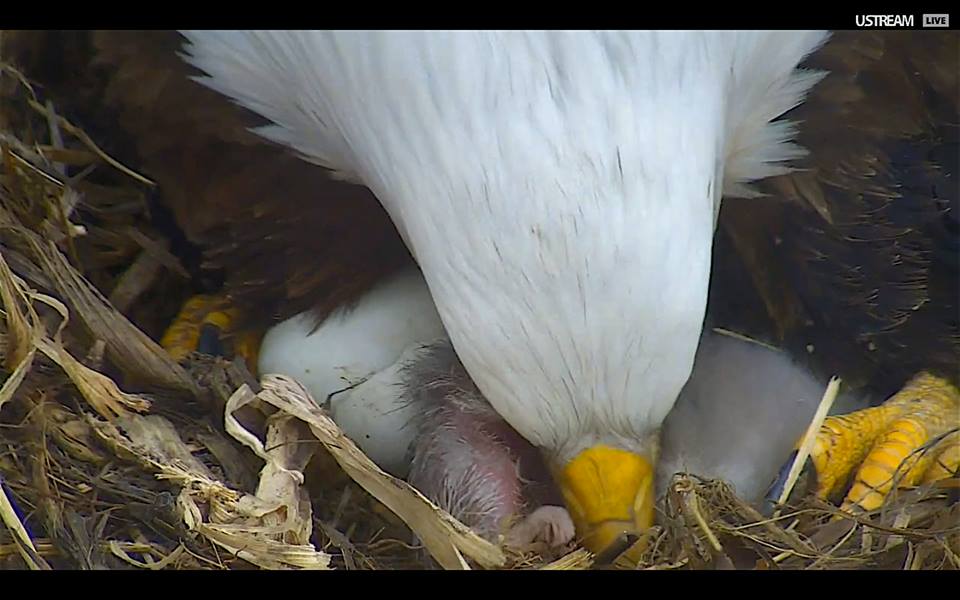
We are watching eaglets at three nests right now: Decorah, Decorah North, and Xcel Energy Fort St. Vrain. The oldest (FSV34) is five days old, and we're still waiting for DN6 and all of the Decorah eaglets as I write this. What can we expect in the first week of watching? Weight Gain!

DN4 at the Decorah North Nest
Like humans and other animals, growing nestlings have developmental milestones. The eaglets spend roughly the first week of their life gaining weight. They aren't able to thermoregulate yet, so depending on the weather and temperature, they may spend a lot of time under Mom and Dad. We'll see them eat, sleep, scuffle, and grow stronger as they interact with one another.  They will go from roughly 3.2 ounces - about the weight of 18 nickels - to roughly 16 ounces or one pound, increasing their weight five times over in just seven days.

Weight gain (g/day) as a function of age for male and female nestling Bald Eagles
This chart was reprinted from The Wilson Bulletin 96: 527 from an article published by G. R. Bartolotti (1984) with the written permission of the Wilson Ornithological Society. 
Many structural features, including foot pads, tarsi, and hallux claws, won't start rapid growth until 10-15 days after hatch. But the hatchlings' mid-toes and culmen - the dorsal ridge of the upper mandible - are already growing longer! Food is the root of all else besides, so it isn't surprising that the culmen achieves maximum growth in the first ten days. I suspect that the mid-toe aids balance, a crucial element of sitting up and exploring the nest. While our eaglets won't truly stand on their feet until they are roughly four weeks old, they will begin to shuffle around the nest on their tarsi long before that.

Enjoy the downy bobbleheads this week! By next week, they will already be growing their longer 'wooly' second or thermal down and alternately worrying and thrilling us with their interactions and sojourns around N2B.

The general stages of eagle development are:

  • Stage 1 - Structural growth. In their first thirty-five to forty days of life, eagles grow very rapidly, gaining weight and building bones, muscles, tissue, and features like tarsi, footpads, toes, and claws. This phase of development slows down about halfway through an eaglet's time in the nest, even though individual features might continue some level of growth.
  • Stage 2 - Feather and flight-related growth. Eagles grow four sets of feathers - natal down inside the egg, thermal down, juvenile feathers, and adult feathers. While thermal down starts growing at about ten days and juvenile flight feathers at about 27 days, feather growth doesn't overtake structural growth until thirty-five to forty days after hatch. Flight muscles also begin growing as eaglets wingercize, flap, hover, and eventually branch and fledge.
  • Stage 3 - Neurological Coordination. Eagle watchers know how ungainly eaglets can seem! As they grow, they become more adept at controlling beaks, legs, wings, and feet. They learn to stand on their own feet, tear food, self-feed, and flap their wings, going from cute but clumsy clown clompers to graceful young eaglets poised at the edge of fledge.

I'm not sure how familiar many of you are with the cortical homunculus, an image-based tool that maps tactility. We discussed it very briefly in this blog and I'll include links below. While useful and extremely cool, most cortical homunculii are static - that is, they reflect just one phase (usually adult) of an organism's life. But an eaglet's cortical homunculus will differ from an adult's as body parts and associated skills are gained and neural pathways developed. Our eaglets' brains and bodies are rapidly growing and changing as they gain the skills they need for life outside the egg!


Things that helped me write this blog, with a few considerations:

Thursday, March 23, 2017

What's inside those bald eagle eggs?

It is 31 days since egg number one was laid in Decorah, 32 days since egg number one was laid at Decorah North, and 36 days since egg number one was laid in Fort St. Vrain. We are starting hatch watch for Fort St. Vrain on Saturday, Decorah North on Sunday, and Decorah on Monday. The embryonic eagles are either in or approaching their final stages of development now, but what did they look like as they developed and grew inside their eggs?

Dr. Peter Sharpe from the Institute for Wildlife Studies developed a table of bald eagle embryonic development based on work done by Hamburger and Hamilton (1951). While not all bald eagle eggs hatch in 35 days, the stages of development look something like this...

Development of a chick, drawing from Frank Lillie photos. Artist William Sillin
From 0 to 4 days: A single cell is formed by the union of sperm and egg. It divides into multiple cells and forms layers. Head and tail are established, the emerging embryo divides into blocks called somites, and basic life support structures begin to develop, including the nervous system, skin, circulatory system, gastrointestinal system, and optical system.  The embryo turns onto its left side. Its heart begins to beat roughly 72 hours after incubation begins.
Chicken embryo at roughly two days incubation: equivalent to an eagle at about 3.5 days
At four days of age, the embryonic eagle doesn't look anything like a bird, but it has inside and outside layers, it can transport materials through its developing circulatory system, and its nervous system has an anterior-to-posterior template in place. The brain and nervous system will continue to grow and change, but the stage is set for the development of a skeletal system, limbs, a beak and tongue, foot and wing digits, and organs. 


From 3.5 to 9 days: The amnion closes, sealing the developing embryo inside the egg's innermost membrane. The allantois forms to sequester liquid waste and exchange gases through the porous eggshell. Wings, tail, and leg buds form. Eyes develop pigment.  Leg buds grow larger than wing buds and limbs begin to form. Elbow and knee joints are distinct by roughly 8 days and digital grooves - the precursors of toes and wing structures - are distinct by roughly nine days. The embryo's beak and tongue begin to form.
Chicken embryos roughly 23 to 25% of the way to hatch
At nine days, the minute embryonic eagle is about 25% of the way to hatch and still doesn't look especially birdlike. It has a head, eye pigmentation, stiff differentiated limbs, the beginnings of a beak, rudimentary digestive organs, and a defined sex. The stage is set for further organization as the embryo develops an egg tooth, true eyes, and feather germs. 


From 11 to 17 days: The egg tooth and two scleral papillae form on the 11th-12th day. Limbs are bent. Dorsal feather germs form on the 12th day. A nictitating membrane is visible on day 13. Ventral feather germs develop, the eyelids begin closing, and flight feather germs develop. 

A chicken embryo roughly 50% of the way to hatch
At 17.5 days, we are roughly halfway to hatch. Our embryo's head is disproportionately large, but it is definitely a bird. It has a beak, distinct toes, bent limbs, and eyes that take up most of its head. Its eyes and eye cavities aren't done forming and it needs to develop scales, nails, rough pads and spicules, and down feathers. Its yolk sac and small intestines are still outside its body cavity, and it has a lot of growing to do!


From 18 to 23 days: Leg scales, tiny talons, and plantar food pads appear. The eyelids are almost closed and the eyes are no longer quite as large in proportion to the rest of the head.

We are 65% of the way to hatch! Other than the closing of the body cavity, most major morphological changes are done. The eyelids will close, the eyes will grow into their sockets, the eaglet will develop natal down, it will internalize its egg yolk sac, its body cavity will close (leaving behind an egg yolk sac scar) and it will position itself for hatching! 

So what happens right before hatch? Just a few days from external pip, the rapidly growing embryo is taking up nearly all the space in the egg. It...
  • Turns so that its head is at the large end of the egg next to the air space.
  • Pierces the internal membrane - the internal pip - and begins to breathe air with its lungs. Hatch has started!
  • Takes the yolk sac into its body as it consumes most of the remaining albumen and yolk. 
  • Grows enough to contract the hatching muscle, pointing its head up and positioning its egg tooth against the shell of the egg. The eggshell is thinner and weaker than when it was laid, since the growing embryo absorbed calcium from the shell for its bones. 
  • Rubs its egg tooth against the shell, which cuts a small hole. We have an external pip!
  • Rotates its body, slowly cutting a ring around the shell.
  • Pushes its body against the shell, forcing the shell apart.
  • Works itself free of the shell membranes and halves. The eaglet has landed and hatch is complete!
We are looking forward to hatch later this week! Curious about what's in store? Watch this 2015 video of the very final stages of hatch in N2. 


Illustrations were taken from Popular Science Monthly/Volume 71/September 1907/The Problem of Age, Growth and Death III:  Link. Thanks to artist William Sillin for allowing us to use his lovely illustrations: http://www.willsillin.com/ (check it out - his illustrations are very cool!). Also take a look at this cool plate by Keibel and these lovely photos of chicken embryos: http://www.microscopy-uk.org.uk/mag/artnov04macro/mlchicken.html.

Things that helped me learn about this subject:

Tuesday, May 10, 2016

What is going on at the Decorah North Nest?

What is going on at Decorah North? The oldest eaglet, DN1, is displaying far more aggression than we are used to towards its siblings. It is upsetting to human watchers, especially since little DN3 takes much of DN1's biting, yanking, and twisting. However, we have also seen DN1 and even DN3 attack DN2. In most cases, the aggressive behavior ceases once the target submits, but we have seen biting and bonking continue past submission at least twice.

Why is this happening?
We don't know. Food certainly seems to be part of the puzzle, since we've often seen the eaglets act aggressively towards one another as they establish a feeding-related pecking order. However, we've also seen aggression break out in circumstances seemingly unrelated to food. For example, DN3 attacked DN2 at around 2pm this afternoon, giving it multiple bites, yanks and twists before DN2 submitted. The eaglets had all been fed well earlier today, so why the aggression? Perhaps differences in age and size also contribute to aggression. I would tend to believe that aggressive behavior is hard to stop once it starts, and I'm very curious whether we will see the drop-off in aggression here that we have seen in Decorah.

While siblicide is rare, aggressive behavior is common. It ranges from the relatively mild aggression seen in Decorah and at Fort St. Vrain to the biting, twisting, and yanking seen at Decorah North, Southwest Florida, and several other nests. I think this looks odd and frightening at least in part because Decorah has tended to lack extreme aggression. But Decorah and Fort St. Vrain could very well be outliers when it comes to eagle behavior. At this point, only the eagles know for sure.

Is DN3 growing normally?
It is very tough to tell with nothing but the two 'Cropzillas' to compare it to. DN3 is growing in thermal down to replace natal down, has gotten larger relative to the other two (seemingly overnight!), and is growing footpads. What we've been able to see of its beak has indicated a fairly regular size and shape in accordance with eaglet growth curves, and its talons are appropriately changing to black.

DN3 is just moving into the steepest part of its growth curve. The next five to seven days will give us a look at whether or not it is growing normally. We'll also look for developmental changes like nest wandering, attempting to stand, and tracking Mom and Dad outside the nest. DN3 has already been observed doing some of those things on warm days and we should see them more often as its thermal down grows in.

Is DN2 growing normally?
Yes, DN2 is growing and behaving normally.

Will DN3 survive?
DN3 is strong, gets fed, participates in nest aggression, and submits appropriately. The eaglets tend to fight with their beaks instead of their talons and, while the aggression looks frightening, DN3 hasn't been badly injured. It is rapidly growing in thermal down, which will help protect it from cold weather and aid nest exploration. Fighting is very hard to watch, but generally rare when one compares the time spent fighting with the time spent laying around the nest and eating.

There are no guarantees, but siblicide is uncommon and DN3 is much stronger than it seems. It often comes back with its own beaking, displaying its own fierceness, or can be seen afterward cuddling up to a former aggressor. We are hopeful it will survive and even thrive as it grows...but again, there are no guarantees with wildlife.

Will you intervene?
Absolutely not. We might consider interfering if the situation were human-caused, but these behaviors are completely normal from an eagle perspective. If we rescued every eaglet we were concerned about, there would be no wild eaglets left to watch. It is very important to keep eaglet behavior in perspective. For the most part, the parents have acted according to our expectations: feeding, interacting, brooding, and in general caring for their family. While the eaglets fight with one another, they spend more time cuddling, eating, and sleeping. While the fighting is upsetting to watchers, none of it is out of line or outside the parameters of normal eagle behavior.

In summary, the worst may happen but we are not giving up on DN3. The next five to seven days will tell us a lot more about its growth. It looks like we are starting to get pinfeathers on DN1, which means its growth will start slowing as feathers take over. While we have never seen this level of aggressive interaction in Decorah, eagles have survived it at other nests. We remain hopeful.

Kay from SOAR also provided some feedback after she was approached about the situation. She agrees that the situation "looks" terrible but that at this developmental stage of the eaglets they don't have a huge amount of strength in their beak.  Right now, those beaks are something like pointy salad tongs. Hopefully all three eaglets will grow well and this will not be a concern for much longer.  


Tuesday, April 26, 2016

Eaglet Growth and Development: Week Four


D24 and D25, April 25, 2016

D24 is 28 days old today, while D25 turns 26 days old. At this point, feather growth is starting to overtake structural growth as the eaglets approach the half-way point in the nest. Pinfeathers emerged this week, growing at an astonishing rate as they poked out from their keratin sheaths along the edge of the eaglets' wings. Feathers also started to emerge along their backs - the 'cloak' - and sprout from their tails. As beak, leg, and footpad growth began to slow, wing growth sped up, leaving the eaglets with noticeably longer, larger wings by the end of week four.

We also saw changes in behavior. Although the eaglets will continue to compete for food, baby bonking has ceased. This always makes me wonder what functions it serves. We know it strengthens muscles, aids coordination, and helps improve eyesight. Does food competition lead to greater food intake, helping to fuel an eaglet's rapid growth? Does it lay the ground for future social interaction, which includes plenty of body language, vocalization, and dominant/submissive interaction? Does it give parents information about an eaglet's overall heath, or help prompt provisioning? Or is it simply replaced by a new suite of physical behaviors as the eaglets begin to explore the nest and enter the next phase of nestling life? Bonking may have ended, but the eaglets are starting to play with sticks, move towards a full stand, and expand their explorations of the nest. They've also begun noticing the area around the nest, tracking with Mom and Dad as the adults pay attention to the outside world.

So what can we expect to see in week five? Watch for an explosion of dark feathers, leading to an evenly mottled grey and white appearance some time in the next week. The eaglets will begin standing and walking, leading to many mouse clicks as we try to shoo them back to the center of the nest! We may see them begin to tear their own food and we will get to see them 'play house' as they begin moving sticks around themselves and with Mom and Dad. If past years are any judge, Mom and Dad will give them plenty of materials to work with as they pile up the crib rails with larger, heavier sticks!

We've talked a lot about physical changes. We are also entering a period of rapid developmental changes as the eaglets acquire new skills and grow feathers. The eaglets will play cooperatively and competitively, learn to stand, walk, and tear food, and begin moving their wings. Following the appearance of Mom's teakettle whistle, I'm waiting for baby vocalizations to turn into juvenile screes for food! I'm looking forward to watching D24 and D25 move into the next phase of their lives as feather growth takes over from body growth and greater mobility leads to changes in behavior.

The general stages of eagle development are:

Stage 1 - Structural growth. In their first thirty-five to forty days of life, eagles grow very rapidly, gaining weight and building bones, muscles, tissue, and features like tarsi, footpads, toes, and claws. This phase of development slows down about halfway through an eaglet's time in the nest, even though individual features might continue some level of growth.

Stage 2 - Feather and flight-related growth. Eagles grow four sets of feathers - natal down inside the egg, thermal down, juvenile feathers, and adult feathers. Thermal down starts growing at about ten days, juvenile deck feathers at about 20-23 days and juvenile flight feathers at about 27 days, but feather growth doesn't overtake structural growth until thirty-five to forty days after hatch. Flight muscles also begin growing as eaglets wingercize, flap, hover, and eventually branch and fledge.

Stage 3 - Neurological Coordination. Eagle watchers know how ungainly eaglets can seem! As they grow, they become more adept at controlling beaks, legs, wings, and feet. They learn to stand on their own feet, tear food, self-feed, and flap their wings, going from cute but clumsy clown clompers to graceful young eaglets poised at the edge of fledge.

So where is our cortical homunculus in weeks 4-5? I'd tend to think that legs, feet, and wings are accelerating in importance this week, leading important behaviors like standing, tearing, and flapping! I also wonder what impressions are being made now that they are beginning to pay attention to the outside world and have moved from playing with grass to nibbling at larger, heavier sticks. The nest and eagles always have more to teach us!

Things that helped me write this blog, with a few considerations:


Wednesday, April 20, 2016

Eaglet Growth and Development: Week Three

04/13/16: Decorah Nest
04/19/16: Decorah Nest
D24 is 22 days old today, while D25 turns 21 days old. In the past week, the eaglets' footpads and talons have grown, their feet and legs have yellowed, and their talons have turned almost entirely black. Their mohawks have become more apparent as they shed their white natal down, which disappears from the head last. Almost every time I checked in, the eaglets were either eating or recovering from a meal. Their crops bulged so heavily at times that it was hard to believe they could sit up! They also had a fine buffet to chose from, including trout from the hatchery (look for finer scales and a front pointing mouth with thin lips), sucker (look for rougher scales and a bottom pointing mouth with fleshy lips), rabbit, muskrat, and even a mink.

Eaglets spend roughly 75-80 days in the nest, so we are a little under a third of the way to fledge. Most birds of prey seem to spend roughly the first half of nest life gaining weight and growing structural features like footpads, talons, toes, and beaks. While some structural growth may occur later on, the second half of nest life is dedicated to feathers and wings as feathers replace down and wings lengthen.

This week we were treated to a lot of eating and sleeping, but big changes are on the way! Pinfeathers started growing out late in week three and poop went from little slices to big spatters as the eaglets got better at sitting up, bending over, and shooting poop! What else can we look forward to in the coming week?
  • The eaglets should start standing on their feet. This will change nest exploration and enable them to really get to work on the Poopcasso tree!
  • Natal down mohawks will vanish and dark deck feathers will poke through the eaglets' natal down at an astonishing rate.
  • Still enclosed in their keratin sheaths, eaglet pinfeathers will grow longer. 
  • We may be treated to the beginning of wingercizing sessions! Once the eaglets can stand, they can really begin exploring their wings. 
By the end of the fourth week, the eaglets should be standing well and may be starting to walk and tear their own food. I have no doubt that many of us will be mouse-clicking, shoeing, and blowing to get inquisitive eaglets back into the center of the nest as they widen their explorations and begin broadening their horizons! 

While we've been making guesses at gender, the weight of the two sexes begins to separate as females gain weight faster than males.  Sex takes over from age as a size determinant around 50-60 days. But cameras can be tricky and clutches can have large males and small females or be all one sex, making ID impossible without measurements or a genetic test. We'll have a lot of fun seeing if size conforms to our observations based on what we have seen of beak size, commissure extension, and other traits, and I can hardly wait for food tearing and wingercizing!

The general stages of eagle development are:

Stage 1 - Structural growth. In their first thirty-five to forty days of life, eagles grow very rapidly, gaining weight and building bones, muscles, tissue, and features like tarsi, footpads, toes, and claws. This phase of development slows down about halfway through an eaglet's time in the nest, even though individual features might continue some level of growth.

Stage 2 - Feather and flight-related growth. Eagles grow four sets of feathers - natal down inside the egg, thermal down, juvenile feathers, and adult feathers. Thermal down starts growing at about ten days, juvenile deck feathers at about 20-23 days and juvenile flight feathers at about 27 days, but feather growth doesn't overtake structural growth until thirty-five to forty days after hatch. Flight muscles also begin growing as eaglets wingercize, flap, hover, and eventually branch and fledge.

Stage 3 - Neurological Coordination. Eagle watchers know how ungainly eaglets can seem! As they grow, they become more adept at controlling beaks, legs, wings, and feet. They learn to stand on their own feet, tear food, self-feed, and flap their wings, going from cute but clumsy clown clompers to graceful young eaglets poised at the edge of fledge.

I'm not sure how familiar many of you are with the cortical homunculus, an image-based tool that maps tactility. We discussed it very briefly in this blog and I'll include links below. While useful and extremely cool, most cortical homunculii are static - that is, they reflect just one phase (usually adult) of an organism's life. But an eaglet's cortical homunculus will differ from an adult's as body parts and associated skills are gained and neural pathways developed. Our eaglets' brains and bodies are rapidly growing and changing as they gain the skills they need for life outside the egg! I'd tend to think that legs, feet, and wings are starting to 'light up' this week, leading important behaviors like standing, tearing, and flapping!

Things that helped me write this blog, with a few considerations:


Wednesday, April 13, 2016

Eaglet Growth and Development: Week Two

D24 and D25: 04/04/16
D24 and D25: 04/12/16

D24 is 15 days old today, while D25 turns 13 days old. The week-old difference between these two photos is striking. In their second week of development, the eaglets grew larger, gaining roughly two pounds between April 4th and April 12th. They experienced rapid growth in features like beaks, culmens, and footpads, replaced their white natal down with thicker grey thermal down, and began exploring the nest. Although they aren't yet standing on their toes, they are able to sit up - way up! - for feeding and shuffle around on their metatarsi.  Their eyes are wide open and fit more comfortably in their eyesockets, features like brow ridges are beginning to appear, and their legs and footpads are yellow, not pink. 

Gary Bortolotti wrote that bald eagles might gain more weight per day than any other north American bird, although the majority of their weight gain occurs within the first 30-40 days. This rapid weight growth is fueled by their nutrient-rich diet of meat. Over the past week or so, we watched the eaglets chow down on fish, roe (fish eggs), venison (aborted fetal deer), rabbit, squirrel, something that might have been a muskrat, waterfowl, and several other birds. D24 became proficient enough at shooting poop to christen the Poopcasso tree on April 5th, while both eaglets got in plenty of tussling and bonking play, alternately hitting, submitting, and quitting to cuddle in the nest cup, grow, and wait for more food to arrive.

Watchers have been asking why the Fort St. Vrain eaglets began wandering the nest so much earlier than the Decorah eaglets. While we don't know for sure, we suspect that temperature played an important role. Fort St. Vrain experienced unusually warm temperatures in late March and early April, and the leaves hadn't unfurled to provide shade for the nest. Cold is a challenge to eaglets under 10-15 days of age, but so is heat! With little ability to control body temperature and no way to lose heat except by panting, the eaglets did their best to retire to what little shade tree limbs and the nest itself offered. Once in the shade, they sprawled out as much as they could. Mom did her best to provide shade for the eaglets, moving from one to another and standing between them and the sun.  As alarming as it was to viewers, Mom's ploy worked and we didn't see quite as much wandering, at least for a few days, after the weather cooled down. 

In the week to come, we can expect (continued) rapid growth in footpads, talons, and legs. Beak growth will rapidly slow as the eaglets' beaks approach adult size and we may see dark juvenile feathers start to sprout from their grey down. Overall weight and height gain will continue, most  likely reaching their steepest curves some time this week. By the end of the week, our little bobbleheads at Decorah and Fort St. Vrain will be almost a foot tall, while the eggs at Decorah North should begin hatching! 

Watchers have observed that different nests seem to have different 'parenting' styles: i.e., Dad may be more present at one nest than another, food may come in more or less regularly, and eaglets might spend more time alone. Many things influence nest life, including weather, temperature, food availability, predators, and the presence of other adult, sub-adult, and juvenile bald eagles. While eaglet growth and development occurs along a fairly predictable trajectory, local conditions can change the timing of events - something we've seen in Decorah, Fort St. Vrain, and the year we watched Eagle Valley. We are looking forward to hatch at Decorah North!


The general stages of eagle development are:

Stage 1 - Structural growth. In their first thirty-five to forty days of life, eagles grow very rapidly, gaining weight and building bones, muscles, tissue, and features like tarsi, footpads, toes, and claws. This phase of development slows down about halfway through an eaglet's time in the nest, even though individual features might continue some level of growth.

Stage 2 - Feather and flight-related growth. Eagles grow four sets of feathers - natal down inside the egg, thermal down, juvenile feathers, and adult feathers. Thermal down starts growing at about ten days, juvenile deck feathers at about 20-23 days and juvenile flight feathers at about 27 days, but feather growth doesn't overtake structural growth until thirty-five to forty days after hatch. Flight muscles also begin growing as eaglets wingercize, flap, hover, and eventually branch and fledge.

Stage 3 - Neurological Coordination. Eagle watchers know how ungainly eaglets can seem! As they grow, they become more adept at controlling beaks, legs, wings, and feet. They learn to stand on their own feet, tear food, self-feed, and flap their wings, going from cute but clumsy clown clompers to graceful young eaglets poised at the edge of fledge.

I'm not sure how familiar many of you are with the cortical homunculus, an image-based tool that maps tactility. We discussed it very briefly in this blog and I'll include links below. While useful and extremely cool, most cortical homunculii are static - that is, they reflect just one phase (usually adult) of an organism's life. But an eaglet's cortical homunculus will differ from an adult's as body parts and associated skills are gained and neural pathways developed. Our eaglets' brains and bodies are rapidly growing and changing as they gain the skills they need for life outside the egg! I'd tend to think that visual acuity suddenly 'lit up' this week, leading changes in coordination as the eaglets began sitting up and moving around.

Things that helped me write this blog, with a few considerations:

Friday, April 01, 2016

Eaglet Growth and Development: Week One

Newly hatched D25, March 31st 2016
D24 is three days old today, sibling D25 is not quite a day old as I write, and D26 is still inside the egg. What can we expect in the first week of watching?

Weight Gain!
Like humans and other animals, growing nestlings have developmental milestones. The eaglets spend roughly the first week of their life gaining weight. They aren't able to thermoregulate yet, so depending on the weather and temperature, they may spend a lot of time under Mom and Dad. We'll see them eat, sleep, scuffle, and grow stronger as they interact with one another.  They will go from roughly 3.2 ounces - about the weight of 18 nickels - to roughly 16 ounces or one pound, increasing their weight five times over in just seven days.

Many structural features, including foot pads, tarsi, and hallux claws, won't start rapid growth until 10-15 days after hatch. But the hatchlings' mid-toes and culmen - the dorsal ridge of the upper mandible - are already growing longer! Food is the root of all else besides, so it isn't surprising that the culmen achieves maximum growth in the first ten days. I suspect that the mid-toe aids balance, a crucial element of sitting up and exploring the nest. While our eaglets won't truly stand on their feet until they are roughly four weeks old, they will begin to shuffle around the nest on their tarsi long before that.

Enjoy the downy bobbleheads this week! By next week, they will already be growing their longer 'wooly' second or thermal down and alternately worrying and thrilling us with their interactions and sojourns around N2B.


The general stages of eagle development are:

Stage 1 - Structural growth. In their first thirty-five to forty days of life, eagles grow very rapidly, gaining weight and building bones, muscles, tissue, and features like tarsi, footpads, toes, and claws. This phase of development slows down about halfway through an eaglet's time in the nest, even though individual features might continue some level of growth.

Stage 2 - Feather and flight-related growth. Eagles grow four sets of feathers - natal down inside the egg, thermal down, juvenile feathers, and adult feathers. While thermal down starts growing at about ten days and juvenile flight feathers at about 27 days, feather growth doesn't overtake structural growth until thirty-five to forty days after hatch. Flight muscles also begin growing as eaglets wingercize, flap, hover, and eventually branch and fledge.

Stage 3 - Neurological Coordination. Eagle watchers know how ungainly eaglets can seem! As they grow, they become more adept at controlling beaks, legs, wings, and feet. They learn to stand on their own feet, tear food, self-feed, and flap their wings, going from cute but clumsy clown clompers to graceful young eaglets poised at the edge of fledge.

I'm not sure how familiar many of you are with the cortical homunculus, an image-based tool that maps tactility. We discussed it very briefly in this blog and I'll include links below. While useful and extremely cool, most cortical homunculii are static - that is, they reflect just one phase (usually adult) of an organism's life. But an eaglet's cortical homunculus will differ from an adult's as body parts and associated skills are gained and neural pathways developed. Our eaglets' brains and bodies are rapidly growing and changing as they gain the skills they need for life outside the egg!

Things that helped me write this blog, with a few considerations:

Thursday, April 30, 2015

Red-tailed hawk growth and development in the nest

Eaglets aren't the only thing growing right now! The two eyas red-tailed hawks at Eaglecrest are morphing into adults right before our eyes. Like bald eagles, different parts of their bodies grow at different times and different rates, reflecting developmental priorities and impacting behavior. How will hawks EC2 and EC3 (also known as Speckle and Snickers on the Eaglecrest Wildlife facebook page) grow?

  • 0-7 days: the culmen achieves maximum growth. Red-tailed hawks hatch with a culmen (the dorsal ridge of the upper mandible) that is about 30% of the maximum size it is likely to achieve in the nest. During a red-tailed hawk's first week of life, its already large culmen nearly doubles in length, going from an average of 6.9 mm in length to an average of 12.3 mm in length. Since the consumption of food is the root of all else besides, the hawk's food-consuming apparatus is given developmental priority. While the culmen continues to grow after week one, its rate of growth slows dramatically, becoming almost flat by week five. Bald eagles follow a similar pattern, although they have almost twice the growing time in the nest that red-tailed hawks do and their developmental milestones reflect that.  
  • 7-14 days: third toe and tarsus achieve maximum growth. Eating has priority, but movement isn't too far behind. A young hawk needs to move to build muscle and feed once it is past the point where Mom and Dad simply stuff food into its waiting mouth. In the second week of life, a red-tailed hawk's third toe and tarsus are given developmental priority. The third toe is the real stand out here, nearly doubling in length from 16.9 to 27.9 millimeters. With longer toes and thicker, longer tarsi, the hawks are better able to sit up, move around the nest on their feet and knees, and interact with one another. We see a similar pattern with bald eagles, who reach asymptotic mid-toe and tarsus size about half-way through their nestling period - 40 days, in their case. 
  • 14 to 21 days: body weight achieves maximum growth. With food intake well in hand, young hawks gain weight rapidly. While they've been growing all along, weight gain is the biggest actor in week three. The young hawks spend a great deal of time eating and sleeping as their weight increases. 
  • 21 to 24 days: weight gains decline, independence increases. During the fourth week, weight gain declines, the nestling hawks begin feeding independently, and feather growth takes over. The hawks have the strength and physical structures they need to stand upright on their feet, manipulate food, and feed on their own. At about day 24, the length of primary seven overtakes weight as the best indicator of age.  At this point, fledge is just two or three weeks away. 
  • 24 to 35 days: Feathers take front and center. As fledge comes closer, developmental energy is channeled into growing feathers. The primaries enter their maximum growth phase during weeks four and five, the two weeks prior to fledging. The young hawks will also be growing sub-adult feathers elsewhere, including their backs, their tails (which won't become red until molt two, in their second year of life), and their chests. 
  • 36 to 44 days: Time to fly! Feather growth will slow, but the growth of flight-related muscles is happening in leaps and bounds. Wingercizing will take front and center stage as they young hawks practice for the big event by flapping, wing-hopping, hovering, and eventually taking flight! 
Both red-tailed hawks and bald eagles allocate developmental energy into producing weight and structure first (day 0 to day 24), and feathers second (day 24 onward). While feathers often seem light and simple, these two distinct periods of growth point to the incredible amount of energy needed to produce a proper 'coat' of feathers. Enjoy the hawks now, since they will be leaving the nest soon. It takes just 44-46 days to grow a red-tailed hawk from hatchling to fledgling! 


Resources
Did you know?
Red-tailed hawks are excellent falconry birds. While their are many excellent falconry organizations, I'm most familiar with NAFA. Interested in falconry? Follow this link: http://n-a-f-a.com/