Showing posts with label eaglets. Show all posts

Friday, March 31, 2017

Eaglet Growth and Development: Week One

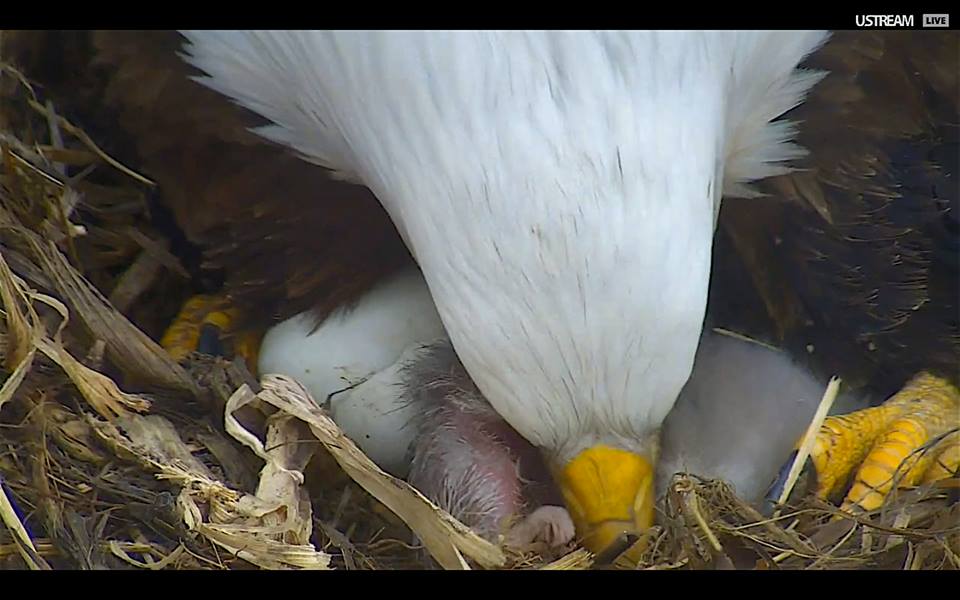
We are watching eaglets at three nests right now: Decorah, Decorah North, and Xcel Energy Fort St. Vrain. The oldest (FSV34) is five days old, and we're still waiting for DN6 and all of the Decorah eaglets as I write this. What can we expect in the first week of watching? Weight Gain!

DN4 at the Decorah North Nest
Like humans and other animals, growing nestlings have developmental milestones. The eaglets spend roughly the first week of their life gaining weight. They aren't able to thermoregulate yet, so depending on the weather and temperature, they may spend a lot of time under Mom and Dad. We'll see them eat, sleep, scuffle, and grow stronger as they interact with one another.  They will go from roughly 3.2 ounces - about the weight of 18 nickels - to roughly 16 ounces or one pound, increasing their weight five times over in just seven days.

Weight gain (g/day) as a function of age for male and female nestling Bald Eagles
This chart was reprinted from The Wilson Bulletin 96: 527 from an article published by G. R. Bartolotti (1984) with the written permission of the Wilson Ornithological Society. 
Many structural features, including foot pads, tarsi, and hallux claws, won't start rapid growth until 10-15 days after hatch. But the hatchlings' mid-toes and culmen - the dorsal ridge of the upper mandible - are already growing longer! Food is the root of all else besides, so it isn't surprising that the culmen achieves maximum growth in the first ten days. I suspect that the mid-toe aids balance, a crucial element of sitting up and exploring the nest. While our eaglets won't truly stand on their feet until they are roughly four weeks old, they will begin to shuffle around the nest on their tarsi long before that.

Enjoy the downy bobbleheads this week! By next week, they will already be growing their longer 'wooly' second or thermal down and alternately worrying and thrilling us with their interactions and sojourns around N2B.

The general stages of eagle development are:

  • Stage 1 - Structural growth. In their first thirty-five to forty days of life, eagles grow very rapidly, gaining weight and building bones, muscles, tissue, and features like tarsi, footpads, toes, and claws. This phase of development slows down about halfway through an eaglet's time in the nest, even though individual features might continue some level of growth.
  • Stage 2 - Feather and flight-related growth. Eagles grow four sets of feathers - natal down inside the egg, thermal down, juvenile feathers, and adult feathers. While thermal down starts growing at about ten days and juvenile flight feathers at about 27 days, feather growth doesn't overtake structural growth until thirty-five to forty days after hatch. Flight muscles also begin growing as eaglets wingercize, flap, hover, and eventually branch and fledge.
  • Stage 3 - Neurological Coordination. Eagle watchers know how ungainly eaglets can seem! As they grow, they become more adept at controlling beaks, legs, wings, and feet. They learn to stand on their own feet, tear food, self-feed, and flap their wings, going from cute but clumsy clown clompers to graceful young eaglets poised at the edge of fledge.

I'm not sure how familiar many of you are with the cortical homunculus, an image-based tool that maps tactility. We discussed it very briefly in this blog and I'll include links below. While useful and extremely cool, most cortical homunculii are static - that is, they reflect just one phase (usually adult) of an organism's life. But an eaglet's cortical homunculus will differ from an adult's as body parts and associated skills are gained and neural pathways developed. Our eaglets' brains and bodies are rapidly growing and changing as they gain the skills they need for life outside the egg!


Things that helped me write this blog, with a few considerations:

Friday, February 10, 2017

The Diction-Aerie!


We'll get to the fun stuff pretty quickly, but I wanted to write a quick note on abbreviations. Why do we call the active Decorah eagles nest N2B? What in the world is DN1? Do other nests use the same nomenclature?

In general, we use nomenclature to label eagles and nests. In Decorah, our first nest was never online and was not included in the initial nest count. Mom and Dad occupied N1 from the fall of 2007 to the summer of 2012. In the fall of 2012, they began building N2. They lived in N2 from the fall of 2012 to the summer of 2015, when N2 fell in a storm. If we were following the rules, we would have named the nest we built for them N3 (since three follows two) or N4 (since it is the fourth nest on their territory). But since Bob had just passed away, we named it N2B in his honor. Mom and Dad North are on DNN3, or the third nest built in the Decorah North territory.

Eaglets are given a territorial signifier and long count number. This makes it easy for us to differentiate between our nests and reminds of us of how many eagles have been produced at each territory. Unhatched eggs are not counted. Young that die in the nest are counted. So:
  • The first eaglet to hatch in Decorah this year will be D26 (the 26th eaglet produced by Mom and Dad Decorah).
  • The first eaglet to hatch at Decorah North this year will be DN4 (the 4th eaglet produced by Mom and Dad North since we started counting, and possibly the 4th, period).
  • The first eaglet to hatch at Fort St. Vrain this year will be FSV34 (the 34th eaglet produced on this territory, although it appears we had at least one female turnover).
Other nests may or may not use the same nomenclature system. If the moderators use names, they probably don't. But if the moderators use numbers, the numbers are indicating a count of nests, eaglets, and/or adults. Names like D26, E9, and M15 provide context and information once you know how to read them! And now for the fun...

Presenting....The Diction-Aerie!
With Eggstraordinary Graditude to chatters, and many other EAs who contributed to our eggspanding vocabulary of Eagle-ese / Eaglish we proudly present the Decorah Eagles Diction-Aerie for you to print out, mantle over, and devour the knowledge presented by the Fledge-U-Ating Eagle 101 Classes of 2011-2016. A huge thanks to Sherri Elliott, who posted this for the first time in 2011, and has kept it up to date ever since!

Air-obics - Extending wings and catching a bit of air.
Anthropomorphism - projecting human characteristics onto animals.
Apteria - area on breast with no feathers; aka -brood patch.
Babylets – The fuzzball stage of baby eyas.
Balloon Mantle - a puffball of feathers exhibited by E3.
Bantling – A baby mantle … not a full juvenile mantle yet – coined by ElfRuler.
Beak-A-Boo – D14’s beak was often the only thing seen from his hiding spot.
Beak Bonk - depending on level of intensity can be a slight bump to a sibling or a one-two lead up to a TKO.
Beak Geeks - a term for people who avidly watch the eagles everyday!
Beak Kisses - ahh, one of our favorite spectator sports.
Beak Lips -  area of beak sides to corner of mouth.
Beak Off - eaglet beak joust.
Beakering - sibling disagreements.
Beakathon – 3-Way Beak contest of power.
Beakdown – A beak squabble resulting in a take down of a sibling.
Beakoff - eaglets fake fighting with their beaks.
Bedreagled Eaglets - raggedy look after bad weather.
Benihana Dad – aka Bunnihana Dad – No one can defurr and slice and dice better than Dad!
Big Gulp Protein Smoothies - swallowing a whole fish.
Bird Nerds -  another term for people who avidly watch the eagles everyday!
Birshimi - mystery prey of the bird variety.
Bling - unidentified accouterments brought to the nest from Nest Depot - usually brightly colored.
Bobbleheads - self explanatory, but especially adorable dressed in fuzzy white natal down.
Branch Office  -  Mom & Dad spend most of their time in this space adjoining the nest after the eaglets grow into juvies.
Branching - eaglets hopping from one branch to another prior to fledging.
Breakfish -  first meal of the day that is fish.
BreakFur – the first meal of the day that is furry.
Cameraflague – D14 was expert at hiding above the camera and cables.
Cameritisi Permanentitis Bugitis -  bug on camera lens, also known as camera bugs.
Camming – jumping on the camera.
Cere -  fleshy, membranous covering of the base of the upper mandible.
Claw Floss - name given to Pinky, the baling twine. from 2011.
Chef's Surprise - When eagle bodies obscure the meal being served.
Chicken of the Tree – not tuna … squirrel served in the Cottonwood.
Chicklet - affectionate name for our hatchlings ... see also Babylet.
Circe du EEEaglee’ – Feats of aerobic performance (or feets).
Cleaning Coma - behavior emulating Dad’s cleaning skills, but generally tiring quickly, lapsing into face plant.
Clown Clomp - comical eaglet first steps learning how to walk.
Clown Feet - oversized feet/talons that the eaglets haven't grown into yet, nor know what to do with.
Clutch - total number of eggs laid, or birds hatched during a single nesting period.
Convocation - group of eagles in tree or on ground.
Corn Husk - outer dried corn covering coveted in nest.
Corn Husk Pillow - said item used as head rest.
Corn Stalk - building material for nest crib rails.
Clutch - number of eggs laid in a nest.
Crittergetter – Mom & Dad’s wings used when combating an intruder.
Crop - area in neck where food gathers first before entering stomach if it is full.
Crop Plop - aka Crop Flop - falling over or laying down, usually proceeded by a food coma.
Crop Prop - the ability to use the enormous crop to prop up a bobblehead.
Crop rotation - food moving from the crop to the stomach for digestion (and filling up again).
Cuddle Huddle - all the e's close together for safety/warmth in a group.
Cuddle Puddle - horizontal E cuddle sprawl.
Cuddlelet  - one hatchling all cuddled up by itself.
DDD-ia Pets - just add water to little eaglets.
Decorah - the idyllic location in Iowa where our family set up its Home-Tweet-Home.
DecorahLand - A magical place at the top of a Cottonwood Tree.
Decorah Drop - nap flop.
Decorah Front Porch - our place to watch the EEeee's.
Decorah Shimmy - back and forth motion that Mom/Dad use to position themselves over the eggs/eaglets.
Decorahating - beautification of the nest.
EA'S - Eagle Addicts, aka: Eagle-holics.
E-Bots – hatchlings more ambulatory at age 4+weeks.
E-ddicts - those who watch eaglets and stay in pajamas all day.
E-Gulp - swallowing food whole.
E-Heap - pile of eaglets.
E-Lump - same as cuddle huddle.
E-Pology - Submission bow or another act of 'sorry' after a sibling altercation.
E-Team - long suffering worrywarts who love eaglets.
E-Ticket Ride - the Decorah Eaglet antics are the ultimate ticket to fun in DecorahLand.
EEE-Mail - self explanatory.
E.N.S. - Empty Nest Syndrome
EWOT - Eaglet Without Transmitter (believed to be D18 from  2014).
EWT - Eaglet With Transmitter (believed to be D19 from 2014), now known as Four.
Eagle Condo - eagles in penthouse, smaller birds in lower stories.
Eagle Kneivel - daredevil or showoff behavior.
Eagle Time - no time that has anything to do with human time.
Eagleholics Anonymous -12 step recovery program for eagle addiction.
Eagleholics - (Eagle-holics) people that are avidly watching them daily.
Eagleology – online camera course in eagle watching.
Eaglestock/Eaglefest - 300+ million viewers united on web cam broadcast.
Eagle-ese - our unique vocabulary, also known as Eaglish.
Eagleibrium - balance achieved only by eagle walking.
Eaglemaniacs - people who eat, drink and sleep eagles, with not much real sleep actually occurring.
Eagleicious Delicious - any delightful E behavior.
Eagletecture - construction skills used by Dad to create the nest.
Eagletude - any display of eagle attitude.
Eaglish - all the words we made up for this dictionary.
Eagulp - swallowing food whole.
Ealergies - involuntary sneezing reaction.
Eeelie Button – D14 gave us the first view of the protuberance at belly of the outtie left from yolk sac cord.
EEElympics - athletic feats of prowess.
EEEnsane - an affliction of most Eagleholics.
Eggnant - Mom's condition prior to egg lay.
Elebenty Billion – an enormous number .. coined by our ElfRuler.
Ellergy – eaglet sneezesEyas – eagle hatchlings
Eyas stage - fresh from nest.
Face Plant - off balance eaglet plopping into nest face first, perhaps going into food coma.
Feaking - cleaning a beak on a stick or branch.
Feathairdresser - wind redecorating Mom's hair.
Featherline  - the eee’s hairline feather growth giving them distinguishable identifiers.
Fish Fledge - result of food fight when intended meal accidentally goes off the nest bowl.
Fish Flops - any of the EEeee's wearing a skewered fish are said to be wearing fish flops.
Fishapalooza - a buffet bounty consisting of 4 or more fish brought to the nest in rapid succession.
Fishereagle - Dad, Dad, Dad!
Fishcicles - a serving of frozen fish nestovers.
Fjerky - fish jerky
Flap Mob – siblings rushing to mantle over new food item brought in.
Flapadoodle - Amusing flurry of wing flaps performed by Mom or Dad while sitting (incubating) the eggs.  Generally occurs in middle of night and scares the heck out of everyone watching.
Flappathon - endurance contest of eee 's getting pumped up.
Flatabit – aka Goodyear Rabbit – unmistakable steel belted rabbit roadkill.
Fleaping - flapping & leaping - aka hoppersizing
Fledge - taking the leap from branches to the air of the big beyond.
Fledge Fest - gathering of Eagleholics making road trips to witness fledging.
Fluffles – new tail feathers emerging in a ruffle pattern.
Fly-By - parent checking in, but not landing, and with or without food.
Fly-By-Fake-Out - parent flying by with food to lure E's out of nest.
Flying monkeys - teenlets similarity when wingersizing to the Wizard of Oz flying army. Hum the song: oh weeee oh...ohhhh oh when seeing this behavior.
Food Coma - state of suspension E's go into after eating too much.
Food Fledge – result of food falling/ going overboard from nest.
FOUR - our 3rd transmittered eaglet (believed to be D19 from 2014).
Fret of chatters - a group of chatters worried about the eagles.
Flapping Jacks - eaglets exercizing their wings.
Flash Chat – If something important happens on the nest, there is an immediate convocation of chatters and mods to discuss and view.
Fledge - when the juveniles are ready to leave the natal nest.  Unforunately, Eagleholics are unable to due the same.
Fledge-U-Ation - eaglets graduate to fledging.
Fritching - itching new emerging feathers.
Full-Feathered - a loving way to describe Mom Decorah's 'plus size'.
G.F.Z. - gnat free zone -- a mythical place in Decorah.
Gnat - larger than noseeums and especially fond of the eagle's head area resulting in eagle neck jerk twitching.
Gnat Gnat - a term of endearment used interchangeably for nite nite by EAs.
Gnat Off - miracle deterrent for gnasty gnats.
Gnat Scat Boogie – the eee’s headtwich dance.
Gnatercizing - shaking off the gnats.
Goodyear Rabbit – flat rabbit road kill.
Grub Buddy – sibling feeding food to another sibling … D11 did this often to its siblings.
Guest Nest - aka N1 as when FOUR (believed to be D19 from 2014) took over N1.  Kind of like having your kid move out ... but to the detached garage.
Guy-liner - one way to identify Dad is black liner around his eyes.
Hallux - rear locking talon, also known as eagle thumb.
Hard Penned - feathers firmly attached to bone.
Home-Tweet-Home – The nest.
Homeland Seggurity - mythical agency in charge of nest enforcement rules and regulations.
Hoo-Coos - soft little vocals from the eaglets.
Hoppersizing - up and down movement, usually in conjunction with wingersizing.
Hop-Squash - exhuberent nest hop resulting in a sibling step on. Usually E2 gets hop-squashed.
Hoppiness - what else would you do after a good feed and found you had wings?
Happy-Hop!
Hover Mantle - mantling behavior parallel to the prey of the day.
Hovering - catching air with outspread wings while staying in a fluttering suspended motion.
Hugbrella - wingstretch from one e to another.
Kettle - group of eagles in the air.
JuvEEE's - our beloved eee 's and ddd 's just before ready to fledge.
JuvEEE Court – Justice of the Peeece presided over the matter of D14 allegedly dislodging a cam mount screw and breaking the cam on Trunk Tower in 2012.  The case against the daredevil was thrown out by the EEE-Pellet Court and the darling was eeequitted.
Juvie Jump – another name for the game of leap eaglet.
Juvie sprawl - juveniles taking up extra nest space spreading wings out while napping.
King of Mulch Mountain - EWOT (believed to be D18 from 2014) defending city mulch pile, aka N3.
Leap Eagle - hopping over a sibling.
LEGO Eagle - pixilated image of our eagles.
Lumpasizing - E's staying close together or sleeping in a pile.
MODA - new acronym for is it Mom or Dad when a very rainy 2014 day prevented a positive ID by chatters and mods.
M.O.D.S  - Master Ornithological Data Searchers; also gatekeepers of the RRP FB page or chat.
Mantle - The action of a bird spreading its wings, fanning the tail & arching over prey, to hide it from other predators, including other birds or siblings. From Old English/Norse for cloak. (E3 delighted us with several distinct mantles: Balloon Mantle and Ninja Mantle).
Mantle Fluff ... not a mantle, not a bantle, but a puff of the feathers to intimidate and claim first noted by D18 at 6 weeks old.
Master Mantler - E3 showed extraordinary mantle diversity.
Mest – the nest in disarray from active juveee’s.
Moist Fowlettes - wet eaglets.
Momblock – Mom’s windbarrier for the babies.
Mombrella - Mom covering her eaglets with her wings, mostly in inclemate weather. (see also poptent).
Moonwalk - backup walk prior to a poop shoot.
Mousepad – off-season nest at night turns into a mouse pad.
Mulch Mountain - City of Decorah's mulch pile site.  It's where D18 was found a week after his fledge.  Also the place where D19 (EWT) (FOUR) was relocated to be with her sibling.  AKA N3 (Nest 3).
Muskrat jerky - poor thing which gets picked on by the eee’s when unearthed from the nest.
N1 – the original Cottonwood nest used from 2007/08 thru 2012.
N2 – the New Nest, aka: Yonder Nest used in 2013 and 2014. Subsequently destroyed 7-18-15 after a microburst toppled the top 20ft of nest tree.
N2B - (in Bob's memory = N2Bob) starter, human-built nest constructed and installed in a cottonwood tree just 75ft from the former N2 site, and has been adopted by Mom and Dad Decorah for the 2016 season.
N3 - temporary mulch pile nest taken over by EWT & EWOT in 2014.
N.W.Z - the state of zen Eagleholics try to remain in during each season.
Name That Prey - a favorite chat game of guessing what prey has just bee brought in by the P's.
Nare - nostril holes on the beak.
Neck Biter - D19 from 2014 wasn't a beak bonker as much as she was a back of the neck biter.
Nest Depot - wherever Mom & Dad can find new decor for the nest; ie- horsehair, corn husks, branches, straw.
NestFlix - the nightly video round-up.
Nest Bowl - the deeply insulated vault within the nest that corrals eggs and/or hatchlings.
Nest Guests - anyone watching the UStream video.
Nest Potatoes - eagles lazily lounging, usually after eating.
Nestcapades – any eee antics of a comedy nature.
Nestflix – the videos taken during the day of our famileee.
Nesterpiece Theatre – after dinner play antics .. sometimes accompanied by a food free for all.
Nestication - staying put in nest or branches; too relaxed to pack and fly off.
Nestogarbage - nest garbage or debris.
Nestoration - The act of rearranging or redecorating the nest.
Nestovers - uneaten food found in the nest.
Netiquette - a level of decorum expected on Decorah RRP Facebook page.
Nictitating Membrane - transparent inner eyelid, also known as the third eyelid protecting the eye.
Numb Butt - affliction caused by sitting at the computer too long.
Ninja Mantle -  heightened Zen-Like state of mantle & hover (first exhibited by E3 on 5-29-11).
O.C.N.D. – Obsessive Compulsive Nestoration Disorder.
Obstacle Occlusion - varying perspectives of the reality of the nest.
Outstinkt - eaglets knowing instinctively to PS out of the nest.
Owl - urban legendary creature purported to have attacked eagle nest; totally mythical.
P.I.P. – People In Panic waiting for impending pip.
PS - poop shoot - evacuation of the bowels.
Pancake - flat eagle in sleeping position.
Pantaloons - feathered leg eaglet britches.
Pantree – the nest storage locker where extra food is stowed.
Peaglets – piggy little eaglets clamoring for food.
Pet Pillow - using your sibling as something to rest a part of your body on.
Pffffftt! - the distinct sound coming from a PS.
Pickup Stalks - eaglet version of child's game played with cornstalks.
Pinky - the name given to the pink/red bailing twine brought into the nest that inadvertently wound around E2 (D1’s) foot in 2011.
Pip Squeek - a new emerging hatchling.
Pipping Toms – Eaglholics watching for pipping to start.
Pole Dance – D14’s wiggles on the Trunk Tower in front of the camera.
Piscivore - fish eater.
Poop Art - original whitewash gouache on the nearby trees; a takeoff of the 1960s  Pop Art Movement.
Poopcasso - PS artist.
Poptent - Dad standing over the chicks with wings spread keeping them safe from snow/rain/wind or predator.
Porch Peeps - The E's adoring EA's who sit on an evereggspanding porch overlooking the beloved cottonwood tree to pay homage to our eagles.
Post D-Epartum Depression - condition to what will happen to Eagleholics when eagles leave the nest.
Predicure - manicure for a predator.
Prey Buffet - whatever the parents happened to bring for dinner.
Prey Toy - meal tidbit used as plaything.
PSFS - Print Screen Finger Syndrome synonymous with copy, print and save web stream photo captures.
Puddle 'O Eaglet - description when too big for a cuddle puddle.
Puffmallows – the hatchlings first puffy and fuzzy phase.
R.O.T.N.S.O.L. - Rolling On Nest Squeeing Out Loud.
RWS - restless wing syndrome.
Raptor - a bird of prey, regal in the birddom. (Latin, one who seizes, from rapere).
Re-Decorahations - Eagles can redecorate, or nestorate, but only in Decorah can you Re-Decorate for the next nest season!
Raptortherapy - what all Eagleholics need after each season is over.
Reverse Sexual Dimorphism – In most cases when size differences exist between the male and female of a species, it is the male that is the larger of the two sexes. But in a few species, such as birds of prey and owls, it is the female is the larger of the sexes, and such a size difference is referred to as reverse sexual dimorphism.
Rictus - wide open mouth.
Riding The Rails – First perching times on the crib rails.
Rockem’ Sockem Baby Bots – Hatchlings pecking order squabbles with siblings.
Rug O’ War – A food item tugged between two eaglets trying to claim said item as their own.
Rumpicitis – Eagleholic affliction from sitting for 13+ weeks.
SED's - abbreviation for Sweet Eagle Dreams or Sweet Eaglet Dreams.
Screeching - sound associated with food frenzy.
Screech-fest - sound associated with food fest.
Screagling - screeches made by the eee’sScreeeeeeee - typed sound the eee’s make in one or multiple vocalizations; can interchangeable  with squeeeeee.
Scree-Geee’s – D12, D13, D14’s scree band.
Screeenami Siren – the screee alarm alert by juvies at an impending food drop.
Screeescendo – ear piercing frenzy of little eee vocalizations.
Separation Eagxiety - the anxiety that the last eaglet feels when it is left in the nest alone, sans siblings.
Shaking Juvie Syndrome - trying to get the gnats off ones head by shaking it.
Shell Helmet  - D20 emerged rolling out of its shell in 2014 and wearing a shell hat.
Snack Pack - another name for the eaglets crop, courtesy of "TeamCarnes 2nd grade class" in the 2015 season.
Snite - an eagle or eaglet sneeze.
Snuggle Huggles – simultaneous spooning and hugging while planted in a pile resting.
SOAR - Saving Our Avian Raptors - premiere rehab faciity in Iowa and present temporary lodging for injured eaglet D20 aka SOAR Baby.
Speggulation - wondering when those eggs will ever pip and hatch.
Spicules – knobby part of talons to hold onto slippery fish like suction cups.
Splish Splash -  three eaglets taking a bath in rainstorm 6-18-14
Sprawled Eagle - eaglet sleeping with wings spread covering a larger mass area than spread eagle.
Spread Eagle - eaglet sleeping with wings spread (see also sprawled eagle).
Squabbit - what we call the newest furry snack when we can’t  figure out if it is a squirrel or rabbit.Squeeep – babies vocalizations characterized as between a squeee and a peep.
Squeeeisnart – Mom & Dad’s fast and furious filleting of food at chow time.
Squeeesame Street - mythical play place for eaglets.
Squerky – unidentified leftover meal of either squirrel or rabbit jerky.
Squibetti - long entrail strands from mystery food source.
Squibbit – aka Squabbit – unidentified meal of squirrel or jerky.
Squirrel Slippers – fur bits taloned by the juveniles and worn around the nest.
Squish – unidentified meal of squirrel or fish.
StarBeaks – Eagleholics favorite corporate cawfee. Most popular blends: Decorah Decaf and Mocha Mantle.
Sub-Adult - juvenile eagle.
Sun Pose – aka Sunning – the regal eagle iconic horizontal wing drop stance associated with thermoregulation and E1, D12, D13, and D14 all D18, D19 and D20 offered their own versions.
Sun Pose Sundial - all 3 eaglets simultaneously in sun pose noted 5-20-14 by D18, D19 & D20.
SED – Sweet Eagle Dreams.
Sweagle Dreams - sweet eagle dreams.
Synchronized Switching - Mom & Dad's precisely timed incubation take-overs.
Syrinx - flap between esophagus and lungs for eagles vocalization sounds.
T.H.E. – abbreviation for ‘The Eagle Way’.
T.K.O. - Technical Knock Out -- usually preceded by eaglet beak bonking.
Tail Wiggle-Waggle -  movement of the eaglets tail after they realized they had one.
Tarsus - the section of vertebrate foot between the leg and metarsus.
Teeter Totter – using a stick on the side of the nest as a see saw.
The Beakerson’s – affectionate term of endearment given to Mom & Dad during their occassional tiff's.
Three Amigos – 2011 clutch of E1, E2 (D1) and E3. (see Tree Amigos for 2012).
Tippytalon - eaglets doing the ballerina thing.
Tree Amigos – 2012 clutch of D12, D13, D14.
Treeples – Eagleholics, aka Tree People.
Trunk Tower – the Cottonwood camera trunk that D14 ascended as its main lookout point.
Trunked – a vertical jump up to the tree trunk that D14 was most famous for doing.  D18 & D20 also utilized the cam tree trunk for vertical branching in 2014.  All three of these eaglets while "trunked" at the top of the cam, stayed long enough to give us some "selfie" photos.
Tweagles -  juvenile teen eagles.
Tweed Overcoats - when woolly down replaces white natal down.
Tween Preen - eaglets in their eee-awkard phase trying to get their feathers unfurled.
Twigging – going out on a twig prior to official branching.
Twiggs - playing with branches like Lincoln logs.
Twittering - calls made by young eaglets.
U-Branch – the U-shaped branch at the uppermost right of our screen frequented by Mom & Dad.
U.F.E. – unidentified flying eagle in background.
U.F.O - unidentified food object.
U.L.O. - unidentified laying object as when a well-intentioned but misguided fan dropped off a hay bale for extra nest warmth and seen in 2014 yonder field.
Whackdown - Wingwhack Wrestling takedown
Whatta - The best way to start a sentence!
Wilson - name given to the beloved cornhusk that resembled the volleyball in the film Castaway.
Windteruption - high wind day that causes the e's to lay low.
Wingercizing - excercizing the wings.
Wingertainment – new clutch fun in experiencing the joy of those little appendages.  The EA’s of course can be Wingertained by this action.
Wingpits - self explanatory.
Wing Nuts – Eagleholics, Beak Geeks or Bird Nerds … aka devoted fans.
Wing Smackdown - exhuberent wingersizing between two or more eagles resulting in a takedown.
Wing Whack - one eaglet stretching his wing while laying down and hitting his/her nearby sibling with it.
Wonderstruck - The overwhelming feeling produced by the EEeee's.
Y-Branch - the most beloved horizontal branch in N1, the old nest.
Yellow Suede Shoes - D20’s distinctive clown feet appeared to be wearing famous footwear.
Yonder Nest – name given to the new nest constructed by Mom & Dad in Fall, 2012.  Now known as New Nest or N2.

Thursday, May 12, 2016

Decorah North News: DN3 has died

Eaglet DN3 died sometime yesterday. Why did DN3 die? While it didn't get nearly as much food as its larger siblings, it was still shooting poop yesterday, indicating that it had enough in its system to be pooping and excreting urates normally. However, DN3 may not have eaten yesterday and didn't eat much the day before that. It also didn't help that the weather was cold and damp. Mom and Dad North are brooding based on the older nestlings, who no longer require daylight brooding unless it is raining, snowing, or unusually cold. DN1 and DN2 have thermal down, but DN3's thermal down was just beginning to come in and it would have benefited from brooding.

We suspect there is no one cause for DN3's death. The six-day difference between DN3 and its oldest sibling resulted in insurmountable developmental differences, including dominance interactions that DN3 always lost given its much smaller size, a resulting lack of food, and a lack of brooding before it was really able to thermoregulate on its own. Had the weather been warmer, DN3 might have been able to survive even given the shortage of food and dominance interactions with the older two, but all three together were too much.

Are Mom and Dad North bad parents? No. Eagles don't fit neatly into our human ideas about what good parents are. The older two have been thriving under their care. From an eagle point of view, there is no purpose in caring for weaker young that are less likely to survive than healthy young. Personally, I would love to have seen DN3 survive and I was very hopeful up until yesterday afternoon. But as someone who loves and watches birds, I also need to accept that this is what they do. Humans don't make good parents for birds.

Why didn't we intervene? What happened at the North Nest is completely normal from an eagle perspective. It is well-documented that the youngest member of a three-nestling clutch can die, even though we haven't seen it in Decorah or Fort St. Vrain (eaglets have died because of hypothermia and illness at FSV, but those were very straightforward deaths and didn't involve just the youngest sibling). We haven't intervened in these situations in the past and will not moving forward.

Watching wild creatures doesn't give us ownership over them. The lives of 'our eagles' are truly their own and this was yet another example of how we differ from them. Juliet Lamb has some excellent perspective on the relationship between watchers and watched here: http://daily.jstor.org/wildlife-cams/


.


Tuesday, May 10, 2016

What is going on at the Decorah North Nest?

What is going on at Decorah North? The oldest eaglet, DN1, is displaying far more aggression than we are used to towards its siblings. It is upsetting to human watchers, especially since little DN3 takes much of DN1's biting, yanking, and twisting. However, we have also seen DN1 and even DN3 attack DN2. In most cases, the aggressive behavior ceases once the target submits, but we have seen biting and bonking continue past submission at least twice.

Why is this happening?
We don't know. Food certainly seems to be part of the puzzle, since we've often seen the eaglets act aggressively towards one another as they establish a feeding-related pecking order. However, we've also seen aggression break out in circumstances seemingly unrelated to food. For example, DN3 attacked DN2 at around 2pm this afternoon, giving it multiple bites, yanks and twists before DN2 submitted. The eaglets had all been fed well earlier today, so why the aggression? Perhaps differences in age and size also contribute to aggression. I would tend to believe that aggressive behavior is hard to stop once it starts, and I'm very curious whether we will see the drop-off in aggression here that we have seen in Decorah.

While siblicide is rare, aggressive behavior is common. It ranges from the relatively mild aggression seen in Decorah and at Fort St. Vrain to the biting, twisting, and yanking seen at Decorah North, Southwest Florida, and several other nests. I think this looks odd and frightening at least in part because Decorah has tended to lack extreme aggression. But Decorah and Fort St. Vrain could very well be outliers when it comes to eagle behavior. At this point, only the eagles know for sure.

Is DN3 growing normally?
It is very tough to tell with nothing but the two 'Cropzillas' to compare it to. DN3 is growing in thermal down to replace natal down, has gotten larger relative to the other two (seemingly overnight!), and is growing footpads. What we've been able to see of its beak has indicated a fairly regular size and shape in accordance with eaglet growth curves, and its talons are appropriately changing to black.

DN3 is just moving into the steepest part of its growth curve. The next five to seven days will give us a look at whether or not it is growing normally. We'll also look for developmental changes like nest wandering, attempting to stand, and tracking Mom and Dad outside the nest. DN3 has already been observed doing some of those things on warm days and we should see them more often as its thermal down grows in.

Is DN2 growing normally?
Yes, DN2 is growing and behaving normally.

Will DN3 survive?
DN3 is strong, gets fed, participates in nest aggression, and submits appropriately. The eaglets tend to fight with their beaks instead of their talons and, while the aggression looks frightening, DN3 hasn't been badly injured. It is rapidly growing in thermal down, which will help protect it from cold weather and aid nest exploration. Fighting is very hard to watch, but generally rare when one compares the time spent fighting with the time spent laying around the nest and eating.

There are no guarantees, but siblicide is uncommon and DN3 is much stronger than it seems. It often comes back with its own beaking, displaying its own fierceness, or can be seen afterward cuddling up to a former aggressor. We are hopeful it will survive and even thrive as it grows...but again, there are no guarantees with wildlife.

Will you intervene?
Absolutely not. We might consider interfering if the situation were human-caused, but these behaviors are completely normal from an eagle perspective. If we rescued every eaglet we were concerned about, there would be no wild eaglets left to watch. It is very important to keep eaglet behavior in perspective. For the most part, the parents have acted according to our expectations: feeding, interacting, brooding, and in general caring for their family. While the eaglets fight with one another, they spend more time cuddling, eating, and sleeping. While the fighting is upsetting to watchers, none of it is out of line or outside the parameters of normal eagle behavior.

In summary, the worst may happen but we are not giving up on DN3. The next five to seven days will tell us a lot more about its growth. It looks like we are starting to get pinfeathers on DN1, which means its growth will start slowing as feathers take over. While we have never seen this level of aggressive interaction in Decorah, eagles have survived it at other nests. We remain hopeful.

Kay from SOAR also provided some feedback after she was approached about the situation. She agrees that the situation "looks" terrible but that at this developmental stage of the eaglets they don't have a huge amount of strength in their beak.  Right now, those beaks are something like pointy salad tongs. Hopefully all three eaglets will grow well and this will not be a concern for much longer.  


Tuesday, May 03, 2016

Decorah North: DN1, DN3, and today on the nest

Watchers of the Decorah North Nest got quite a shock today after DN1 went after DN3 with a ferocity we haven't seen at any of the bald eagle nests we watch. It looked liked this:
  • Mom North lands on the nest, chasing away a sparrow that was stealing straw from the nest. DN1 and DN2 are huddled together at about 7:00 on the left side of the nest, while DN3 is laying at about 4:00 on the right side of the nest.
  • Both eaglets rise to a sitting position.
  • DN1 dominates DN2, pecking and pulling on DN2's left wing. DN2 submits and DN1 stops.
  • DN1 shoots poop, staying at roughly 7:00..
  • DN3 sits up and walks over to the turkey wing at about 3:00, where it appears to be look up at Mom. Keep in mind that the eaglets are walking on their tarsi, not their feet.
  • DN1 walks from 7:00 to 3:00 and begins a dominance interaction with DN3. In addition to pecking, DN1 bites and pulls on DN3, who submits. 
  • As DN3 submits, it rolls against DN1, scraping DN1 with its talons in what appears to be an accident.
  • DN1 resumes the dominance interaction, pulling and biting at DN3's wing and body and flipping DN3 over. DN3 remains in a submissive posture.
  • DN1 pulls DN3 up by the 'scruff' of its neck four times
  • Mom North, who has been watching the entire interaction, walks over and looks at DN1.
  • DN1 ceases the interaction, although we don't know to what degree Mom North interfered with it. Was DN1 ready to quit given the lack of a response from DN3, or did Mom's arrival distract DN1?


Following this event and subsequent battles, the ugly specter of siblicide - one sibling killing another - leapt to everyone's mind. So how common is siblicide in bald eagles? Sources disagree, with some referring to it as relatively common (University of Nebraska, American Eagle Foundation) and others calling it fairly rare (Hornsby). It hasn't yet occurred at any of our cams - not in Decorah (since 2008), not at Decorah North (since 2016), not in Fort St. Vrain (since 2003), and not during the one year we were able to watch Eagle Valley (2013). Our nests have different parenting 'styles', levels of food availability, surrounding environments, and nest invaders, but to date all eaglet fatalities have been caused by hypothermia, predators, and suspected disease. Why did DN1 take after DN3 and (to a lesser degree) DN2 today? We don't know, but as tough as it was to watch, it wasn't especially prolonged and didn't lead to death.

People also worried about a lack of food deliveries to the nest. While we don't know why parents don't pile up the pantree here as they do in Decorah, birds of prey (even young ones) can go a long time between meals. The eaglets remain healthy, alert, and pooping, which tells us that their digestive systems are working just fine. They are moving around the nest, interacting with one another and with parents, and showing interest in their surroundings. I'm sure they would like a meal, but they aren't starving yet and won't be for some time.

Several people referred to Dad and Mom as 'bad' parents. Again, different nests have different parenting styles, but eagles don't divide neatly into human narratives of good and bad behavior. It is a warm day, the young don't need brooding, and either Mom or Dad have been perched nearby much of the day. They are taking care of their young as they see fit, and we know from studies on human-raised birds that young birds have very different needs than young humans.

We've also been asked if we will rescue DN3. Absolutely not. We might consider interfering if the situation were human-caused, but what happened today was completely normal from an eagle perspective. If we rescued every eaglet we were concerned about, there would be no wild eaglets left to watch. It is very important to keep today in perspective. This is one of the first days we have seen a lot of concern about Decorah North. For the most part, the parents have acted according to our expectations: feeding, interacting, brooding, and in general caring for their family. It is also the first day - the first time - we have seen that level of aggressive interaction in one of the bald eagle nests we watch. But none of it was out of line or outside the parameters of normal eagle behavior. If eaglets died after a warm day with just one meal, we wouldn't have eagles to admire and worry about.

In 2011, a follower sent me a lovely watercolor painting of the fledglings at the Decorah nest. It said "You are braver than you believe, stronger than you seem, and smarter than you know." It remains a favorite artwork of mine and I often think of it when I am concerned about the eagles. As anthropomorphic as the painting may be, eagles are truly stronger than we think and often smarter than we know. As much as we love them, they are only their own and what we saw today was simply part of the way they live their lives.

Note: Hornsby follower gzebear compiled observations from 147 nests checked in an 8 year period and found only a 2% incidence of siblicde in hatches of 2, and 3.8% in hatches with 3. Follow the link to read gze's data, references, and additional comments from contributors to the thread. I think it might be time to revisit the whole subject of three-egg versus two-egg clutches. How common is one versus another? Are there regional differences? Is it an inheritable trait? Do we have more three egg clutches than we used to? It's off-topic here, but I subject that interests me quite a bit.

Tuesday, April 26, 2016

Eaglet Growth and Development: Week Four


D24 and D25, April 25, 2016

D24 is 28 days old today, while D25 turns 26 days old. At this point, feather growth is starting to overtake structural growth as the eaglets approach the half-way point in the nest. Pinfeathers emerged this week, growing at an astonishing rate as they poked out from their keratin sheaths along the edge of the eaglets' wings. Feathers also started to emerge along their backs - the 'cloak' - and sprout from their tails. As beak, leg, and footpad growth began to slow, wing growth sped up, leaving the eaglets with noticeably longer, larger wings by the end of week four.

We also saw changes in behavior. Although the eaglets will continue to compete for food, baby bonking has ceased. This always makes me wonder what functions it serves. We know it strengthens muscles, aids coordination, and helps improve eyesight. Does food competition lead to greater food intake, helping to fuel an eaglet's rapid growth? Does it lay the ground for future social interaction, which includes plenty of body language, vocalization, and dominant/submissive interaction? Does it give parents information about an eaglet's overall heath, or help prompt provisioning? Or is it simply replaced by a new suite of physical behaviors as the eaglets begin to explore the nest and enter the next phase of nestling life? Bonking may have ended, but the eaglets are starting to play with sticks, move towards a full stand, and expand their explorations of the nest. They've also begun noticing the area around the nest, tracking with Mom and Dad as the adults pay attention to the outside world.

So what can we expect to see in week five? Watch for an explosion of dark feathers, leading to an evenly mottled grey and white appearance some time in the next week. The eaglets will begin standing and walking, leading to many mouse clicks as we try to shoo them back to the center of the nest! We may see them begin to tear their own food and we will get to see them 'play house' as they begin moving sticks around themselves and with Mom and Dad. If past years are any judge, Mom and Dad will give them plenty of materials to work with as they pile up the crib rails with larger, heavier sticks!

We've talked a lot about physical changes. We are also entering a period of rapid developmental changes as the eaglets acquire new skills and grow feathers. The eaglets will play cooperatively and competitively, learn to stand, walk, and tear food, and begin moving their wings. Following the appearance of Mom's teakettle whistle, I'm waiting for baby vocalizations to turn into juvenile screes for food! I'm looking forward to watching D24 and D25 move into the next phase of their lives as feather growth takes over from body growth and greater mobility leads to changes in behavior.

The general stages of eagle development are:

Stage 1 - Structural growth. In their first thirty-five to forty days of life, eagles grow very rapidly, gaining weight and building bones, muscles, tissue, and features like tarsi, footpads, toes, and claws. This phase of development slows down about halfway through an eaglet's time in the nest, even though individual features might continue some level of growth.

Stage 2 - Feather and flight-related growth. Eagles grow four sets of feathers - natal down inside the egg, thermal down, juvenile feathers, and adult feathers. Thermal down starts growing at about ten days, juvenile deck feathers at about 20-23 days and juvenile flight feathers at about 27 days, but feather growth doesn't overtake structural growth until thirty-five to forty days after hatch. Flight muscles also begin growing as eaglets wingercize, flap, hover, and eventually branch and fledge.

Stage 3 - Neurological Coordination. Eagle watchers know how ungainly eaglets can seem! As they grow, they become more adept at controlling beaks, legs, wings, and feet. They learn to stand on their own feet, tear food, self-feed, and flap their wings, going from cute but clumsy clown clompers to graceful young eaglets poised at the edge of fledge.

So where is our cortical homunculus in weeks 4-5? I'd tend to think that legs, feet, and wings are accelerating in importance this week, leading important behaviors like standing, tearing, and flapping! I also wonder what impressions are being made now that they are beginning to pay attention to the outside world and have moved from playing with grass to nibbling at larger, heavier sticks. The nest and eagles always have more to teach us!

Things that helped me write this blog, with a few considerations:


Wednesday, April 20, 2016

Eaglet Growth and Development: Week Three

04/13/16: Decorah Nest
04/19/16: Decorah Nest
D24 is 22 days old today, while D25 turns 21 days old. In the past week, the eaglets' footpads and talons have grown, their feet and legs have yellowed, and their talons have turned almost entirely black. Their mohawks have become more apparent as they shed their white natal down, which disappears from the head last. Almost every time I checked in, the eaglets were either eating or recovering from a meal. Their crops bulged so heavily at times that it was hard to believe they could sit up! They also had a fine buffet to chose from, including trout from the hatchery (look for finer scales and a front pointing mouth with thin lips), sucker (look for rougher scales and a bottom pointing mouth with fleshy lips), rabbit, muskrat, and even a mink.

Eaglets spend roughly 75-80 days in the nest, so we are a little under a third of the way to fledge. Most birds of prey seem to spend roughly the first half of nest life gaining weight and growing structural features like footpads, talons, toes, and beaks. While some structural growth may occur later on, the second half of nest life is dedicated to feathers and wings as feathers replace down and wings lengthen.

This week we were treated to a lot of eating and sleeping, but big changes are on the way! Pinfeathers started growing out late in week three and poop went from little slices to big spatters as the eaglets got better at sitting up, bending over, and shooting poop! What else can we look forward to in the coming week?
  • The eaglets should start standing on their feet. This will change nest exploration and enable them to really get to work on the Poopcasso tree!
  • Natal down mohawks will vanish and dark deck feathers will poke through the eaglets' natal down at an astonishing rate.
  • Still enclosed in their keratin sheaths, eaglet pinfeathers will grow longer. 
  • We may be treated to the beginning of wingercizing sessions! Once the eaglets can stand, they can really begin exploring their wings. 
By the end of the fourth week, the eaglets should be standing well and may be starting to walk and tear their own food. I have no doubt that many of us will be mouse-clicking, shoeing, and blowing to get inquisitive eaglets back into the center of the nest as they widen their explorations and begin broadening their horizons! 

While we've been making guesses at gender, the weight of the two sexes begins to separate as females gain weight faster than males.  Sex takes over from age as a size determinant around 50-60 days. But cameras can be tricky and clutches can have large males and small females or be all one sex, making ID impossible without measurements or a genetic test. We'll have a lot of fun seeing if size conforms to our observations based on what we have seen of beak size, commissure extension, and other traits, and I can hardly wait for food tearing and wingercizing!

The general stages of eagle development are:

Stage 1 - Structural growth. In their first thirty-five to forty days of life, eagles grow very rapidly, gaining weight and building bones, muscles, tissue, and features like tarsi, footpads, toes, and claws. This phase of development slows down about halfway through an eaglet's time in the nest, even though individual features might continue some level of growth.

Stage 2 - Feather and flight-related growth. Eagles grow four sets of feathers - natal down inside the egg, thermal down, juvenile feathers, and adult feathers. Thermal down starts growing at about ten days, juvenile deck feathers at about 20-23 days and juvenile flight feathers at about 27 days, but feather growth doesn't overtake structural growth until thirty-five to forty days after hatch. Flight muscles also begin growing as eaglets wingercize, flap, hover, and eventually branch and fledge.

Stage 3 - Neurological Coordination. Eagle watchers know how ungainly eaglets can seem! As they grow, they become more adept at controlling beaks, legs, wings, and feet. They learn to stand on their own feet, tear food, self-feed, and flap their wings, going from cute but clumsy clown clompers to graceful young eaglets poised at the edge of fledge.

I'm not sure how familiar many of you are with the cortical homunculus, an image-based tool that maps tactility. We discussed it very briefly in this blog and I'll include links below. While useful and extremely cool, most cortical homunculii are static - that is, they reflect just one phase (usually adult) of an organism's life. But an eaglet's cortical homunculus will differ from an adult's as body parts and associated skills are gained and neural pathways developed. Our eaglets' brains and bodies are rapidly growing and changing as they gain the skills they need for life outside the egg! I'd tend to think that legs, feet, and wings are starting to 'light up' this week, leading important behaviors like standing, tearing, and flapping!

Things that helped me write this blog, with a few considerations:


Wednesday, April 13, 2016

Eaglet Growth and Development: Week Two

D24 and D25: 04/04/16
D24 and D25: 04/12/16

D24 is 15 days old today, while D25 turns 13 days old. The week-old difference between these two photos is striking. In their second week of development, the eaglets grew larger, gaining roughly two pounds between April 4th and April 12th. They experienced rapid growth in features like beaks, culmens, and footpads, replaced their white natal down with thicker grey thermal down, and began exploring the nest. Although they aren't yet standing on their toes, they are able to sit up - way up! - for feeding and shuffle around on their metatarsi.  Their eyes are wide open and fit more comfortably in their eyesockets, features like brow ridges are beginning to appear, and their legs and footpads are yellow, not pink. 

Gary Bortolotti wrote that bald eagles might gain more weight per day than any other north American bird, although the majority of their weight gain occurs within the first 30-40 days. This rapid weight growth is fueled by their nutrient-rich diet of meat. Over the past week or so, we watched the eaglets chow down on fish, roe (fish eggs), venison (aborted fetal deer), rabbit, squirrel, something that might have been a muskrat, waterfowl, and several other birds. D24 became proficient enough at shooting poop to christen the Poopcasso tree on April 5th, while both eaglets got in plenty of tussling and bonking play, alternately hitting, submitting, and quitting to cuddle in the nest cup, grow, and wait for more food to arrive.

Watchers have been asking why the Fort St. Vrain eaglets began wandering the nest so much earlier than the Decorah eaglets. While we don't know for sure, we suspect that temperature played an important role. Fort St. Vrain experienced unusually warm temperatures in late March and early April, and the leaves hadn't unfurled to provide shade for the nest. Cold is a challenge to eaglets under 10-15 days of age, but so is heat! With little ability to control body temperature and no way to lose heat except by panting, the eaglets did their best to retire to what little shade tree limbs and the nest itself offered. Once in the shade, they sprawled out as much as they could. Mom did her best to provide shade for the eaglets, moving from one to another and standing between them and the sun.  As alarming as it was to viewers, Mom's ploy worked and we didn't see quite as much wandering, at least for a few days, after the weather cooled down. 

In the week to come, we can expect (continued) rapid growth in footpads, talons, and legs. Beak growth will rapidly slow as the eaglets' beaks approach adult size and we may see dark juvenile feathers start to sprout from their grey down. Overall weight and height gain will continue, most  likely reaching their steepest curves some time this week. By the end of the week, our little bobbleheads at Decorah and Fort St. Vrain will be almost a foot tall, while the eggs at Decorah North should begin hatching! 

Watchers have observed that different nests seem to have different 'parenting' styles: i.e., Dad may be more present at one nest than another, food may come in more or less regularly, and eaglets might spend more time alone. Many things influence nest life, including weather, temperature, food availability, predators, and the presence of other adult, sub-adult, and juvenile bald eagles. While eaglet growth and development occurs along a fairly predictable trajectory, local conditions can change the timing of events - something we've seen in Decorah, Fort St. Vrain, and the year we watched Eagle Valley. We are looking forward to hatch at Decorah North!


The general stages of eagle development are:

Stage 1 - Structural growth. In their first thirty-five to forty days of life, eagles grow very rapidly, gaining weight and building bones, muscles, tissue, and features like tarsi, footpads, toes, and claws. This phase of development slows down about halfway through an eaglet's time in the nest, even though individual features might continue some level of growth.

Stage 2 - Feather and flight-related growth. Eagles grow four sets of feathers - natal down inside the egg, thermal down, juvenile feathers, and adult feathers. Thermal down starts growing at about ten days, juvenile deck feathers at about 20-23 days and juvenile flight feathers at about 27 days, but feather growth doesn't overtake structural growth until thirty-five to forty days after hatch. Flight muscles also begin growing as eaglets wingercize, flap, hover, and eventually branch and fledge.

Stage 3 - Neurological Coordination. Eagle watchers know how ungainly eaglets can seem! As they grow, they become more adept at controlling beaks, legs, wings, and feet. They learn to stand on their own feet, tear food, self-feed, and flap their wings, going from cute but clumsy clown clompers to graceful young eaglets poised at the edge of fledge.

I'm not sure how familiar many of you are with the cortical homunculus, an image-based tool that maps tactility. We discussed it very briefly in this blog and I'll include links below. While useful and extremely cool, most cortical homunculii are static - that is, they reflect just one phase (usually adult) of an organism's life. But an eaglet's cortical homunculus will differ from an adult's as body parts and associated skills are gained and neural pathways developed. Our eaglets' brains and bodies are rapidly growing and changing as they gain the skills they need for life outside the egg! I'd tend to think that visual acuity suddenly 'lit up' this week, leading changes in coordination as the eaglets began sitting up and moving around.

Things that helped me write this blog, with a few considerations:

Friday, April 01, 2016

Eaglet Growth and Development: Week One

Newly hatched D25, March 31st 2016
D24 is three days old today, sibling D25 is not quite a day old as I write, and D26 is still inside the egg. What can we expect in the first week of watching?

Weight Gain!
Like humans and other animals, growing nestlings have developmental milestones. The eaglets spend roughly the first week of their life gaining weight. They aren't able to thermoregulate yet, so depending on the weather and temperature, they may spend a lot of time under Mom and Dad. We'll see them eat, sleep, scuffle, and grow stronger as they interact with one another.  They will go from roughly 3.2 ounces - about the weight of 18 nickels - to roughly 16 ounces or one pound, increasing their weight five times over in just seven days.

Many structural features, including foot pads, tarsi, and hallux claws, won't start rapid growth until 10-15 days after hatch. But the hatchlings' mid-toes and culmen - the dorsal ridge of the upper mandible - are already growing longer! Food is the root of all else besides, so it isn't surprising that the culmen achieves maximum growth in the first ten days. I suspect that the mid-toe aids balance, a crucial element of sitting up and exploring the nest. While our eaglets won't truly stand on their feet until they are roughly four weeks old, they will begin to shuffle around the nest on their tarsi long before that.

Enjoy the downy bobbleheads this week! By next week, they will already be growing their longer 'wooly' second or thermal down and alternately worrying and thrilling us with their interactions and sojourns around N2B.


The general stages of eagle development are:

Stage 1 - Structural growth. In their first thirty-five to forty days of life, eagles grow very rapidly, gaining weight and building bones, muscles, tissue, and features like tarsi, footpads, toes, and claws. This phase of development slows down about halfway through an eaglet's time in the nest, even though individual features might continue some level of growth.

Stage 2 - Feather and flight-related growth. Eagles grow four sets of feathers - natal down inside the egg, thermal down, juvenile feathers, and adult feathers. While thermal down starts growing at about ten days and juvenile flight feathers at about 27 days, feather growth doesn't overtake structural growth until thirty-five to forty days after hatch. Flight muscles also begin growing as eaglets wingercize, flap, hover, and eventually branch and fledge.

Stage 3 - Neurological Coordination. Eagle watchers know how ungainly eaglets can seem! As they grow, they become more adept at controlling beaks, legs, wings, and feet. They learn to stand on their own feet, tear food, self-feed, and flap their wings, going from cute but clumsy clown clompers to graceful young eaglets poised at the edge of fledge.

I'm not sure how familiar many of you are with the cortical homunculus, an image-based tool that maps tactility. We discussed it very briefly in this blog and I'll include links below. While useful and extremely cool, most cortical homunculii are static - that is, they reflect just one phase (usually adult) of an organism's life. But an eaglet's cortical homunculus will differ from an adult's as body parts and associated skills are gained and neural pathways developed. Our eaglets' brains and bodies are rapidly growing and changing as they gain the skills they need for life outside the egg!

Things that helped me write this blog, with a few considerations:

Thursday, July 03, 2014

What's up with Four (or why aren't you calling the Decorah eaglets "Dx" anymore)?

For the last couple of days, the most commonly asked question on facebook has been something along the lines of "Why are you calling D19 or EWT Four now?" We've also been asked if that means this year's fledglings are going to be referred to as D2, D3, and D4, and what this means for any other birds we've transmitted. I'll start with a recap of our EEE's:
  • Four, fka EWT or Eaglet With Transmitter, was first spotted on a road near Decorah roughly a week after fledge began. After a call from police, Bob brought her to his mews for examination and observation and fitted her with a transmitter. She has been rescued twice -- once in a corn field and another time when she was wedged against some woven wire fencing on the ground. She was the one who was relocated to the mulch pile to be with her brother EWOT/Indy. Beak depth and hallux claw measurements taken at the time we fitted the transmitter indicated that she was a female eagle. 
  • EWOT, or Eaglet Without Transmitter (aka Indy), has never been picked up and moved elsewhere. It was found at the city mulch piles about 1 mile from the nest. Bob and Brett trapped him on July 4th, attached a transmitter, and renamed him Indy. Sadly, Indy was found electrocuted on July 8th: http://goo.gl/0vjcy0
  • SOAR or Mr. SOAR is the eaglet who had surgery at the rehab facility of the same name (Saving Our Avian Raptors). SOAR (the eaglet) is recuperating and we get almost daily updates of his progress. Kay at SOAR and veterinarian Dr. Dirks believe that SOAR is a male eagle based on his size and weight. 
So why the name change? As looks and defining features change, (especially after fledge), Bob preferred to have new nomenclature established since we cannot be 100% sure of IDs. "Four" is the last number of Four's transmitter ID and WOT (Without Transmitter) was an obvious and easily identifying feature (or lack thereof) that could be used to differentiate between the two. After we attached a transmitter to EWOT, Bob and Brett renamed him Indy, short for Independence, because he was captured on the 4th of July. We don't have any plans to change the pre-fledge nomenclature of D + N, so as far as I know we'll start with D21 next year. 


I'm going to close with a quote by William Shakespeare, which seems appropriate both for its subject matter and the Bard's great fondness for falconry metaphors: "What's in a name? That which we call a rose by any other name would smell as sweet." Fly on, fledglings! You are such stuff as dreams are made on!


Citations

BA1, personal communication and information about Shakespeare's falconry metaphors.
http://www.raptorresource.org/

SE1, personal communication and facebook responses.
https://www.facebook.com/pages/Raptor-Resource-Project/103786266324668?ref_type=bookmark


TW1, personal communication and Ustream responses.
http://www.ustream.tv/decoraheagles


Wednesday, July 02, 2014

Your Top Thirteen Questions For SOAR and Dr. Dirks

Last week we asked Decorah watchers for their questions about the Decorah fledging that went to SOAR. Thanks to Kay and Dr. Dirks for answering them. Next week we'll ask for questions from Bob and Brett about development and fledge, so stay tuned!

Where will the eaglet be released?
This is a big leap to the end – IF he is able to be released… I think it would be an excellent idea to release him in the NE Iowa area. The exact location will depend a lot on the time of year. We will definitely be too late/too much time will have passed to expect that the Parents would take over any care or guidance. When the time comes we will do some consulting with our eagle experts (Bob and Brett) and find a spot where there is not a current eagle territory – just to avoid any conflicts there – usually the juvies are pretty safe. The big thing will be HABITAT – a good spot for scavenging and fishing. As we know from eagles with transmitters, eagles can travel long distances in short amounts of time. If he is able to be released, he will go wherever he wants to go. 

How do you determine where to release the birds you find, especially if they have been held for a while?
Again – good habitat is what we look for so the birds will not have to work too hard for food. We also look at time of year and weather. Winter is hard for everyone so we hold most birds late November through to early spring for release. Along with the quality appropriate habitat type, we look for travel corridors such as a river. If we release in a resident bird’s territory, which we try very hard not to do, the released bird can easily move to a new spot through the corridor habitat. 

What do you feed your eagles?
We need to mimic the things that they would be eating in the wild the best we can. This helps them to recognize what we are offering as food and is also completely nutritious. We try to give variety. Our eagles really seem to like carp – rough fish that most human anglers do not like to eat – so this helps us with donations of this type of fish. We salvage road killed deer – this meat is rich and dark – lots of vitamins and iron. We have a friend that provides some grown chickens and rabbits.

We start with hand-feeding our extremely ill patients. As they recover, they will eventually take food on their own.

The eaglet looks comfortable with humans. Does it try to bite or how does it react to handling?
A good question. Biting is involved when we need to handle him, so we have big gloves and we handle him carefully yet firmly. Overall comfort is an important part of our care. 
Most of the time our intensive care or ICU patients are in carry crates so we can limit movement. Like humans in ICU units, these birds have severe, often life-threatening injuries or conditions. We provide climate control and make sure that food and water bowls can be seen and are accessible. We also need to be able to easily administer medication and capture our patients to change bandages and perform other necessary tasks.  Of course as they feel better, they want out! When they are ready we have larger flight areas they move into for exercise pre-release. 

This little eaglet would not sit still in a crate. So he is in our small ICU room, which gives him a bit more room to move around. He is quite comfy there right now. 

What is the ICU and what does it look like?
Intensive Care is basically two large rooms and one smaller one that we heat and cool. Check SOAR’s web page for photos of SOAR facilities, including flight areas: www.soarraptors.org

How does the eaglet learn to fly and hunt absent parents?
If they are physically able to fly, they will fly. While skill is learned on the wing, flying and hunting are instinctual. SOAR has a 100 X 20 foot flight area for our eagles. After bone healing is complete, which could take approximately eight weeks or more, our patient will spend time in this large flight area with our other eagles. We have Spirit and Liberty, a bonded pair of non-releaseable education bald eagles that have fostered two different eagle chicks so far in their own large enclosure. He will not need to be fed, but they can model socialization, vocalizations, and eagle behavior. He is well past the age when he would imprint on humans, so we have no worries there. He is not going to like us no matter what!

It's my understanding that bald eagles can present unique challenges in housing and handling. If so, can you elaborate a little?
They are big and powerful. So housing requires large spaces. Handling requires experience and protective gear, including gloves, goggles, and a heavy coat. 

What particular challenges do you anticipate during the Decorah eaglet's rehab, both short term and long term?
We have crossed several hurdles. He survived his initial injuries. His fracture was not compound (bones sticking out of the skin) and was not too severe to surgically stabilize. He went through a successful major surgery. He’ll be on antibiotics to prevent infection and the next step is eating on his own. 

After about three weeks of healing, we will head back to Dr. Dirks for another x-ray to determine the amount of healing and whether or not we can remove the pin. If we can, he’ll have another three to four weeks of limited movement, but no flight attempts yet, since we need to make sure everything is solidly healed. After that, he’ll need physical therapy to get muscles into shape, and of course he’ll need to grow a tail back and we don’t know how long that will take. We will have to see how it goes/grows! 

What percentage of eagles make a full recovery and can be released back into the wild after an injury like this?
We don’t have an answer for that off the top of our heads.  We’ll have a better prognosis at the three week check up.

What is the gender of this eagle?
Judging by size, Dr. Dirks and I both think it is a male. 

Will P's recognize it and care for it or will it just be another eagle to them now?
He is in for a quite long recovery period. He will be with us too long for the parents to be in the mode of caregiving and he will be too old to need them. I don’t know if they will be able to recognize him or not.

How much of the hunting skills are learned vs instinct?
Instinct gets them started hunting and experience hones skill, since there are rewards for doing certain things and disappointment for doing others. 

Do you feel that the break in his/her humerus was due to the owl attack? 
This break is way up in the shoulder area – there is a lot of muscle around the bones there. Owls look big – but they are big puff balls – mostly fluffy feathers. These eaglets out-weigh owls by a lot.  There were no puncture wounds near the break area. I don’t think owls could have done this. Dr. Dirks and I discussed this a bit. This break would take quite a bit of trauma – like being hit by a car. But we just have no way to know for sure what happened. His feathers were grown in well enough to glide/fly from the nest, so it is doubtful leaving the nest would have resulted in this type of break either. [Amy's note: Bob made a similar observation after handling "Four", the fledgling formerly known as EWT. He also confirmed that the eaglets were developed enough to fly].


Friday, May 16, 2014

Eagle Valley: How did the owl get by Mom and Dad?

We're getting a lot of questions about how the owl could have gotten past Mom and Dad in Eagle Valley. Are Mom and Dad bad parents? Unobservant? Poor protectors? No. However, they are primarily diurnal birds. Although we've seen bald eagles awake and active after dark, they tend to sleep at night: http://www.ustream.tv/recorded/47617300. In contrast, owls are outstanding nocturnal hunters. They fly silently, have very large, tubular eyes with an abundance of light gathering rods, and possess exceptional hearing thanks in part to their facial disks and in part to ear hole placement. The owl could have landed on the nest before either parent was aware of it. When Mom reacted, she may have uncovered her young and unintentionally made them available to the hunting owl.

On February 25, an owl jumped on Mom in Decorah. While she wasn't injured and there were no young in the nest, the video below provides an example of just how silent they can be in flight. Thanks to David Lynch for finding it. If you'd like to read more about owls, click here: http://goo.gl/W0pL0K

We've also been asked why an owl would target an eagle's nest. Owls eat a wide variety of prey and the nest was a potential source of food, adult eagle or not. The eagle nest invaders we've seen include owls, raccoon, red-tailed hawks, squirrels, starlings, sparrows, and mice. Some of them were drawn by eggs and young birds, others wanted nestovers, and one hungry red-tailed hawk attempted to steal prey from Dad in 2011 (clearly visible at 2:15 in the video): http://youtu.be/VbrBUMS_ZPc. Many animals are willing to risk approaching the nest for a meal. Sometimes they are successful and sometimes, like the hawk at Duke Farms last year, they die in the attempt (warning: some readers may find this video disturbing): https://www.youtube.com/watch?v=QqooTTD8sn4

In short, the parents at Eagle Valley are not deficient or lax. I've watched the footage a number of times and I can't hear an owl coming (or see anything). The nest was targeted by a specialist nocturnal hunter who was able to get into the nest before either of the adult eagles were aware of it. We hope the remaining eaglet survives until fledge.