Showing posts with label bald eagles. Show all posts

Monday, April 23, 2018

Questions about N2B: Dad, UME, Mom, and the eaglets

We're getting a lot of questions about the situation in Decorah. What happened to Dad? Will Mom abandon the eaglets? Did the unknown male eagle attack Dad or drive him away? Are the eaglets being fed? Is Mom feeding herself? We put together a timeline and answers to the most asked questions. Keep in mind that, while researchers have studied bald eagles for years, this level of observation became possible only very recently and there is much that we are seeing for the first time.

Timeline of events
  • 4/18/18: A serious snowstorm follows right on the heels of a three-day weekend storm. Mom and Dad spend the day caring for the eaglets, at times feeding and brooding them together in the nest. Dad is last seen on the nest around 7:30 PM. Mom broods overnight. We have been reviewing the footage to look and listen for anything unusual, but the process is time-consuming. We will let everyone know if we do.
  • 4/19/18: A bright, sunny day follows the storm. We are a little concerned when Dad doesn't replace Mom for his morning shift, but think that he might be resting up from the intense flurry of activity following two large storms. As the day wears on without Dad, we become more concerned and begin making plans to go look for him. We see another eagle. Is that Dad? We send an on-the-ground observer, who tells us that Dad is there. However, Dad doesn't show up to feed the eaglets or give Mom a break. 
  • 4/20/18: We enter a second day without Dad. We are increasingly worried that something has gone wrong. Mom continues to care for the eaglets, who are stuffed to the point of bursting with nestovers and fresh-caught fish. However, she clearly knows that Dad is gone and at times seems very wary about activity near the nest. She peal calls throughout the day with no response. Our camera operators catch several glimpses of another eagle in the area. We determine it is a male eagle and designate him UME, or unidentified male eagle. Could that be Dad? If it isn't, why is Mom tolerating him so close to the nest? He spends part of the day perched above it and Mom at one point perches near him. If it is, why isn't he giving Mom a break, bringing in prey, responding to her peal calls, and harassing an osprey that has perched by the pond? Why does she seem so wary of his presence? Unfortunately, UME never comes close enough for a look at his iris, molt pattern, or foot scales. John launches a search of the hatchery and nearby areas with some friends, but doesn't find anything. Despite yesterday's observation, we become increasingly convinced (based on behavior and photographs) that Dad isn't here. After a consultation with our eagle experts, we announce that UME is not Dad.
  • 4/21/18: John coordinates a search from the hatchery. 20 volunteers and a drone team from the Decorah Fire Department look for Dad. They search roadways around the hatchery, the bike trail, the stream, the area around N1, the hatchery grounds, hatchery buildings, and power poles and lines to the east. We don't find any sign of Dad. Meanwhile, Mom continues to feed the eaglets and we see UME fly on to the Skywalk and stay for about five minutes. Mom is agitated by the intrusion and remains wary of UME, although her peal calling has largely stopped. 
  • 4/22/18: Dad is still absent, another search doesn't turn up anything, and Mom is still wary of UME (who is still hanging around and does a fly through at one point). She feeds the eaglets throughout the day. While we worry, they have bulging crops and are developing on track: eating, sleeping, pooping, bonking, playing house, wingercizing, exploring their clown-clomping feet, and starting to grow pinfeathers. 
Your questions
  • QQ: Could UME have driven Dad away? Or did Dad leave because he was tired of caring or could no longer care for the eaglets after two big storms?
    We talked with our eagle experts about the likelihood of both questions. It isn't unknown for new eagles to drive away territorial eagles, although we haven't seen displacement during the nesting season at any of our nests. We don't have any documentation of an adult eagle, male or female, simply deserting young, and Dad was caring for the eaglets up until the time he disappeared. Put simply, we don't believe that Dad voluntarily deserted the nest but we don't know where he is or whether UME had anything to do with his disappearance. After several days of terrible migration weather, birds finally got a break and were busy heading north. UME could have displaced Dad, or he may have been migrating through the area when Dad disappeared. Since there was no response to his tentative exploration of the area around the nest, he might have decided to stay and get a little closer. 
  • QQ: What could have happened to Dad? 
    Our search was structured along the following possibilities: UME injured Dad in a fight (we searched around the nest with binoculars and checked the trail, stream, fields, and area around N1). Dad was hit by a car while eating or getting roadkill (we searched roadways and ditches). Dad was electrocuted on or collided with a powerline (we searched the base of poles and along powerlines). Dad got caught in a building (we searched hatchery buildings). We covered a lot of area with 20 volunteers and a Decorah Fire Department drone, but didn't find Dad. We still don't know what happened to him. 
  • QQ: Is UME a threat to the eaglets?
    This is a tough question. Anecdotes and scientific literature both contain examples of new adults killing eaglets and caring for eaglets. We are hopeful that he won't, given that he hasn't behaved in an aggressive way towards the eaglets or Mom. We're waiting to see if he brings Mom any food or courts her. 
  • QQ: Are you going to pull the eaglets from the nest? 
    We are not.  From a human perspective, we would be caring for the eaglets by keeping them safe from hunger and predators. But from Mom's perspective, we would be invading and killing her eaglets. Mom is far more capable of caring for her eaglets than we are, and we have no plans to take her young from her.  
  • QQ: So Mom can feed the eaglets by herself? 
    Mom has fed the eaglets to bursting multiple times every day since Dad disappeared. Between the hatchery and the stream, she is more than capable of keeping them fed. 
  • QQ: I saw that Mom was attacked by a bird. Was that an eagle? 
    Mom was being swooped by crows earlier today. We've also seen starlings and nuthatches steal nesting material and search for food. All of this is completely normal behavior and has nothing to do with Dad being gone. 
  • QQ: Mom seems really wary and watchful. Why?
    Mom is probably responding to UME, who as of this post on April 23rd was still in the area. While he hasn't treated her aggressively, he still isn't her mate and she is usually very wary when he comes near the nest. We've only seen one exception, which happened on Friday, April 20, when she perched near him.
  • QQ: Could this be Mom and Dad's offspring from another year? 
    While it could be, we have no way of knowing one way or another.
  • QQ: How old was Dad?
    We don't know, but believe him to be at least 21 years old based on his plumage and when we first started watching him.. Is it possible that he could have been less cold-tolerant because of age? We're asking our team on that, but we don't know at this point. 
Thank you for all of your care and kind comments. We know this is hard on everyone. We promise to keep you all posted. 


Tuesday, April 10, 2018

Bald eagle tongues and beaks!

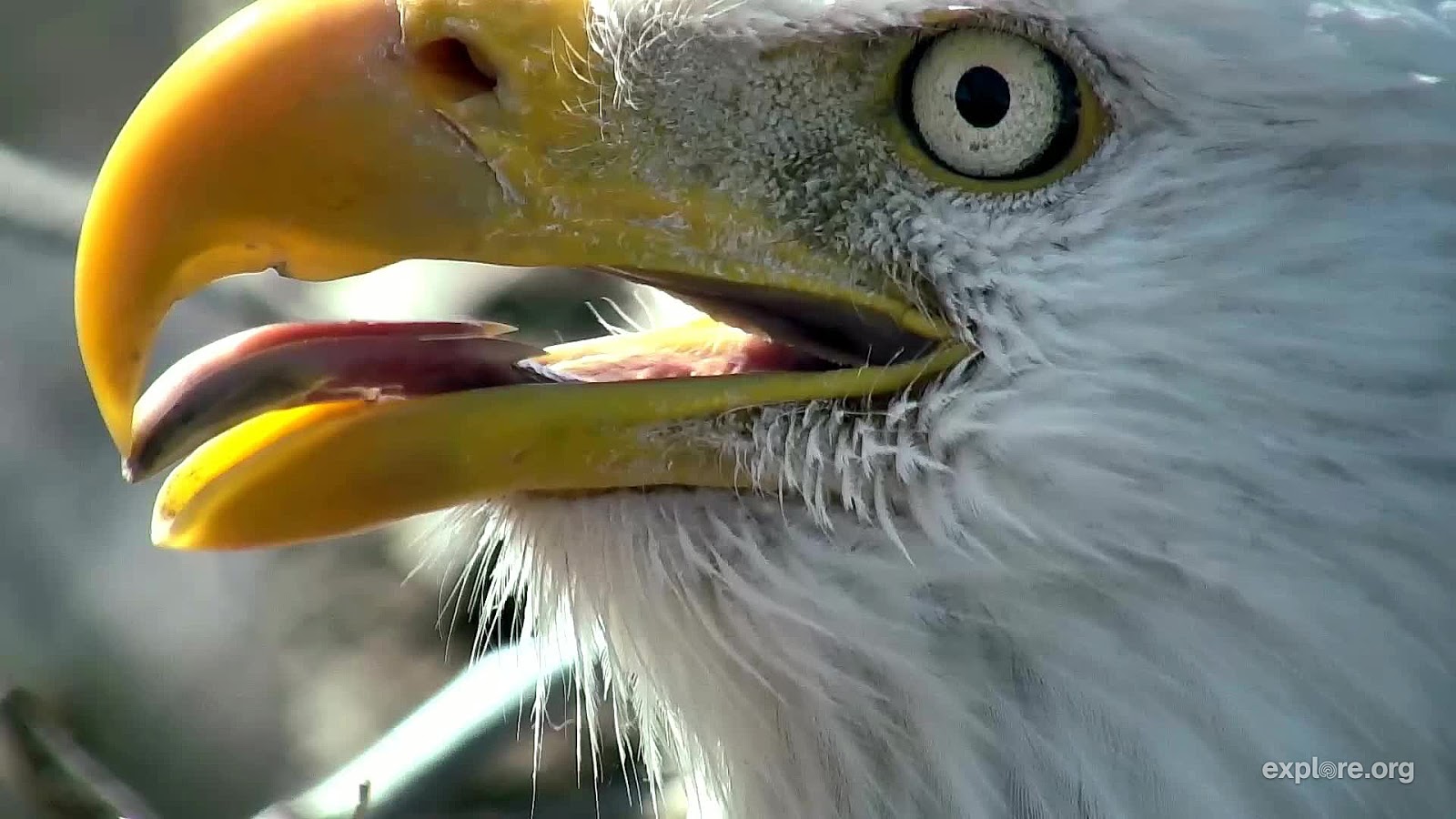
This blog was inspired by RRP Director John Howe, who was reviewing footage of Mom and Dad feeding eaglets and was delighted by the dexterity of their beaks and tongues. I had never blogged about that topic and it was very fun to learn about just how specialized some beaks and tongues are!

We know that bird beaks are specialized for feeding and daily tasks. Birds of prey have strong, curved beaks with sharp edges to help them tear meat. Falcons specialize even further, adding a tomial tooth to help them kill prey. Dabbling ducks have tiny, comb-like structures on their beaks to strain small animals, insects and plants from water and mud, while piscivorous ducks have saw-like structures to help them hold on to struggling fish. But what about bird tongues or, more specifically, bald eagle tongues? Are they specialized as well?

Let's start by taking a look at Mom and Dad's tongues!
Dad's Tongue


Mom's Tongue


At first glance, bald eagle tongues look somewhat similar to ours. They are pinkish, relatively narrow, fit nicely between the sharp ridges of their beaks, and are flexible. They are short enough that eagles can't easily bite their tongues, although they can stick them out. Unlike us, bald eagles have two barbs, or rear-directed papillae, to help lift and pull food items to the back of their long mouths: a relatively common feature in bird tongues.

Although birds of prey don't have specialized tongues, their tongues (and beaks) are packed with mechanoreceptors that respond to pressure, distortion (think of an eagle stretching its tongue or biting into bone), temperature, texture, and vibration. Merkel cells are sensitive to very fine changes in touch, pressure, and temperature. These tonic cells keep providing information to tell Mom and Dad exactly where their beaks and tongues are and what they are doing. Phasic Herbst and Ruffini cells sound an alarm to let Mom and Dad know that something has just happened. Herbst cells are sensitive to vibration, pressure changes (I grabbed or dropped an object), and texture changes. Ruffini cells are sensitive to stretching, distortion, and temperature (I just bumped something warm and hard like an eaglet's beak and mouth).

These sensors aren't evenly distributed throughout a bird's beak. While I couldn't find any studies on birds of prey, studies have been done on quail and ducks. Sensory cells in a quail's beak are distributed like this:

Cadual BeakMiddle BeakCranial BeakBeak TipCell Type
.95%014.28%3.8%Herbst
1.9%051.42%2.89%Ruffini
0012.38%12.38%Merkel

Bald eagles have considerably different diets and lifestyles than quail, but both ducks and quail concentrate sensors in the cranial areas of their beaks (think of a falcon's tomial tooth or Mom and Dad's tomial ridge). Once a bird has allowed something past the tip of its beak, it has a lot of decisions to make about how to respond to it and what to do with it. Given that quail and ducks are preccocial omnivores and bald eagles are altricial carnivores, I would love to see a study on bald eagle beaks.

Thanks to their beak blinders, bald eagles have a blind spot directly in front of them, which means they can't always see their young during feeding. So how do they select food, find the eaglets, and get food into their mouths? Immediate and ongoing sensory feedback helps parents and young align beaks, and tells new hatchlings to open their mouths wide for food delivery! Once both beaks are in the correct position, Mom or Dad use their sensitive, flexible tongues to carefully push food into the eaglet's waiting mouth. Changes in pressure, temperature, and texture help the eagles change course in mid-delivery, detect dropped food, find eaglets, and pull back as needed. Mom and Dad also use their tongues and beaks to detect and avoid feeding young hatchlings chunks of bone, large pieces of fur, or sharp fins that could cause them to choke.

How do Mom and Dad manipulate food so well? Check out the top photo, which shows a side view of Dad's tongue. We can clearly see that its fleshy tip rests on a muscular stalk. As described in Laura Erickson's excellent blog on bird tongues, this stalk controls Dad's tongue to manipulate food items. Dad can stretch and tip his tongue forward to feed eaglets, pull and tip it backwards to move food into his mouth, or move his tongue to one side or another as needed. His flexible two-stage tongue and rear-directed papillae give him incredible control, and the sensory cells packed into the tip of his beak and tongue provide the feedback he needs to feed eaglets...even when he can't quite see where they are. Annoyed with Mom or Dad over dropped food or missed beak-loading opportunities? Imagine trying to feed eaglets using your just tongue and nose! The video below shows just how delicate they are when it comes to feeding hatchlings.


Did you know? 
Bird banders can use the color of a bird's mouth and tongue to help age birds. Younger birds may have spots or bands to help parents with food targeting. Colored tongues in some adult birds can aid mating displays and/or signal a warning to other birds.

Understanding a species' behavior and diet helps us understand how its tongue and mouth evolved. Check out Laura Erickson's blog More About Bird Tongues Than A Normal Person Would Want To Know for a great look and description of some bird tongues! You know you want to learn more!

Things that helped me learn and write about this topic

Thursday, November 30, 2017

Bird kills, no 30-year take permit required!

An amendment from the House Committee on Natural Resources to House Energy Bill H.R. 4239 effectively guts the Migratory Bird Treaty Act by absolving oil and gas companies from responsibility for bird deaths in oil pits, on power lines, and from other energy-related infrastructure, including wind power projects. Are energy-related deaths really a problem for birds? Well, four of the Decorah eaglets that we know have been electrocuted and electrocution was the biggest source of mortality in Golden Eagles in a multi-year study recently published by the National Wildlife Health Institute, so we certainly think so. But beyond that, Audubon put together these figures:
Who needs a 30-year take permit under this law? NO ONE. Remember how angry everyone was about the 30-year take permit on bald and golden eagles? THIS IS WORSE. Phone your representative and add your voice to Audubon and the American Bird Conservancy's protests. You can use this tool to get contact information based on your zip code: https://callyourrep.co/. Do it now!  


While we're on the dismal topic of legislation that is bad for birds, here's a list of  bills aimed at the Endangered Species Act:

H.R. 717 by Rep. Pete Olson (R-Texas) would require consideration of the economic costs of protecting an animal or plant on the endangered species list and remove deadlines for completing the listing process. Deadlines assure completion of a process: removing them does the opposite.
  • The Endangered Species Act provides many exceptions and alternatives to allow economic growth within the framework of environmental protection. Between 1998 and 2004, less than one percent of the 429,533 development projects that underwent Section 7 consultation were temporarily put on hold. Only one project could not proceed; the rest were implemented after modification. Removing the deadlines for completing the listing process will allow opponents of listing to prevent it through endless rounds of comment submissions and information stonewalling. 
H.R. 1274 by Rep. Dan Newhouse (R-Wash.) would automatically deem any information submitted by a state or local government to be the “best available” science even if such information were contradictory, out-of-date or fraudulent, weakening the listing process for endangered species. Your voices will become less significant than the voice of state and local governments in decisions involving the listing of endangered species.
  • Under present law, the service considers any information submitted on the biology, distribution, or threats to the species when making their decisions. When we asked you to comment on the 30-year take proposal in 2016, we did our best to provide you with scientifically accurate information - the same information that we used in our own comments. Although their decision wasn't perfect, your input helped to improve it. Under the proposed law, your comments won't be weighted as heavily as the comments of state and local governments, whether those comments are accurate and truthful or not. 
H.R. 3131 by Rep. Bill Huizenga (R-Mich.) would hamper citizen enforcement and participation in the implementation of the Act’s provisions. Undercutting the ability of citizens to bring lawsuits would make the agency more prone to improperly consider politics in its listing decisions and prevent imperiled species from receiving protections in a timely manner.  Citizen suits are the primary mechanism by which the ESA is enforced against government agencies and private entities.
  • A real-life example: Citizen suits have required the EPA to conduct scientific assessments and make effects determinations for numerous pesticides, thereby protecting animal and human health. You can learn more about that here: https://www.epa.gov/endangered-species/endangered-species-litigation-and-associated-pesticide-limitations. These assessments happened only after the lawsuits were brought.  
  • Another real-life example: In Beech Ridge, the Animal Welfare Institute and other environmental groups brought an ESA citizen suit against Beech Ridge Energy LLC, a wind project developer in West Virginia. The project was found to violate the “take” prohibition in ESA section 9 with respect to an endangered bat, resulting in restrictions on the timing and duration of the wind turbine operation. Their actions helped protect an endangered bat and the project was still able to move forward, albeit with some restrictions. https://awionline.org/cases/protection-indiana-bats.
  • Speaking of wind turbines, the American Bird Conservancy and the Black Swamp Bird Observatory filed a citizen suit regarding the installation and operation of a wind turbine at Camp Perry, which is sited in a major bird migration corridor, is located in close proximity to numerous bald eagle nests, and is likely to kill species protected under the Endangered Species Act. Construction on the project was halted (and yes, we signed their petition): https://abcbirds.org/article/bird-conservation-groups-win-fight-great-lakes-wind-project/
H.R. 2603 by Rep. Louie Gohmert (R-Texas) attempts to limit the Endangered Species Act’s provisions for exotic game species that have been imported into the United States for trophy hunting. If taken literally, this legislation would remove the need for conservation permits of exotic game species, eliminating a critical funding source for overseas conservation of those very species. Removing or limiting oversight for the importation of live exotic animals is a bad idea given how easily exotics can become invasives.
  • This bill addresses the importing of live exotic game species into the United States for hunting. For example, zebras are imported into the United States for hunting in Texas, Mr. Gohmert's home state. You can also hunt the scimitar-horned oryx, gemsbock, kudu, bongo antelope, addax, wildbeest, and so on. While some people find trophy hunting distasteful, it is legal, the ranches have helped conserve very rare species (some of them claim to have the only populations of these species in the world), and the required conservation permits help fund overseas conservation. However, H.R. 2603 removes the need for conservation permits, taking away funding and oversight. Given how rare some of these species are, and how easily exotic species become invasive species - take a look at the "Snow Monkeys of Texas" for an example - both things are needed. I recommend starting with this article to learn more about exotic animal hunting in the United States. 
H.R. 424 by Rep. Collin Peterson (D-Minn.) would reinstate a 2011 decision by the U.S. Fish and Wildlife Service to remove federal protections for gray wolves in the western Great Lakes states. In 2014 a federal judge found numerous scientific and legal deficiencies with that 2011 decision and brought back protections for gray wolves. The legislation would invalidate the court opinion and preclude all judicial review into the future.
  • Why does this have to do with birds, or anything other than gray wolves? H.R. 424 is seeking to overturn a federal judge's ruling that the original 2011 decision was flawed legally and scientifically. But nothing precludes anyone from calling for removal of the gray wolf again - it isn't a system where listing or delisting can only be required once. This bill sets a process for completely ignoring standards by overturning decisions through the legislative process. If it wins, the process - which circumvents the Endangered Species Act  - will be applied in other laws to other species. 
Again, we encourage everyone to call their representatives and stand up for the Endangered Species Act! You can use this tool to get contact information based on your zip code: https://callyourrep.co/. The American Bird Conservancy also has an ESA petition tool here: https://abcbirds.org/action/petition-esa/

Friday, November 17, 2017

Eagle eyes!

Has anyone ever called you eagle-eyed? Relative to humans, bald eagles have larger, sharper eyes that see further, collect more details, and produce stereoscopic vision to greatly improve depth perception.

A bald eagle's visual acuity begins with its eye size and shape. Dad's somewhat tubular eyes occupy over 50% of the volume of his skull, as compared with less than 5% in us spherically-eyed human types.  He can voluntarily adjust the curvature of his large cornea and lens (we're restricted to involuntary adjustments of our relatively smaller lenses only), which lets him rapidly change focus and increases the size of images reflected on to his retina. His two-lens system functions very similarly to a pair of binoculars, letting him see small objects in great detail at a distance and changing focus quickly as he flies - extremely important when hunting for squirrels, avoiding tree limbs, and locking talons with other eagles!
Eagle Eye Versus Human Eye. See end of blog for note.
The differences don't stop there. Our retinas would die without blood vessels, which supply oxygen but also scatter light and cause blind spots or shadows since light isn't reflected through them. But Dad's retinas don't have blood vessels! A pleated structure called the pecten supplies oxygen to Dad's eyes, preventing blood vessel-related light scattering and blind spots, and leaving more room to pack in light-sensitive rods and color-sensitive cones. In short, Dad's lack of retinal blood vessels enhances his visual acuity and ability to resolve detail. Large, razor-sharp images are reflected through his cornea and lens on to a much denser, clearer field of photosensors than our retinas have. How much denser? According to Keith Bildstein, the cone density of birds of prey is roughly 5 times greater than that of human beings. Dad sees farther than us, focuses better than we can, and collects more visual information about the world around him with his HD retinas!

Not enough visual acuity for you yet? Dad has two deep foveae compared to our single shallow one.  His more densely packed and deeper central foveae function in monocular vision, while his forward facing temporal foveae function in binocular vision. A densely cone-packed trench - Helen McDonald refers to it as a sort of smeared third fovea - connects Dad's central and temporal foveae, which helps him track moving objects as he switches from one mode of vision to the other, and lets him scan the horizon without moving his head. He can also fuse images from both foveae to produce a virtual reality-like stereoscopic image, which greatly improves his depth perception and ability to lock on objects. When Dad cocks his head sideways and looks skyward with one eye, he is using his monocular vision and his central foveae to scan for movement. When he looks forward intently, he is using his binocular vision and his temporal foveae to bring whatever he's looking at into sharp focus. Watch for those behaviors in the nest!

To create a 3-D'ish stereoscopic image, click on this image to enlarge it.
Cross your eyes until a third image forms between the left and the right image.


So given that Dad's visual system combines image detectors, tracking devices, binoculars, high-definition cameras, and virtual reality headsets, how far can he see? Accounts differ, but we've watched Mr. North respond to a squirrel in his nest from 550-600 feet away with no problem at all, and we've seen eagles at both nests respond to nest intruders long before they come into our view. Sources suggest that bald eagles can resolve:
  • A 2-millimeter insect from 18 meters away
  • A mouse from 446 feet away
  • An ant from the top of a ten-story building
  • The faces of basketball players from the back of a large arena
  • A rabbit from over three miles away
As if that weren't enough, Dad also sees more colors than we do! In addition to perceiving red, green, and blue, a fourth cone allows him to see into the ultraviolet spectrum. Drops of oil in each cone selectively filter out certain colors, giving Dad greater sensitivity to different color shades and allowing him to see polarized light. These adaptations allow him to see the urine trails or prey, signal mate health, and may help him navigate as well. 

Helen McDonald states that Dr. Andy Bennett, a researcher in the field of avian vision, considers the difference between human vision and bird vision as that between black-and-white and color television. Bald eagle eyes see a world that is brighter, sharper, more colorful, and far more detailed than our own. I wish I could see like they do!

Did you know?
Bald eagles have three eyelids! Their clear nictitating membrane helps keep their eyes free of debris while they are flying. A specialized gland associated with the membrane produces an antibody (lysozyme) that helps keep their lens free of infection.

Despite these advantages, bald eagles have one big disadvantage - a blind spot directly in front of them. I was not able to find any information about the size of the spot, but it is most likely increased by their relatively prominent brows and large beaks. We've seen them hit one another - and in Dad's case, the tree trunk! - and this might also be another reason why collision-based trauma is a leading cause of death for bald and golden eagles. 

We can't see stereoscopically like bald eagles can unless we trick our eyes! You can learn more about stereoscopes here, or check out a video of images here!

Things that helped me learn and write about this topic
If you have a bird-lover in your life, I highly recommend the top two books
Note: The image of the eagle's eye that I used can be found at several websites, including learner.org. However, it looks a little bit more like an owl's eye to me. Having said that, I'm not an expert and eagles and owls have fairly similar eyes, so I decided to use it.

Friday, October 20, 2017

What's on the menu at Fort St. Vrain? An exploration of nest remains, part II

The last time we blogged about prey remains from Xcel Energy's Fort St. Vrain bald eagle nest, we talked about mammals. This time, we're going to explore fish and turtles! In all, we found 35 fish remains, seven prairie dog skulls and one foot, one desert cottontail skull, one common muskrat skull, three western painted turtle shells, and some unknown vertebrae. Even in a relatively dry environment, the eagles show a clear preference for fish. Our aquatic remains included:
  • seventeen opercular bones (eleven left and six right, from at least twelve different fish)
  • eight preopercular bones 
  • one otolith 
  • four skull tops 
  • five skull fragments, and; 
  • three turtle shells. 
So what are opercular bones and otoliths? The operculum, which includes the preopercular and opercular bones, is a series of bones found in bony fish that serves as a facial support structure and a protective covering for the gills; it is also used for respiration and feeding.

The opercular series. Nine/yellow is the opercular bone. Six/red is the pre-opercular bone
Otoliths are a calcium carbonate structure in the inner ear of vertebrates. They act as gravity, balance, movement, and directional indicators in all vertebrates, and have a secondary function in sound detection in higher aquatic and terrestrial vertebrates, including fish. Vertebrates have three pairs: the astericus (Ast), lapillus (Lap), and sagitta (Sag). Many fish can be identified to genus and species by their sagittal otoliths but alas, we found only one!


At least we had several opercular bones. While we couldn't use them to determine genus and species, they could determine the size of the fish the eagles were bringing in. Several papers document a close relationship between the size of the opercular bone and the total length (from nose to tail) of the fish. I chose Hostetter and Munroe's 1993 paper Age, growth, and reproduction of Tautoga omtis, which used the formula log10 TL = 1.2916+0.860 log10 OR for males. The paper meticulously documented Hostetter and Munroe's methodology and results, which were used in subsequent studies of several fish species. It was also well-cited and required nothing more than a dial calipers, intact opercular bones, and a good calculator - three things I had on hand!

I used the dial calipers to determine Opercular radius (OR). which Hostetter and Monroe define as the distance from the articular apex center to the midpoint of the posterior margin of the opercle. It looked something like this...

Opercular and preopercular bones of our largest fish. 
I ran my measurements through the formula log10 TL = 1.2916+0.860 log10 OR to obtain the lengths below (more on that at the end of the blog). While we collected 17 bones, only 14 were intact enough to use.
ORTotal lengthNumber/side
61mm26.3" / 668.02 mm1 / left
47mm20.9" / 530.86 mm1 / left
46mm20.6" / 523.24 mm1 / right
43mm19.4" / 492.76 mm2 / both left
42mm19.0" / 482.60 mm2 / both right
41mm18.6" / 472.44 mm2 / left, right
40mm18.3" / 464.82 mm3 / left, right, left
34mm15.9" / 403.86 mm2 / both left

While I was impressed by the largest fish, it was a real outlier. The average fish size was 19.0" - a nice size at just a little over 1-1/2 feet long. So what kind of fish would they be likely to be and how heavy might they have been? I checked out a fishing report for the St. Vrain state park and emailed the Laughing Grizzly fly shop to find out! Given the size of the fish and the stretch of the river, Mike suggested either sucker or bass, with the outlier possibly belonging to a carp. Their length/weight profiles look something like this:
  • Common Carp: 16 to 26.5 inches at 2 pounds to 10 pounds
  • Largemouth Bass: 16 to 25 inches at 2.4 pounds to 9.10 pounds
  • White Sucker: 16 to 20 inches at roughly 4 to 6 pounds 
  • Longnose Sucker: 15-25 inches at 1 to 2 pounds (although Montana's field guide states that the largest can be around 5 pounds and fish of up to 7.3 pounds have been reported)
In addition to sizing fish, opercular bones can also be used to age fish. Like trees, they produce annular rings that can be counted once the bones have been cleaned and held up to a strong light. However, I was confused by the age of my fish. Almost every opercular I counted yielded an age of four or older, with several between six and nine years of age and the oldest (the outlier) about fourteen. I hadn't expected my fish to be as old or as big as they were. Was I counting wrong? What was going on?

Operculars. Mr. Big is at left. It was the oldest and the largest opercular bone.
As eagle cam watchers might recall, sucker fish rise in the spring and early summer to spawn on gravel beds and sand bars. Every year, Dad Decorah and Mr. North haul in suckers by the dozens once the run starts, sometimes bringing in more than one at a time! However, Longnose Sucker don't become sexually mature until they are between five and nine years of age, while White Sucker don't reach sexual maturity until they are three to eight years old. This means that spawning suckers are a minimum of three years old at spawning, and could easily be older. Finally, my large old bones make sense! Do we know that these fish are suckers? No - but age and size as determined by the opercular bones fit the species, especially given the presence of suckers as identified by local fishing guides, their age at sexual maturity, the amount of sand and gravel bars in the area, and the seeming preference of eagles for suckers when given the choice between suckers and, say, trout. Bob would love this, since he theorized back in 2012 that sucker fish spawning could be the Midwest's equivalent of a salmon run when it comes to protein sources for eagles and other animals that eat them. We'll be watching closely during the spawning season in 2018 to see if we can identify the fish that Ma and Pa FSV bring in! (Amy's note: There were two very distinct shapes of opercular bone, which makes me think that at least two different species were brought into the nest. One was rounded [Mr. Big and several of the others], while the other was more angular).  

Of course, fish weren't the only aquatic animal the eagles brought into the nest. We also found three turtle shells. Alan Resetar, the McCarter Collections Manager for the Chicago Field Museum's Amphibian and Reptile Collection, identified them as spiny softshells (Apalone spinifera). This was very helpful, since I originally thought they might be western painted turtles or small snapping turtles. He also provided a link to this guide for identifying turtle shells and remains: http://fieldmuseumlibrary.worldcat.org/title/turtle-atlas-to-facilitate-archaeological-identifications/oclc/35793760. Take a look at the picture below, which clearly illustrates how the spine and ribs are fused to the shell, giving turtles their distinctive walk.

The underside of a turtle's shell 
So what did we learn? Collecting prey remains from the Fort St. Vrain nest gave us a couple of unexpected insights. As dry as the area is, aquatic animals (especially fish) are still an important part of Ma and Pa FSV's diet - something we didn't expect. The spiny softshells were a surprise, since they are at the extreme western end of their range. And like the Decorah and Decorah North eagles, the Fort St. Vrain eagles appear to take advantage of the spring sucker run, which comes at a very timely point in the lives of their young! While some specific prey details are different (prairie dogs!), the remains we found fit within the larger framework of bald eagle behavior - getting the most food for the least amount of effort and risk expanded. Benjamin Franklin famously called bald eagle behavior lazy, but it takes experience and intelligence to know where and how to find food, especially in a beautiful but unforgiving place like Colorado's Front Range.

Xcel Energy, thanks for all of your hard work and support. You are wonderful eagle and falcon friends, and I look forward to collecting prey remains from Fort St. Vrain next year! I was quite fascinated by this nest, which is much drier and 'stickier' than our Iowa nests. The lack of humidity means that materials don't tend to compost in the nest, although the eagles still prepare the area under the nest cup and strip bark from the sticks they bring in. We have three eagle nests to watch in Iowa and Colorado. What can we learn from their differences and similarities? We look forward to finding out!

Did you know?

I wish we found more otoliths, since researchers are using them to model climate impacts: https://blog.csiro.au/fish-ear-bones-point-to-climate-impacts/. I am hoping to send our fish and mammal collection to the Field Museum in Chicago!

Most of the fish we found were within the carrying capacity of Ma and Pa FSV. Under standard conditions, Bald Eagles can lift and carry around 60% of their body weight, and in some circumstances they can carry more! A link: https://raptorresource.blogspot.com/2015/11/how-much-can-bald-eagle-carry.html


Things that helped me learn and write about this topic:

Thursday, March 23, 2017

What's inside those bald eagle eggs?

It is 31 days since egg number one was laid in Decorah, 32 days since egg number one was laid at Decorah North, and 36 days since egg number one was laid in Fort St. Vrain. We are starting hatch watch for Fort St. Vrain on Saturday, Decorah North on Sunday, and Decorah on Monday. The embryonic eagles are either in or approaching their final stages of development now, but what did they look like as they developed and grew inside their eggs?

Dr. Peter Sharpe from the Institute for Wildlife Studies developed a table of bald eagle embryonic development based on work done by Hamburger and Hamilton (1951). While not all bald eagle eggs hatch in 35 days, the stages of development look something like this...

Development of a chick, drawing from Frank Lillie photos. Artist William Sillin
From 0 to 4 days: A single cell is formed by the union of sperm and egg. It divides into multiple cells and forms layers. Head and tail are established, the emerging embryo divides into blocks called somites, and basic life support structures begin to develop, including the nervous system, skin, circulatory system, gastrointestinal system, and optical system.  The embryo turns onto its left side. Its heart begins to beat roughly 72 hours after incubation begins.
Chicken embryo at roughly two days incubation: equivalent to an eagle at about 3.5 days
At four days of age, the embryonic eagle doesn't look anything like a bird, but it has inside and outside layers, it can transport materials through its developing circulatory system, and its nervous system has an anterior-to-posterior template in place. The brain and nervous system will continue to grow and change, but the stage is set for the development of a skeletal system, limbs, a beak and tongue, foot and wing digits, and organs. 


From 3.5 to 9 days: The amnion closes, sealing the developing embryo inside the egg's innermost membrane. The allantois forms to sequester liquid waste and exchange gases through the porous eggshell. Wings, tail, and leg buds form. Eyes develop pigment.  Leg buds grow larger than wing buds and limbs begin to form. Elbow and knee joints are distinct by roughly 8 days and digital grooves - the precursors of toes and wing structures - are distinct by roughly nine days. The embryo's beak and tongue begin to form.
Chicken embryos roughly 23 to 25% of the way to hatch
At nine days, the minute embryonic eagle is about 25% of the way to hatch and still doesn't look especially birdlike. It has a head, eye pigmentation, stiff differentiated limbs, the beginnings of a beak, rudimentary digestive organs, and a defined sex. The stage is set for further organization as the embryo develops an egg tooth, true eyes, and feather germs. 


From 11 to 17 days: The egg tooth and two scleral papillae form on the 11th-12th day. Limbs are bent. Dorsal feather germs form on the 12th day. A nictitating membrane is visible on day 13. Ventral feather germs develop, the eyelids begin closing, and flight feather germs develop. 

A chicken embryo roughly 50% of the way to hatch
At 17.5 days, we are roughly halfway to hatch. Our embryo's head is disproportionately large, but it is definitely a bird. It has a beak, distinct toes, bent limbs, and eyes that take up most of its head. Its eyes and eye cavities aren't done forming and it needs to develop scales, nails, rough pads and spicules, and down feathers. Its yolk sac and small intestines are still outside its body cavity, and it has a lot of growing to do!


From 18 to 23 days: Leg scales, tiny talons, and plantar food pads appear. The eyelids are almost closed and the eyes are no longer quite as large in proportion to the rest of the head.

We are 65% of the way to hatch! Other than the closing of the body cavity, most major morphological changes are done. The eyelids will close, the eyes will grow into their sockets, the eaglet will develop natal down, it will internalize its egg yolk sac, its body cavity will close (leaving behind an egg yolk sac scar) and it will position itself for hatching! 

So what happens right before hatch? Just a few days from external pip, the rapidly growing embryo is taking up nearly all the space in the egg. It...
  • Turns so that its head is at the large end of the egg next to the air space.
  • Pierces the internal membrane - the internal pip - and begins to breathe air with its lungs. Hatch has started!
  • Takes the yolk sac into its body as it consumes most of the remaining albumen and yolk. 
  • Grows enough to contract the hatching muscle, pointing its head up and positioning its egg tooth against the shell of the egg. The eggshell is thinner and weaker than when it was laid, since the growing embryo absorbed calcium from the shell for its bones. 
  • Rubs its egg tooth against the shell, which cuts a small hole. We have an external pip!
  • Rotates its body, slowly cutting a ring around the shell.
  • Pushes its body against the shell, forcing the shell apart.
  • Works itself free of the shell membranes and halves. The eaglet has landed and hatch is complete!
We are looking forward to hatch later this week! Curious about what's in store? Watch this 2015 video of the very final stages of hatch in N2. 


Illustrations were taken from Popular Science Monthly/Volume 71/September 1907/The Problem of Age, Growth and Death III:  Link. Thanks to artist William Sillin for allowing us to use his lovely illustrations: http://www.willsillin.com/ (check it out - his illustrations are very cool!). Also take a look at this cool plate by Keibel and these lovely photos of chicken embryos: http://www.microscopy-uk.org.uk/mag/artnov04macro/mlchicken.html.

Things that helped me learn about this subject:

Tuesday, March 21, 2017

Body plans and BOP shapes

Since we are watching bald eagles and peregrine falcons, I wanted to talk a little bit about body plans and their influence on flight, hunting, and prey base. As watchers know, eagles are soaring generalist hunters that eat almost anything they can sink their talons into, while peregrine falcons are energetic, acrobatic flyers that specialize in catching birds in the air. Both are birds of prey, but their body plans and wing shapes result in very different lives.

Body plans, size, and flight
With their long, broad, slightly rounded wings, large wing slots, and broad, wedge-shaped tails, bald eagles are built for soaring. They hold their wings flat and save aerial acrobatics for hunting and encounters with other birds. While tail winds and thermals aren’t absolutely necessary for eagle flight, their migration corridors and styles take advantage of both. Thermal winds are powered by sunlight, which means that eagles migrate during the day. They also tend to prefer wind corridors, including ridgelines and funnels that concentrate and amplify wind – think of the cliffs of the Mississippi river or the tight river valleys and ridges of NE Iowa. A stiff tail wind will send migrating eagles aloft in their thousands, especially over surfaces with little opportunity for thermal soaring. The Bald eagle body plan and low-aspect wings - large, broad wings relative to its overall surface area - is most suited to low-angle, low-energy soaring flight.

Unlike bald eagles, Peregrine falcons are built for speed and maneuverability. They have long, narrow, pointed wings and long tails shaped for diving, twisting, and turning in flight. Where eagle flight is flat, peregrines often fly in a series of arcs as they dive, dash and pursue other birds in flight. The peregrine body plan and high-aspect wings - narrow, pointed wings relative to its overall surface area - is most suited to high speed, energetic and often acrobatic powered flight.

Bald eagle silhouette
Peregrine falcon silhouette

Although I don't confuse falcons and bald eagles, I often find body plan and flight style to be very helpful in identifying similarly-sized birds of prey at a distance. Is it large and flying flat, holding its wings in a vee and tilting as it flies, or M-shaped? If you are in northeastern Iowa, the first is probably an eagle, the second is probably a turkey vulture, and the third is probably an osprey. Are the wings large or small in proportion to the rest of the bird? Are its wings pointed or rounded? Is its tail long or wedge-shaped?  Is it flapping and gliding, diving, hovering, or quartering low over a field? Did you see it in the woods or in the open? Body plan, behavior, and habitat are very helpful in identifying birds of prey, especially at a distance.

Silhouettes of birds of prey in flight from learner.org: http://www.learner.org/jnorth/tm/HawkPrimer.html
Body plans, hunting, and prey base
In general, all birds of prey have keen vision, talons, and curved beaks to help them hunt, kill, and eat prey. But not all beaks, talons, and hunting styles are the same. The peregrine falcon’s speed and maneuverability makes it uniquely suited to catching birds in flight, while a bald eagle’s size, strength, powerful feet, and long talons make it an excellent generalist hunter. Both birds take full advantage of their very different body plans when it comes to catching and eating prey.

A peregrine's high speed, high angle dive
A bald eagle's lower speed, lower angle flight


A peregrine falcon’s speed and maneuverability allow it to fly high, dive steeply, and hit prey so hard that the force of impact severs its prey’s spinal cord. A peregrine begins its dive by rolling, cupping its wings around its body, and tucking in its feet, yielding an aerodynamic raindrop that slices through the air at high speeds.  Special cone-shaped bones in its nostrils – an adaptation unique to peregrine falcons – allow it to breath while diving at speeds of over 200 miles per hour.  As the falcon approaches its prey, it extends its feet, brakes sharply, and snatches it out of the air with its long, slender toes and sharp talons. If hitting a bird doesn’t kill it, peregrine falcons use their tomial tooth – a special notch in their beaks that bald eagles don’t have – to sever their prey’s spine. While a peregrine’s feet are strong and quick – great for grabbing and slashing attacks – they don’t have the crushing strength of a bald eagle and their diet is largely restricted to other birds. 

A bald eagle’s large size, soaring flight, and strong feet help it to take a wide variety of prey, although its speed of attack is slower, its angle of attack is lower, and it usually kills prey with its feet. As we’ve seen at the fish hatchery, Mom and Dad swoop shallowly over the retaining pond, braking heavily as they plunge their feet into the water and pull out trout. Without stopping, they fly into a tree, on to the bluff, or into the nest, crushing or stabbing the trout with their powerful feet and sharp talons. Although they have special adaptations called spicules – rough bumps that help them grip slippery fish - bald eagles don’t specialize in any one kind of prey, and their size, strength, powerful feet, and fishing ability give them access to an extremely wide prey base.

Again, falcons and eagles are very different and I don't confuse the two, even at a distance. But understanding how body plans influence birds is useful to understanding their lives and identifying them in the field. I find it to be more helpful overall than looking for hard to see features, especially if a bird is far away. 

Hashtag #musing: could body plans impact gregariousness? Off their breeding grounds, bald eagles are quite gregarious. Their flashy colors, large, visible body plans, and wind-seeking behavior often bring them into proximity with other eagles. Eagles compete (think piracy and kleptoparasitism) but they also eat a wide variety of prey and often benefit from following other eagles when searching for food. As far as we know, peregrine falcons are loners. During migration or following dispersal, there can be multiple peregrines in a site with an abundance of food. However, they aren’t gregarious. Perhaps their more solitary behavior is driven in part by a body plan that results in a restricted prey base (leading to serious food competition), no real benefit to stealing or attempting to steal food, and less congregation around important dynamic and thermal soaring points.

Did you know?
A turkey vulture "V" is more correctly referred to as a dihedral. Turkey vultures are masters of soaring without flapping as they ride the wind in search of carrion. How do they do it? As wind strikes one wing or another, tipping the vulture right or left, one wing tips high and the other tips low. Wind flows under the low wing, pushing the vulture and righting it until it tips again. This allows them to exploit the smallest of air currents as they soar lowly and slowly through the sky. While they sacrifice some maneuverability, their food - carrion - doesn't require agility to catch.

Harriers also engage in dihedral flight, but their food - small mammals, reptiles, amphibians, and birds - requires considerably more agility. Compare their body plan with that of a turkey vulture. Dihedral flight allows them to soar very slow and very low, but they have a long tail and wings more like a falcon, which helps them roll and twist when needed. Harriers are a very interesting bird of prey: visit Cornell's website to learn more about them! https://www.allaboutbirds.org/guide/Northern_Harrier/lifehistory

And finally, I've seen some interesting conundrums when people compare birds to aircraft. Remember that aircraft can't change their shape to respond to wind conditions or the need to rapidly change position. But birds can and often do change shape as they fly! I chose silhouettes that I thought best represented each bird overall, but birds might adopt different flying styles under different conditions, even if they can't change their overall body plan.

Things that helped me learn about this topic

Friday, January 20, 2017

Endangered Species Act Under Threat From Congress

"When the last individual of a race of living things breathes no more, another Heaven and another Earth must pass before such a one can be again" - William Beebe

Dad Decorah near N2B
What is the Endangered Species Act? Signed into law by President Nixon in 1973, the ESA is the strongest and most important federal law protecting imperiled wildlife and plants. It has prevented hundreds of species from going extinct since it was enacted. Do you enjoy watching Mom and Dad Decorah or any other eagle families? Although they are no longer endangered - protections under the Act are supposed to recover species - the banning of DDT and the passage of the Endangered Species Act was critical to their survival.

Now the Endangered Species Act is under threat from some members of Congress, who see a chance to roll back its influence. “It has never been used for the rehabilitation of species. It’s been used for control of the land,” said House Natural Resources Committee Chairman Rob Bishop. “We’ve missed the entire purpose of the Endangered Species Act. It has been hijacked.”

Bald eagles, peregrine falcons, brown pelicans, California condors, whooping cranes, Puerto Rican parrots, and spotted owls beg to differ with Congressman Bishop's assessment, as do grizzly bears, several species of whales, southern resident orcas, sea otters, gray wolves, and manatees. Unfortunately, recently extinct Carolina parakeets, ivory-billed woodpeckers, passenger pigeons, eskimo curlews, and dusky seaside sparrows are gone forever and thus unavailable for comment.

Peregrine falcon at Xcel Blackdog power plant
I had the privilege of visiting Chicago's Field Museum during a peregrine conference three years ago. Attendees were given a behind-the-scenes tour of the museum, including a look at their vast bird collection - lovingly preserved corpses of birds kept for study and remembrance. It was there that I got my only look at the Carolina parakeet and the ivory-billed woodpecker. Gone forever from life, the two species now exist only as study skins in museums. Had the United States not banned DDT and passed the Endangered Species Act, it is highly likely that peregrine falcons, bald eagles, and many other animals would have joined them, existing only as museum specimens and curiosities on film. However cherished their memories or lovingly preserved their corpses, they too would be gone, dead, extinct, lost. Forever.

Imagine life without them. I can't stand the thought.

Looking for proof of the Act's success? The Center for Biodiversity conducted an exhaustive analysis of bird recovery under the Endangered Species Act and found it has been extraordinarily successful in recovering imperiled birds. Eighty-five percent of bird populations in the continental United States increased or stabilized while protected by the Act, and the average population increase was 624 percent. It was believed that listed bird populations would need 63 years to recover, but several populations (including bald eagles and peregrine falcons) have recovered far more rapidly than expected. As mentioned earlier, peregrine falcons and bald eagles have both been removed from the list.
Dan Berger's notes. All of the Peregrines east of the Mississippi in the
surveys he made in the 1950s and early '60s. Not an exaggeration...this was it.
Habitat/land has long been part of the argument against the Endangered Species Act. Those who oppose the act tend to cite the subjection of humans to land use regulation; the restriction of activities like farming, lumbering, construction, and mining, and the lack of compensation to landowners impacted by endangered species. But there are also many untruths in their arguments. Contrary to their arguments:
  • The Endangered Species Act has recovered species.
  • Landowners won't lose their homes because an endangered species is on their property. 
  • Conservation groups and biologists do not just want money from the federal government. Folks, I have to tell you - conservation is the wrong field if your goal is money!
  • It does not kill jobs. Section 7 of the US Endangered Species Act (ESA) directs federal agencies to help conserve listed species. One way it does this is by requiring agencies to consult with the US Fish and Wildlife Service and National Marine Fisheries Service to ensure that proposed federal actions won’t threaten a listed species’ survival. Between 2008 and 2015, 81,461 projects advanced without protections for wildlife, 6,382 advanced requiring only minor modifications for wildlife, 2 advanced requiring protections, and 0 were stopped. This seems to indicate that ESA could work even more effectively than it does now.
I don't understand the argument against preserving habitat. Animals can't live without it and so much is already gone. Why is it considered bad to preserve the 10% of Iowa that isn't under till? Or the Boundary Waters Canoe Area, which covers just 1.9% of Minnesota's total area? Does it really all need to be mined, timbered, and torn up for profit?

I believe in public/private collaborations such as ours and this shining example - how could I not, with what Bob called our 'unique marriage between industry and conservation'? I've seen the power that these relationships can have to secure habitat, change perceptions, and help species. But legislation and enforcement are also necessary, and the reforms being proposed right now are aimed at the destruction of the Act, not its betterment. For the sake of the birds we watch and love, please stand up and say "No" to any attempts to weaken or repeal the Endangered Species Act. We will be following and blogging on this issue and the issue of public land transfer.

Things you can do:
You are welcome to take anything from this blog and re-use it in a letter, email, or editorial. Keep your tone respectful and remember that conservation is not and should not be a partisan issue.  But please comment! Bob always believed that we can make a difference. Let's prove him right.


Resources
Public land is understandably a far hotter issue in the western United States, where the federal government owns vast tracts of land. But even there, groups like Sportsmen's Access, Backcountry Hunters and Anglers, and the Theodore Roosevelt Conservation Partnership are fighting for public land. I get upset email on our support for hunting and fishing, but I encourage people to take a look at what these groups and others like them are doing to support public lands. They are also an important reminder that conservation isn't, in the words of the Theodore Roosevelt Partnership, red or blue.

It has also been pointed out to me that bald eagles and peregrine falcons live pretty comfortably with humans. But not all species can live as comfortably with humans as bald eagles and peregrine falcons do. Do species that can't matter less than those that can?

And finally, the struggle to preserve wildlife and wildland is, in my opinion, an absolute necessity for our own survival. If they don't make it, we won't either. We aren't an exception to the requirements of clean air, clean water, and habitat, and humans and animals are in this glorious, lovely mess called life together.

Wednesday, January 11, 2017

National Save The Eagles Day!

How many readers remember their first sight of a bald eagle? I saw my first bald eagle flying along the Mississippi river near Minneapolis, MN. This was back before cell phones and cameras, so I had to wait to get home to tell my husband and call my Mom. I was so excited!

My children don't remember when bald eagles were rare. Like children will, they sometimes roll their eyes or sigh when I get excited about eagles today. When my middle son counted bald eagles and crows on a peregrine survey last March, he counted many more eagles than crows. They soared over Lake Pepin, perched on trees, sat on rapidly melting ice, and kettled over bluffs, driving the local peregrine falcons crazy. I pointed out how fortunate we were to watch one formerly endangered species duking it out with another on a sunny spring day: a moment that very nearly didn't happen since both species were perched on the brink of extinction just fifty years ago.

Persecution, habitat loss, and the pesticide DDT nearly wiped eagles and falcons out. From a population of hundreds of thousands, bald eagles were whittled down to 412 breeding pairs by the 1950s. The peregrine falcon declined even more precipitously. By 1970, the peregrine was extinct east of the Mississippi and there were only 39 breeding pairs left in the lower 48 states, period. What was going on? Researchers found that the widely used pesticide DDT was causing bald eagles and peregrine falcons to lay eggs so thin that they cracked under the weight of incubating parents.

While eagles were already protected by the Lacey Act, the Migratory Bird Treat Act, and the Bald and Golden Eagle Act (read about them here), it was clear that more was needed to save the eagle from extinction. The newly created Environmental Protection Agency banned DDT in 1972 (read more about that here) and Congress passed the Endangered Species Act in 1973. The Act was signed into law by President Nixon on December 28, 1973. I was seven years old and had never seen a wild bald eagle or peregrine falcon despite living and vacationing in what was once prime territory for both of them. I can't stress this enough: they were gone.

As Trip Van Noppen points out in his article on the subject, "Because of the act, today’s children are able to experience not only bald eagles but also orcas, alligators, condors, grizzly bears and myriad other creatures as living, breathing parts of our natural heritage — not as dusty museum specimens." While my children don't always appreciate bald eagles, they live in a world where eagles and falcons are a common sight. This wasn't the result of luck or accident, but rather the result of hard work, determination, and a great deal of personal courage on the part of people like Rachel Carson and Joseph Hickey. We celebrate bald eagles as a symbol of our national freedom, but they also symbolize the commitment we made back in 1973 to preserve wild life and wild lands.

Tuesday, November 08, 2016

Where did all of those eagles come from?

Decorah North watchers know that we've seen an incredible number of eagles in around the nest, especially November 4th through November 7th. The tally looks something like this:
  • Friday evening, November 4th: What appear to be two sub-adult eagles are seen in the vicinity of the nest. A lot of vocalization can be heard off-screen, including chattering and pealing. Video: https://youtu.be/jLf2gYPVcyk
  • Saturday, November 5th: At about 8am, an intruding adult is in the nest with a sub-adult perched nearby. Mom and Dad North chase them off. At 6:03pm, a juvenile bald eagle perches on a branch near the nest but is chased away by Mom North. Chattering and pealing is heard offscreen several times throughout the day. Video: https://youtu.be/INVx8RInv98
  • Sunday, November 6th: A juvenile eagle is spotted on a lower right branch near the nest at 9:00am, but the true follies don't get started until 1:30pm, when an intruding adult female flies into the nest with two sub-adults (or an juvenile and a sub-adult) in hot pursuit. There may have been a third sub-adult in a tree near the nest, and there was definitely another sub-adult in a tree in the pasture. The immature and adult intruders are all driven out, but another adult (or the same one - we don't know) shows up later with food and is driven away. A lot of pealing and chatter can be heard off screen throughout the day. Video: https://youtu.be/zabzKoQjQnY
  • Monday, November 7th: A sub-adult eagle visits the North nest to play house at about 7:30am: https://youtu.be/Xaw5Yb_FUkY, followed by a pool party later in the day, when five immature eagles, one adult eagle, and two sandhill cranes were counted in a stretch of the stream that flows to the east of the North nest: https://youtu.be/hbhMkNcn7Y4
We are getting asked why there are so many intruding eagles here as compared to Decorah, and why so many eagles (and cranes!) right now. While the North Nest has tended to have more intruders, we haven't seen anything quite like this before. A few ideas:

On the question of location (North versus Decorah)
  • The North Nest is in a wilder area with more forests and natural terrain. While Decorah is very beautiful, it is a city on the eastern edge of an extensive agricultural area that stretches across the entire state. Decorah and areas west have much less habitat for wild animals. While only one of our tracked eagles have been seen at the North nest, many of them have visited the North area.
  • Consider an eagle migrating from Ontario to winter along the Mississippi. It will most likely fly along the west shore of Lake Superior before it peels off the tip where Minnesota and Wisconsin meet. At that point, it is about a 150-mile flight almost straight south to Lake Pepin - something eagles can do easily in a single day, especially if the winds are favorable. If they aren't, Wisconsin's lake country offers plenty of habitat for rest and relaxation. Once our eagle gets to Lake Pepin, it might chose to stay - many eagles do - or it might go further south to, say, Eagle Valley. The shorter straight-line path does not follow the river but cuts in-country through the vicinity of the North Nest, narrowly missing Decorah.
  • The North eagles are living just inside a north/south wind-funnel of sorts that cuts through the hills and channels wind - and birds - for miles. Topography influences migration in many birds, including bald and golden eagles. Looking at the terrain, it is no surprise at all to see eagles congregating here - even if the Norths don't exactly put out the welcome mat! 
In short, the North eagles are living in a region that has more habitat for bald eagles and other animals, is in a relatively straight line between critical upper and lower stretches of the river, and is in a long north/south valley that funnels wind and aids migration.

On the question of timing (why now)?
I asked bald eagle expert and board member Brett Mandernack if the eagles he is studying had left their summer grounds. He replied that they had, although given the warm weather, many were staging in Wisconsin and along the Mississippi river north of Eagle Valley. Presumably, these are eagles on their way south to somewhere else, but in no hurry given the weather. 

Unlike many birds, bald eagles migrate almost exclusively during the day. They rely heavily on thermal soaring to aid their flight, so a warm, sunny day with favorable winds can send eagles soaring by the thousands.


Let's look at the wind maps from the week of November 4, 2016. Wednesday through Friday would presumably have been excellent migration days: especially Thursday, which had favorable winds in addition to wonderful weather! But the winds started to change on Friday and were unfavorable from Saturday afternoon through at least late Monday afternoon. Why would eagles go anywhere if they had access to food, water, and high-quality habitat? The area around the North Nest provided a perfect staging spot for migrating eagles headed south. Perhaps large groups of eagles could have been found in many valleys in NE Iowa this weekend. We were fortunate to get to see these!

Chasing an intruding juvenile eagle from the North Nest

Chasing an intruding adult eagle from the North Nest

A visiting - and playful! - sub-adult eagle

Immature and adult eagles at the river east of the nest

Bathing - and interacting - at the river's edge

Sandhill cranes and an adult bald eagle
Chasing an intruding adult eagle from the North Nest

Did you know?
  • Juvenile eagles are fledglings in their first year. They are a darker brown than sub-adult eagles, with less mixed white and lighter brown plumage. Sub-adult eagles are 2-4 years old. They have very mixed plumage compared with juveniles and adults. Adults get their white heads and tails at around five years of age. Immature can refer to juvenile and sub-adult eagles. For more on aging eagles by plumage, visit this website: http://bit.ly/1aGakDV
  • Although bald eagles take advantage of solar power by migrating during the day, many birds migrate at night. It is believed that night migrations allow them to avoid heavy winds and storms, since nights are often calmer; keep away from predators, especially birds of prey that hunt and migrate during the day; and preserve water and energy, since cooler night-time temperatures will induce less heat-related panting.
  • Check out Brett Mandernack's .pdf of D1's migration paths. You can see a real preference for direct lines, especially on repeat journeys. She tended to cut down pretty directly through WI, unsurprisingly passing through the North Nest region, although she was never at the nest or its vicinity that we know.