Showing posts with label Decorah eagles. Show all posts

Wednesday, October 17, 2018

Who's on N2B? Welcome to the Confusion Couch!

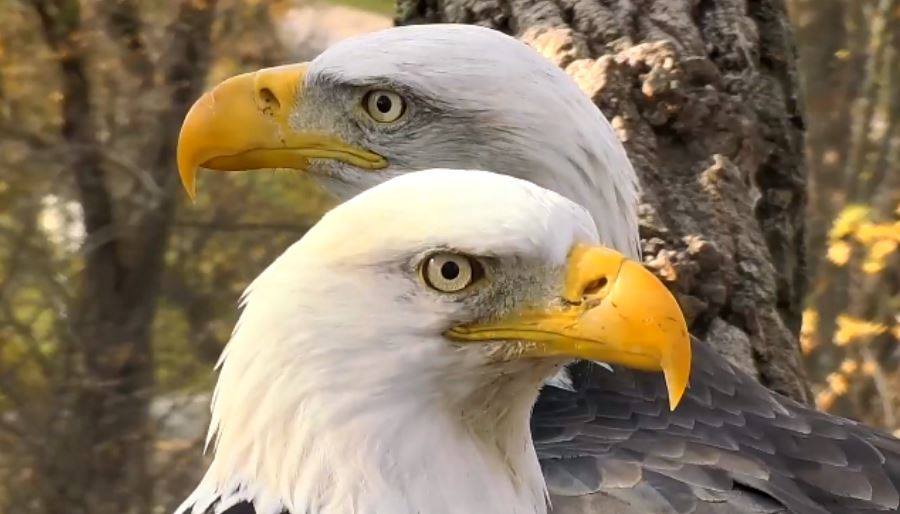
Welcome to the Confusion Couch! Many of our followers are asking "Who is that eagle?" after watching the Decorah and Decorah North nests this week. In Decorah, an adult male eagle that we've been calling DM isn't DM (or Dad - sorry, everyone!). And we can't decide who we're seeing ar Decorah North. Is that Mr. and Mrs. North, or are we seeing somebody else?

Let's start with Decorah. We originally thought that DM came to N2B a couple of days ago, but started to rethink it after taking a closer look. We needed iris patterns and John was able to get some yesterday. We're going to start with head studies...

Decorah Male, FKA UME, June 2018. DM lost feathers during a blackfly strike, which left him pretty tattered looking. He presumably would have grown them in since then.
DM? October 16, 2018. While DM would have regrown feathers lost in the black fly attack, this head study gave us pause. It sure didn't look like DM!
Dad Decorah, February 2018. Rumors quickly began to fly that the October 16 eagle was Dad returning to N2B.

The three head studies offered a tantalizing hint that our October 16th eagle was not DM, but more was needed to prove it. Fortunately, irises are very helpful in ID’ing individual eagles. Like fingerprints, each iris is unique.


DM? Male eagle from October 16, 2018
DM, June 2018
Dad Decorah, February 2018

We are looking at the left side of the eagle’s face in every photo, so we’re comparing left iris to left iris. The irises of all three eagles have distinctly different patterns and markings. The eagle we thought was DM, who we will refer to as UME-2 from now on, has an iris with some patterning around the center and a distinct small blotch at around 3:00. Like UME-2, DM’s eye has some central patterning, but he has two eye spots instead of one, and his eye spots are located at about 5:30 and 7:00. Dad’s eye has less central patterning and more eye spots than either UME-2 or DM. I checked earlier iris surveys and found that Dad’s iris splotches and dots didn’t change much over the years we watched him, which rules out a return. UME-2’s irises are simply too different for him to be Dad.

So why did we think this eagle was DM at first? First and foremost, that’s who we expected to see. DM has been identified recently and has been on territory pretty consistently since he showed up in April. Mom’s response didn’t give us any reason to question the eagle’s identity – a prey chase is often game on and Mom has chased DM around! – and he seemed quite comfortable at the Y and on N2B. We’re reminding ourselves to look closer before ID’ing eagles, especially in a rapidly changing situation like this. Bald eagle mate changeovers are a new thing for us and we’re learning a lot about what that can look like. We’re also wondering if this eagle hasn’t been here a little longer than we thought. Has Mom been perching with UME or DM or some other eagle in the maple tree? At this point, we don’t know.

How about Decorah North? We’re in an active discussion about Mr. and Mrs. North as I write this. We aren’t seeing white pantaloon streaks on the female eagle that is visiting the nest now, but the head and facial features are very similar. Are the white pantaloon feathers really a good marker? I checked in with our eagle panel, who felt that they were pretty reliable given that Mrs. North has had them for the three years we’ve watched her. But no one could say for sure. Both eagles have been seen pretty consistently and they are spending time in familiar spots. However, those spots might be desirable to any eagle, so that’s not really an indicator either. I’ve put myself on the Confusion Couch here, but we will be trying to get some good close-ups for iris and leg scale comparison.

So what’s going to happen next? Is Mom going to bond with a new male this year? Will it be DM or has another male pushed him out? How long will it be until we know? Unfortunately, we have no idea. Until last April, it seemed like Mom and Dad would be together forever. As of this fall, it seemed like Mom and DM might enter into a pair bond. And now we’re throwing our hands up into the air, getting back to eagle time, and waiting for Mom to show us what she’s going to do. Eagles are moving around right now, which means that Mom may have plenty of suitors to choose from and UME-2 may not be the last new male we see at N2B this year. We’ll continue to get eye patterns when we can at both of our nests, we’ll do our best to count the visitors, and we’re looking forward to learning more about this stage of eagle life. Go eagles – and the best of luck to both nests this year.

The takeaway? We don’t always know as much as we think we know and ID takes time and skill…especially in a situation like this. We need to make sure we don’t let our personal stories and ideas about the eagles interfere with our eagle observations – not an easy task when we spend so much time watching and thinking about them! Behavior can help guide observations, but may not be especially helpful given that good perching and nesting spots might appeal to multiple eagles.

A Guide to the Acronyms

  • DM stands for Decorah Male. Formerly known as UME (Unknown Male Eagle), he showed up in mid-April, right after Dad disappeared. 
  • UME-2 stands for Unknown Male Eagle 2. UME-2 has been on site since at least October 15. While we don’t give every eagle we see an ID, UME-2 has been in N2B, perched near N1, and been pursued by Mom. He’s been on site long enough to get an ID. 
  • N2B: N2B stands for Nest Two-Bob. N2, or Nest 2, went down in a storm in 2015. Bob approved the starter nest plan but died before it could be completed. We named the nest in his honor. 
  • N1: N1 is the second nest on this territory. It was over in a tree across Siewers Spring Road, but has mostly disintegrated since the eagles left it in 2012.


Tuesday, August 07, 2018

Birds Threatened By Proposed Rollback Of Endangered Species Act Protections

Imagine a world where there were no bald eagles or peregrine falcons. By the late 1960's, rampant use of the pesticide DDT, habitat loss, and persecution made extinction seem very likely. The Endangered Species Act (ESA), signed into law by President Nixon in 1973, was an important part of bald eagle and peregrine falcon recovery. It:
  • Levied serious legal penalties for killing threatened and endangered species;
  • Mandated the preservation of habitat critical to a listed species' survival, and;
  • Decreed that federal agencies prevent their actions from jeopardizing the existence of threatened and endangered species. 
Despite overwhelming public support for the Act, the U.S. Department of the Interior is currently proposing to roll back endangered and threatened species protections in three critical areas. Their changes will:
  • Roll back habitat protection for endangered and threatened species; 
  • Reduce protections for and allow take of threatened species, and;
  • Weaken the role that biological assessment and science play in listing decisions.
Federal rule changes require a period of public input, which in this case ends on September 24th. If any of you would like to comment, we've put together a breakdown of the proposed changes, what each change actually means when stripped of its bureaucratic language, and links to comment. The changes break down like this...

Critical Area I: Rolling back habitat protection for endangered and threatened species
Revision of the Regulations for Listing Species and Designating Critical Habitat. This proposed rule change will make it harder to designate critical habitat: the land and waters that endangered and threatened species need to survive. It will also make it easier to eliminate existing critical habitat, opening previously protected land to commercial and recreational use.
  • What it says: "We propose to revise section 424.12(a)(1) to set forth a non-exhaustive list of circumstances in which the Services may find it is not prudent to designate critical habitat as contemplated in section 4(a)(3)(A) of the Act. Under the clarifications that we propose in this revision, the Services would have the authority but would not be required to find that designation would not be prudent in the enumerated circumstances."
  • What it means: 4(a)(3)(A) requires the Service to designate critical habitat when it makes an endangered or threatened listing; i.e., when a species is listed, its habitat must also be listed. The proposed rule change would allow the Service to exempt habitat from the listing.
  • Why it's important: For endangered species, critical habitat is the key to survival. A study by the Center for Biological Diversity found that plants and animals with federally protected habitat are more than twice as likely to be moving toward recovery than species without it. Migratory species like birds are especially vulnerable to habitat destruction because they tend to inhabit more than one natural habitat. This seemingly innocuous proposal eliminates one of the most important tools we have to protect and rebuild species in danger of going extinct. If species don't have a place to live, migrate, feed, and breed, listing means little to nothing.
What you can do: Comment on this change by pressing the blue "Comment now" button at the upper right side of this page: https://www.regulations.gov/document?D=FWS-HQ-ES-2018-0006-0001.

The devil in the details: The federal government seeks feedback on whether it should consider modifying the definitions of “geographical area occupied by the species” or “physical or biological features” in Section 424.02. The geographical area is currently defined as an area that may generally be delineated around species' occurrences. This may include those areas used throughout all or part of the species' life cycle, even if not used on a regular basis (e.g., migratory corridors, seasonal habitats, and habitats used periodically, but not solely by vagrant individuals). The physical or biological features are the features that support the life-history needs of the species, including but not limited to, water characteristics, soil type, geological features, sites, prey, vegetation, symbiotic species, or other features - including critical ephemeral locations like migratory feeding, wintering, or summering grounds. Changing these definitions could have a significant negative impact on habitat conservation.


Critical Area II: Rolling back legal protection for threatened wildlife and plants

Revision of the Regulations for Prohibitions to Threatened Wildlife and Plants. This proposed rule change will reduce legal protection for wildlife and plants listed as threatened.
  • What it says: "We, the U.S. Fish and Wildlife Service, propose to revise our regulations extending most of the prohibitions for activities involving endangered species to threatened species. For species already listed as a threatened species, the proposed regulations would not alter the applicable prohibitions. The proposed regulations would require the Service, pursuant to section 4(d) of the Endangered Species Act, to determine what, if any, protective regulations are appropriate for species that the Service in the future determines to be threatened."
  • What it means: "Take protection" was extended to threatened species in 1978. Like endangered species, threatened species can't be harassed, harmed, pursued, hunted, shot, wounded, killed, trapped, captured, or collected. It provides safeguards to species that are in need of support, but allows some activities to be exempted if the Service finds it appropriate. The proposed rule change would remove these protections for species listed as threatened.
  • Why it's important: Section 4(d) provides legal protection and resources to threatened or dwindling species while rewarding collaborative conservation efforts to keep species like the Gunnison Sage Grouse off the endangered species list. Rolling back these protections will allow threatened wildlife and plants to be subject to "take". It will also remove incentives for collaboration, making it more difficult and costly to reverse population declines. The Section 4(d) rule was designed to create fewer endangered species by providing incentives to protect and rebuild threatened species. Rolling it back will cause population declines among wildlife and plants already struggling to hold on, creating more endangered species.
What you can do:  Comment on this change by pressing the blue "Comment now" button at the upper right side of this page: https://www.regulations.gov/document?D=FWS-HQ-ES-2018-0007-0001

The devil in the details: The federal government seeks specific feedback about replacing blanket 4(d) protections with special rules for each species listed as threatened. It also seeks feedback regarding a timeframe for finalizing any rules, after which the rule would be dropped and the process restarted before any decision could be made. Replacing blanket protections with special protections and drop rules will significantly reduce protections for threatened species, especially given the dwindling resources allocated to the Fish and Wildlife Service.


Critical Area III: Weakening the role that biological assessment and science play in listing decisions

Revision of Regulations for Interagency Cooperation. This proposed rule change will weaken the role that biological evidence and science play in listing decisions.

  • What it says: "We, FWS and NMFS (collectively referred to as the “Services” or “we”), propose to amend portions of our regulations that implement section 7 of the Endangered Species Act of 1973, as amended. The Services are proposing these changes to improve and clarify the interagency consultation processes and make them more efficient and consistent."
  • What it means: The Endangered Species Act currently directs all Federal agencies to work to conserve endangered and threatened species and to use their authorities to further the purposes of the Act. The proposed changes to Section 7 weaken the requirement that Federal agencies consult with the U.S. Fish and Wildlife Service when any action an agency carries out, funds, or authorizes may affect a listed endangered or threatened species.
  • Why it's important: When a Federal agency determines that its action is likely to adversely affect a listed species, the agency submits a request for formal consultation to the Fish and Wildlife Service. Formal consultation includes sharing information about the project and species likely to be affected by the action. Once formal consultation is done, the Service prepares a biological opinion on whether the proposed activity will jeopardize the continued existence of a listed species. The Section 7 Rule mandates consultation and produces listing decisions based on the best available biological science. Rolling it back will reduce the role that science-based evidence plays in making listing decisions and minimize the role of the US Fish and Wildlife Service in conserving America's wildlife and plants for the public good.

What you can do:  Comment on this change by pressing the blue "Comment now" button at the upper right side of this page: https://www.regulations.gov/document?D=FWS-HQ-ES-2018-0009-0001.

The devil in the details: Note that the federal government is seeking comment on the extent to which the changes outlined in this proposed rule will affect timeframes and resources needed to conduct consultation and (2) anticipated cost savings resulting from the changes. They are also seeking comment on the merit, authority, and means for the Services to conduct a single consultation, resulting in a single biological opinion, for Federal agency actions affecting species that are under the jurisdiction of both FWS and NMFS. FWS has a higher standard.


According to the proposed rule changes, the federal government seeks only to make things more efficient and streamlined. Their concentration on technical definitions, bureaucratic language, and efficient timeframes conceals their true intent - to drastically roll back protections for endangered and threatened animals and plants and the habitat they live, feed, breed in, and move through. If I didn't find it all so appalling, I might be awed by the sheer nefariousness of this death by a thousand cuts. Follow the comment links earlier in this blog to speak up for America's wildlife and wildlands.

Opponents of the Endangered Species Act sometimes argue that the law hasn't been successful, but according to a 2016 report published by The American Bird Conservancy, seventy-eight percent of mainland birds listed as Threatened or Endangered under the ESA have populations that are now stable, increasing, or have recovered enough to be delisted. That sounds an awful lot like success to me.

Why do I care? I had the privilege of visiting Chicago's Field Museum during a peregrine conference five years ago. Attendees were given a behind-the-scenes tour of the museum, including a look at their vast bird collection - lovingly preserved corpses of birds kept for study and remembrance. It was there that I got my only look at the Carolina parakeet and the Ivory-billed woodpecker. Gone forever from life, the two species now exist only as study skins in museums. Had the United States not banned DDT and passed the Endangered Species Act, it is highly likely that peregrine falcons, bald eagles, and many other animals would have joined them, existing only as rumors, museum specimens and curiosities on film. However cherished their memories or lovingly preserved their corpses, they too would be gone, dead, extinct, lost. Forever. I care because I've come to love them, and because I also believe that their survival is our own. This land is our land. We need to care for it and respect it. 

Monday, April 23, 2018

Questions about N2B: Dad, UME, Mom, and the eaglets

We're getting a lot of questions about the situation in Decorah. What happened to Dad? Will Mom abandon the eaglets? Did the unknown male eagle attack Dad or drive him away? Are the eaglets being fed? Is Mom feeding herself? We put together a timeline and answers to the most asked questions. Keep in mind that, while researchers have studied bald eagles for years, this level of observation became possible only very recently and there is much that we are seeing for the first time.

Timeline of events
  • 4/18/18: A serious snowstorm follows right on the heels of a three-day weekend storm. Mom and Dad spend the day caring for the eaglets, at times feeding and brooding them together in the nest. Dad is last seen on the nest around 7:30 PM. Mom broods overnight. We have been reviewing the footage to look and listen for anything unusual, but the process is time-consuming. We will let everyone know if we do.
  • 4/19/18: A bright, sunny day follows the storm. We are a little concerned when Dad doesn't replace Mom for his morning shift, but think that he might be resting up from the intense flurry of activity following two large storms. As the day wears on without Dad, we become more concerned and begin making plans to go look for him. We see another eagle. Is that Dad? We send an on-the-ground observer, who tells us that Dad is there. However, Dad doesn't show up to feed the eaglets or give Mom a break. 
  • 4/20/18: We enter a second day without Dad. We are increasingly worried that something has gone wrong. Mom continues to care for the eaglets, who are stuffed to the point of bursting with nestovers and fresh-caught fish. However, she clearly knows that Dad is gone and at times seems very wary about activity near the nest. She peal calls throughout the day with no response. Our camera operators catch several glimpses of another eagle in the area. We determine it is a male eagle and designate him UME, or unidentified male eagle. Could that be Dad? If it isn't, why is Mom tolerating him so close to the nest? He spends part of the day perched above it and Mom at one point perches near him. If it is, why isn't he giving Mom a break, bringing in prey, responding to her peal calls, and harassing an osprey that has perched by the pond? Why does she seem so wary of his presence? Unfortunately, UME never comes close enough for a look at his iris, molt pattern, or foot scales. John launches a search of the hatchery and nearby areas with some friends, but doesn't find anything. Despite yesterday's observation, we become increasingly convinced (based on behavior and photographs) that Dad isn't here. After a consultation with our eagle experts, we announce that UME is not Dad.
  • 4/21/18: John coordinates a search from the hatchery. 20 volunteers and a drone team from the Decorah Fire Department look for Dad. They search roadways around the hatchery, the bike trail, the stream, the area around N1, the hatchery grounds, hatchery buildings, and power poles and lines to the east. We don't find any sign of Dad. Meanwhile, Mom continues to feed the eaglets and we see UME fly on to the Skywalk and stay for about five minutes. Mom is agitated by the intrusion and remains wary of UME, although her peal calling has largely stopped. 
  • 4/22/18: Dad is still absent, another search doesn't turn up anything, and Mom is still wary of UME (who is still hanging around and does a fly through at one point). She feeds the eaglets throughout the day. While we worry, they have bulging crops and are developing on track: eating, sleeping, pooping, bonking, playing house, wingercizing, exploring their clown-clomping feet, and starting to grow pinfeathers. 
Your questions
  • QQ: Could UME have driven Dad away? Or did Dad leave because he was tired of caring or could no longer care for the eaglets after two big storms?
    We talked with our eagle experts about the likelihood of both questions. It isn't unknown for new eagles to drive away territorial eagles, although we haven't seen displacement during the nesting season at any of our nests. We don't have any documentation of an adult eagle, male or female, simply deserting young, and Dad was caring for the eaglets up until the time he disappeared. Put simply, we don't believe that Dad voluntarily deserted the nest but we don't know where he is or whether UME had anything to do with his disappearance. After several days of terrible migration weather, birds finally got a break and were busy heading north. UME could have displaced Dad, or he may have been migrating through the area when Dad disappeared. Since there was no response to his tentative exploration of the area around the nest, he might have decided to stay and get a little closer. 
  • QQ: What could have happened to Dad? 
    Our search was structured along the following possibilities: UME injured Dad in a fight (we searched around the nest with binoculars and checked the trail, stream, fields, and area around N1). Dad was hit by a car while eating or getting roadkill (we searched roadways and ditches). Dad was electrocuted on or collided with a powerline (we searched the base of poles and along powerlines). Dad got caught in a building (we searched hatchery buildings). We covered a lot of area with 20 volunteers and a Decorah Fire Department drone, but didn't find Dad. We still don't know what happened to him. 
  • QQ: Is UME a threat to the eaglets?
    This is a tough question. Anecdotes and scientific literature both contain examples of new adults killing eaglets and caring for eaglets. We are hopeful that he won't, given that he hasn't behaved in an aggressive way towards the eaglets or Mom. We're waiting to see if he brings Mom any food or courts her. 
  • QQ: Are you going to pull the eaglets from the nest? 
    We are not.  From a human perspective, we would be caring for the eaglets by keeping them safe from hunger and predators. But from Mom's perspective, we would be invading and killing her eaglets. Mom is far more capable of caring for her eaglets than we are, and we have no plans to take her young from her.  
  • QQ: So Mom can feed the eaglets by herself? 
    Mom has fed the eaglets to bursting multiple times every day since Dad disappeared. Between the hatchery and the stream, she is more than capable of keeping them fed. 
  • QQ: I saw that Mom was attacked by a bird. Was that an eagle? 
    Mom was being swooped by crows earlier today. We've also seen starlings and nuthatches steal nesting material and search for food. All of this is completely normal behavior and has nothing to do with Dad being gone. 
  • QQ: Mom seems really wary and watchful. Why?
    Mom is probably responding to UME, who as of this post on April 23rd was still in the area. While he hasn't treated her aggressively, he still isn't her mate and she is usually very wary when he comes near the nest. We've only seen one exception, which happened on Friday, April 20, when she perched near him.
  • QQ: Could this be Mom and Dad's offspring from another year? 
    While it could be, we have no way of knowing one way or another.
  • QQ: How old was Dad?
    We don't know, but believe him to be at least 21 years old based on his plumage and when we first started watching him.. Is it possible that he could have been less cold-tolerant because of age? We're asking our team on that, but we don't know at this point. 
Thank you for all of your care and kind comments. We know this is hard on everyone. We promise to keep you all posted. 


Tuesday, April 10, 2018

Bald eagle tongues and beaks!

This blog was inspired by RRP Director John Howe, who was reviewing footage of Mom and Dad feeding eaglets and was delighted by the dexterity of their beaks and tongues. I had never blogged about that topic and it was very fun to learn about just how specialized some beaks and tongues are!

We know that bird beaks are specialized for feeding and daily tasks. Birds of prey have strong, curved beaks with sharp edges to help them tear meat. Falcons specialize even further, adding a tomial tooth to help them kill prey. Dabbling ducks have tiny, comb-like structures on their beaks to strain small animals, insects and plants from water and mud, while piscivorous ducks have saw-like structures to help them hold on to struggling fish. But what about bird tongues or, more specifically, bald eagle tongues? Are they specialized as well?

Let's start by taking a look at Mom and Dad's tongues!
Dad's Tongue


Mom's Tongue


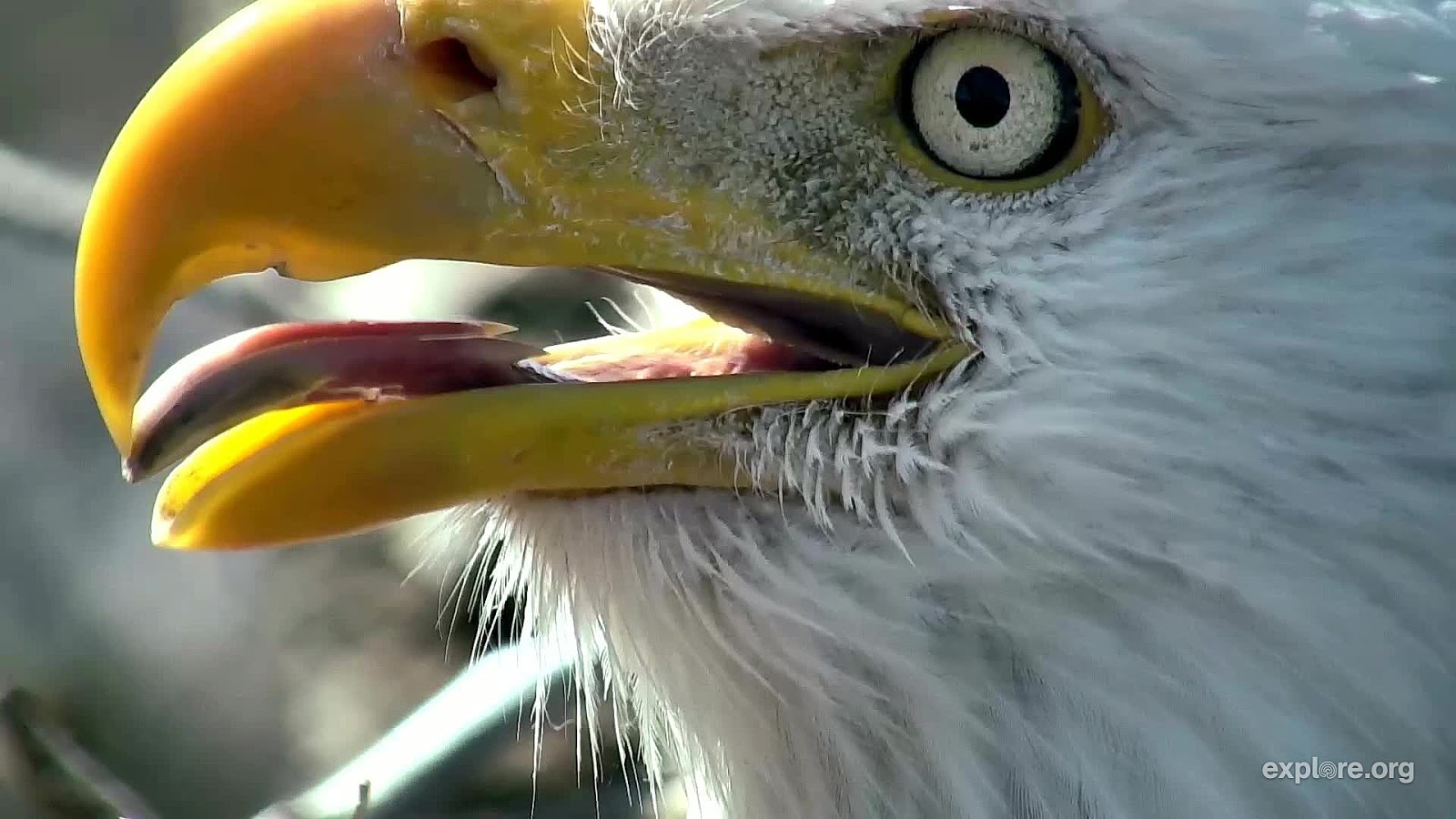
At first glance, bald eagle tongues look somewhat similar to ours. They are pinkish, relatively narrow, fit nicely between the sharp ridges of their beaks, and are flexible. They are short enough that eagles can't easily bite their tongues, although they can stick them out. Unlike us, bald eagles have two barbs, or rear-directed papillae, to help lift and pull food items to the back of their long mouths: a relatively common feature in bird tongues.

Although birds of prey don't have specialized tongues, their tongues (and beaks) are packed with mechanoreceptors that respond to pressure, distortion (think of an eagle stretching its tongue or biting into bone), temperature, texture, and vibration. Merkel cells are sensitive to very fine changes in touch, pressure, and temperature. These tonic cells keep providing information to tell Mom and Dad exactly where their beaks and tongues are and what they are doing. Phasic Herbst and Ruffini cells sound an alarm to let Mom and Dad know that something has just happened. Herbst cells are sensitive to vibration, pressure changes (I grabbed or dropped an object), and texture changes. Ruffini cells are sensitive to stretching, distortion, and temperature (I just bumped something warm and hard like an eaglet's beak and mouth).

These sensors aren't evenly distributed throughout a bird's beak. While I couldn't find any studies on birds of prey, studies have been done on quail and ducks. Sensory cells in a quail's beak are distributed like this:

Cadual BeakMiddle BeakCranial BeakBeak TipCell Type
.95%014.28%3.8%Herbst
1.9%051.42%2.89%Ruffini
0012.38%12.38%Merkel

Bald eagles have considerably different diets and lifestyles than quail, but both ducks and quail concentrate sensors in the cranial areas of their beaks (think of a falcon's tomial tooth or Mom and Dad's tomial ridge). Once a bird has allowed something past the tip of its beak, it has a lot of decisions to make about how to respond to it and what to do with it. Given that quail and ducks are preccocial omnivores and bald eagles are altricial carnivores, I would love to see a study on bald eagle beaks.

Thanks to their beak blinders, bald eagles have a blind spot directly in front of them, which means they can't always see their young during feeding. So how do they select food, find the eaglets, and get food into their mouths? Immediate and ongoing sensory feedback helps parents and young align beaks, and tells new hatchlings to open their mouths wide for food delivery! Once both beaks are in the correct position, Mom or Dad use their sensitive, flexible tongues to carefully push food into the eaglet's waiting mouth. Changes in pressure, temperature, and texture help the eagles change course in mid-delivery, detect dropped food, find eaglets, and pull back as needed. Mom and Dad also use their tongues and beaks to detect and avoid feeding young hatchlings chunks of bone, large pieces of fur, or sharp fins that could cause them to choke.

How do Mom and Dad manipulate food so well? Check out the top photo, which shows a side view of Dad's tongue. We can clearly see that its fleshy tip rests on a muscular stalk. As described in Laura Erickson's excellent blog on bird tongues, this stalk controls Dad's tongue to manipulate food items. Dad can stretch and tip his tongue forward to feed eaglets, pull and tip it backwards to move food into his mouth, or move his tongue to one side or another as needed. His flexible two-stage tongue and rear-directed papillae give him incredible control, and the sensory cells packed into the tip of his beak and tongue provide the feedback he needs to feed eaglets...even when he can't quite see where they are. Annoyed with Mom or Dad over dropped food or missed beak-loading opportunities? Imagine trying to feed eaglets using your just tongue and nose! The video below shows just how delicate they are when it comes to feeding hatchlings.


Did you know? 
Bird banders can use the color of a bird's mouth and tongue to help age birds. Younger birds may have spots or bands to help parents with food targeting. Colored tongues in some adult birds can aid mating displays and/or signal a warning to other birds.

Understanding a species' behavior and diet helps us understand how its tongue and mouth evolved. Check out Laura Erickson's blog More About Bird Tongues Than A Normal Person Would Want To Know for a great look and description of some bird tongues! You know you want to learn more!

Things that helped me learn and write about this topic

Tuesday, March 20, 2018

Why did Mom and Dad lay eggs later this year?

We've been getting questions about egg timing. Why did Mom and Dad lay eggs later this year? Overall, avian egg-timing in the temperate zone is heavily regulated by the light cycle. As the days begin to lengthen, birds' gonads swell and produce sex hormones. Around the end of January, our bald eagle pairs switch from infrequent copulation to frequent, highly enthusiastic copulation, putting us on notice for egg watch! Females chase males, males entice females, copulation takes place on a regular basis, and our eagles start laying eggs in mid-February. We have a general egg outline, but what factors correlate to the onset of egg-laying in any given year?

New mates can equal later eggs
While it doesn't always happen, a new mate (male or female) often pushes egg-laying a little later in the eagles and falcons we watch. Sometimes it happens for very obvious reasons, like mid-season mate replacement. Let's say that female falcon A and male falcon B are nesting together on a cliff in mid-March. Falcon A has begun the process of egg production: her egg follicles are swelling, she's gaining weight, and she's copulating like crazy! Unfortunately, she's killed or displaced by female falcon C, who is producing plenty of sex hormones, but no eggs. B doesn't waste any time courting C. His bowing, gifts of food, and copulation will trigger her to begin egg production, but their egg-laying schedule will be pushed back by as much as or more than ten days. Absent other factors, it should float earlier in the years to come.

Later egg-laying can also happen in new couples that don't experience mid-season mate replacement. Both Mom Decorah and Ma FSV laid the first eggs of their lives in early March (March 2, 2009 for Mom Decorah and March 3, 2007 for Ma FSV) but moved earlier as the years progressed. Mom had just achieved sexual maturity when she bonded with Dad, but we don't know if the same is true of Ma FSV. Is initial egg production - an eagle's first egg - a factor in egg timing? How about receptivity in a new pair versus an already bonded pair? We don't know, but it's something we'll be looking at.

Cold dry weather? Predict eggs on the later side!
Having said that, we didn't have a new eagle in Decorah or at Fort St. Vrain this year. So what happened? We decided to look at weather. Using the nearest weather stations we could find to each nest (especially important in Colorado with its altitude-based weather patterns), we obtained historical figures for temperature and dewpoint from January 30 to February 10. There isn't a long time period between the onset of egg-laying and egg-laying itself, so we started around the time that both sets of eagles usually ramp up copulation and ranked our results from latest to earliest laying date.

FSV: January 30 to February 10
1st Egg DateHigh TempMean TempLow TempDewpoint
2/21/1431 F19 F6 F12 F
2/17/1348 F32 F17 F15 F
2/16/1646 F31 F17 F17 F
2/14/1560 F44 F28 F21 F
2/14/1756 F45 F33 F21 F
2/12/1851 F37 F22 F22 F

Decorah Eagles:  January 30 to February 10
1st Egg DateHigh TempMean TempLow TempDewpoint
2/23/1412 F4 F-3 F-3 F
2/21/1837 F20 F8 F4 F
2/20/1730 F21 F12 F15 F
2/18/1629 F22 F16 F19 F
2/18/1524 F16 F9 F12 F
2/17/1234 F28 F22 F23 F

In general, both sets of eagles laid eggs slightly earlier during periods of unusual warmth and slightly later during periods of unusual cold. But much to my surprise, humidity (as measured by dewpoint) turned out to be a slightly better predictor of egg-timing than temperature! What was going on with that - and with the one interesting exception in Decorah in 2015? Time to do a little reading!

It is widely believed that breeding female raptors gain weight by building fat and storing minerals to provide the energy reserves needed for egg-laying and incubation. But a study of female barn owls found that almost all of their pre-laying weight gain was due to water accumulation! From the study's discussion: "To conclude, the gain in body mass observed in breeding barn owls is not due to an accumulation of energy reserves but of an accumulation of water." Incubating female barn owls undergo a more complete molt than incubating bald eagles, but egg production mechanisms are very similar and it seems reasonable to believe that water retention would be similar in both species. The nutrients required for egg formation can be obtained by routine food intake during egg formation, but if the weather is extremely dry, it might take longer for female bald eagles to accumulate the water reserves they need for egg production, especially give that drier weather results in higher levels of evaporative and cutaneous water loss. It wouldn't make a few weeks difference in any given year, but it might make a few days!

I couldn't find an explanation for the anomaly in Decorah in 2015, but this is a relatively small dataset. As we keep records longer, we may learn more about trends in egg-laying. It also might be worth getting weather stations down below our nests to collect local data about temperature, humidity, and wind at each nest. We still have a lot to learn about the ways in which weather and climate affect the birds we watch.

Did you know?
The barn owl study also had some interesting information about fat/lipid dispersal in a breeding female barn owl's body. Although breeding females had fewer body lipids than non-breeding females, they had more subcutaneous fat in the area of their brood patch. The accumulated fat caused their brood patches to increase in size! So Mom's more visible brood patch and slightly larger appearance aren't just our imaginations. She has gained water weight and shifted fat to her brood patch in preparation for egg-laying and incubation. I'm sure that more than a few of us can relate to that!

While we aren't sure why Midwest peregrine falcons are laying eggs earlier, they are laying significantly earlier than they did at the beginning of falcon recovery in our area. Interested in the topic? Check out Average Nesting Trends!

Why didn't you use data from the North pair?
This was a tough one to leave out, especially given that many watchers think Mr. North was a new mate in 2016 - a year of later egg production. However, we only have three years of production here, the eagles have not established a regular laying pattern (2018 was also late), and we have no weather history anywhere near the nest, so I'm not comfortable including their data. We'll see what happens in the years to come.

Things that helped me learn about this topic

Thursday, February 22, 2018

How long does it take Mom to lay an egg?

We've talked about how long it takes bald eagle eggs to hatch after they are laid (an average of 38 days from first egg to first hatch in Decorah), how long hatch takes once pip starts (it can take upwards of 24 hours), and how long it takes Mom to lay each egg (she usually lays the second egg about two to three days after the first, and the third egg roughly four days after the second egg). But how long does it take Mom to make and lay an egg?

We'll start with copulation. It is believed that female bald eagles begin laying eggs five to ten days after productive mating begins. Mom laid her first egg at 7:28PM CT on February 21st, or about eleven days after copulation went from casual to frequent...and very determined on Mom's part.  Between February 10th and February 18th, Mom and Dad copulated nine times that we saw and had an additional 2 failed attempts. Mom took the lead five times - beak biting Dad, footing him, loudly vocalizing her intentions, and mounting him while wagging her tail (https://youtu.be/I4xlu9IEItY). You didn't need to be a male bald eagle to know that Mom meant business!

So we know that bald eagles ensure fertile eggs by copulating regularly, storing sperm in storage tubules, and concentrating sperm at the infundibulum, or site of fertility. But how long does it take Mom to lay an egg once her first yolk has been fertilized? The short answer: approximately two days (48-50 hours). It goes through a lot of changes along the way! Note that our oviduct times were derived using the ratio between bald eagles (~48 hours) and domestic chickens (~25 hours). The actual times could be slightly different.

Step one: I'm ready!
Diagram of the egg-laying process
According to Tim Birkhead, there are no known cases of copulation-induced ovulation in birds. As we've seen in Decorah, female birds signal their fertile status by their interest in (or their insistence on) copulation. In response to an internal clock and the presence of a male - say, Dad - one of Mom's yolks swells until it ruptures the follicle that produced it, releasing a ripe yolk into her oviduct.

How long does it take for her yolk to swell? Our observations suggest about eight to ten days. For comparison, it takes four to five days in small birds like great tits and white-crowned sparrows, six to eight days in larger birds like ducks and pigeons, 10-13 days for large gulls, and up to 16 days in some penguins.

How many follicles are swelling inside Mom each season? In domestic hens, each follicular cohort (follicles that will become eggs) numbers six to twelve follicles, and follicles are selected roughly every 24 hours. We know that Mom's annual cohort measures at least three. Since it takes roughly 48 hours for her to lay an egg, follicle number two must rupture about the time egg number one is laid. Follicle number three experiences a delay of about 48 hours, giving Mom's 'egg-machine' a chance to rest and resupply!

Step two: The infundibulum! Length of stay: ~15 minutes (T - 47+ hours)
While the name infundibulum (funnel) suggests a passive process, the microscopic yolk stays in one place while the infundibulum flows around it. Since Mom and Dad have been copulating regularly and Mom has been storing sperm, hundreds or thousands of Dad's sperm are waiting inside to fertilize it! Fertilized or not, the infundibulum seals the yolk after 15 minutes, and it proceeds on its journey down her oviduct.

How does the yolk stay in the center of the egg? The infundibulum's seal, or chalaza layer, forms the egg's first layer of albumen, aka egg white. The ends of this dense chalaziferous zone twist with other proteins to create two filaments as the egg spirals through the magnum. These filaments will eventually anchor the yolk to the egg's hard calcareous shell, keeping it in place. 

Step three: The magnum! Length of stay: ~5 hours (T - 42.5 hours)
Her yolk makes its next stop in the magnum, where it receives another coating of albumen. The albumen is secreted by special cells in the magnum wall that absorb water and proteins from Mom's bloodstream. The albumen will cushion the developing embryo and provide much of the protein needed for its development. Remember Dad's food gifts? Mom needs all the protein and calcium she can get to produce viable eggs!

Step four:  The isthmus! Length of stay: ~3 hours (T - 39.5 hours)
The yolk moves into the isthmus next. It receives a little more albumen and its inner and outer soft shell membranes, which (like Mom's feathers, beak, and talons) are made of keratin - another protein! The inner shell membrane provides a point of contact for the chorioallantoic membrane that develops in the first three to four days of an embryonic eagle's life. Both membranes help protect the porous egg from bacterial contamination and keep water from escaping too quickly. The membranes sit closely together during the egg's trip through the oviduct, but separate after the egg has been laid.

An egg in cross section, modified from Romanoff and Romanoff, 1949
Step five: The shell gland! Length of stay: ~39 hours (T - 15 minutes)
Mom's yolk, wrapped snugly in its jacket of albumen and shell membranes, moves into her shell gland or uterus. Water and minerals are pumped into the developing egg and a hard calcareous shell is formed around it. 

Mom is removing a lot of calcium from her body to produce the egg shell. While I couldn't find figures for bald eagles, hen chickens remove about 25 mg of calcium from their blood every 12 minutes during active egg shell formation. Since bald eagle eggs are significantly larger than chicken eggs, it seems very likely that she is removing more calcium than that. Anything that can't be derived from dietary sources will be obtained from her skeleton - another reason that food is extremely important right now! 

Step six: The vagina and egg labor! Length of stay: roughly 15 minutes!
We finally have an egg! Mom's initially microscopic yolk has been wrapped in membranes, plumped up, and surrounded by a hard shell. While we don't know whether Mom was aware of the egg before, she is certainly aware of it now! Contraction of a powerful sphincter muscle causes the egg to rotate in her muscular vagina and enter her cloaca pointed-end first. Mom's powerful vaginal muscles and full-body contractions eject the egg through her cloaca and into the waiting egg cup. Two days after Mom's first egg was started, it emerges after her brief egg labor and she lays down for a well-deserved rest! Her second egg is just beginning its journey!

Does Mom feel pain during egg labor? 
We often get asked whether Mom experiences pain or discomfort, especially in the final phase of laying. Whether or not she knows her follicle burst, egg laying is an energetically expensive process and her behavior changed substantially since she started chasing Dad around the nest! Two or three days before she laid egg number one, we started seeing her on and around the nest more. Dad brought several meals to her, and she spent a long period of time in the nest the morning before the egg was laid. While her soft chirps were lovely to hear, she was obviously experiencing some discomfort. It was a relief to all of us when she finally laid the egg!

Mom will incubate her first egg between 35 to 37 days before it hatches. While Dad does his share of incubation, incubation gives Mom the time she needs to rest and build up her reserves. Sweet eagle dreams, Mom - you've earned them!


What happens when a bird loses its nest and mate with an egg in the pipeline? 
We also get asked what happens when a bird's season is interrupted. We haven't seen it at any of our bald eagle nests, but we have seen it in several peregrine falcons. Last year, an interloper laid an egg in the nest box at Dairyland Alma before the returning female ousted her, and Newman spent a lot of time courting and copulating with St. Louis Girl before Michelle showed up and kicked her out. While there isn't much information about it, I would guess that any eggs in the pipeline get laid somewhere. But if follicle stimulation is about more than just lengthening daylight hours - which it appears to be, at least in wild birds, which don't tend to lay eggs absent a male, copulation, and a nest - losing a mate and territory may shut follicle stimulation and yolk production down. This would prevent additional eggs from forming: a wise strategy given how energy intensive egg production is! 


Does it feel like the parts of a female bird's reproductive system were named by committee? Technical language is daunting enough when it fits together nicely! But people have studied birds, especially domestic chickens, for a long time. Not everything we are describing now was named at the same time by the same people, which can lead to an odd combination of words. 
  • Infundibulum is derived from a16th century Latin word for "pour in" (or funnel): infundere.
  • Chalaza is derived from a Greek word that means "small knot": Khalaza 
  • Magnus is a Latin word that means "great". The magnus is the largest part of the oviduct. 
  • Isthmus is derived from a Greek word that means narrow neck of land: isthmos.


Things that helped me learn and write about this topic!
Image Credits
  • Diagram from the paper Sperm storage in the female reproductive tract in birds, Sasanami T, Matsuzaki M, Mizushima S, Hiyama G - J. Reprod. Dev. (2013). Taken from Open i, US Department of Health and Human Services, https://openi.nlm.nih.gov/detailedresult.php?img=PMC3944358_jrd-59-334-g001&req=4. 
  • Egg cross section derived from The Avian Egg: Alexis L. Romanoff, A.J. Romanoff, 1949. Image credit poultryhub, although it appears in other places as well: http://www.poultryhub.org/physiology/the-avian-egg/. If you own this image and do not want it posted or need the credits changed, please contact me: ries93@gmail.com.

Friday, February 09, 2018

What are feathers? What is molt?

When we think about feathers, we tend to think about their qualities (light, soft, fluffy, hard, flat, and horny are all included in dictionary definitions) and how they help birds fly, stay warm, shed or retain water, build nests, and so much more! (See this blog, for example.) But what are feathers? It sounds like a silly question. We all know what feathers are, right? And we all know what a bird's nest looks like, how to describe the color and shape of an egg, and when bald eagles lay their eggs. Maybe we don't know as much as we think.

So again, what are feathers? Like hair, fingernails, and scales, feathers are growths produced by epidermal cells in the outer layer of a bird's skin, which makes them part of the largest organ system in a bird's body. Derived from the Latin integumentum, which means “covering”, a bird's integumentary system includes its skin, feathers, scales, feet, beak, and the glands in its outer ear canal and at the base of its tail. Mom's integument keeps her insides in and protects her from pathogens while allowing her to exchange wastes, react to stimuli (think of how she fluffs her feathers in the cold), and produce important organic compounds like uropygial (preen) oil.

Feather follicle. Click to enlarge
Where do feathers come from, and how do birds grow them? Birds grow feathers throughout their lives, but feather development begins in the egg. Seventeen to eighteen days after Mom lays an egg, interactions between the embryonic bald eagle's outer and middle layers of skin form feather buds - columns of epidermal cells that dimple its developing body. The cells differentiate into three layers as they grow downward into its skin to create a tiny feather-producing organ that resembles a small pit or tube - the feather follicle. The cells at the base of this tube grow, divide, and die, leaving behind small masses of keratin that are pushed upward through the tube to form a feather. The outermost layer of cells form a temporary sheath that protects developing feathers, while the middle and inner layers form the feather's rachis and barbs. The developing feather has a blood supply that extends through its central pulp to nourish it as it grows - hence the name 'bloodfeather' to describe a feather still connected to its blood supply. When the feather is mature, the blood supply recedes.

Feather follicles, which are nourished by blood and grow via the division and enlargement of cells, are alive and will continue to produce feathers throughout a bird's life. But non-living things like feathers, crystals, icicles, and bald eagle nests grow via accretion: the addition of new material on top of old. Remember N1? Once Mom and Dad stopped replenishing it with branches, it began to disintegrate. The same is true of feathers. They have no blood supply, no cells, and no way to repair or replenish themselves. So how do birds replace feathers, especially flight feathers, without impacting flight? Hormones regulate molt cycles, periods when older feathers are pushed out of their follicles by newer feathers in a genetically programmed, orderly replacement that can take years to complete in larger birds of prey such as bald eagles.

Like so much else in a bird's life, the cue for molt initiation is day length, which effects the hormone levels that control molt progression. In the temperate zone - the part of the earth's surface lying between the tropics and arctic and sub-arctic circles - most breeding birds of prey molt in the summer, after they have finished raising young; and in winter or early spring, as the breeding season begins. Producing new feathers is a costly affair. Molting birds replace 20-40% of their mass through the molt, drawing on protein and energy reserves to create new feathers and offset the effects of reduced insulation and flight ability. Their 'down time' - the space between laying eggs, endlessly feeding hungry nestlings, and migrating or enduring the winter cold - is a good time to engage in the energetically expensive task of producing new feathers. Molt is suspended during periods of intense flight activity (say, when Mom and Dad are feeding young, or falcons are migrating) and food scarcity.

Annual light cycles and rate of change in Decorah
In short, day length (or changes in day length, or the rate of change of day length) initiates hormone production. Among many other things, these hormones trigger the cells at the base of the feather follicle to start growing, dividing, and dying. New feathers are produced and old feathers are pushed out. The molt cycle does not take feather condition into consideration - feathers are replaced whether they need it or not. While this might seem wasteful given the amount of energy that molt takes, it is better to replace feathers automatically during 'down time' than to develop a replacement on demand system that could leave a molting bird vulnerable to the weather or impair its flight during nesting season.

Components of a bird's wing
In birds of prey like bald eagles and peregrine falcons, molt progresses from the front to the rear of the bird. Unsurprisingly, flight feathers molt symmetrically. In falcons, primary feather molt begins with the fourth innermost primary (P4) and works its way inward and outward, but in bald eagles and most other birds of prey, the innermost primary (P1) is molted first and molt proceeds outward. Tail molt (bald eagles have 12 tail feathers) usually begins with the third and fourth feathers on either side of the bird's central tail feathers and proceeds simultaneously outward and inward. The growth of individual flight feathers takes 2-3 weeks in a smaller bird like a kestrel, and 2-3 months in a larger bird like a bald eagle.

Sharp-eyed watchers have recently noticed Mom and Dad shedding adult down and body feathers. The production of sex hormones triggered body feather molt at a time when we might expect birds to be conserving insulation, not regrowing it! However, this is a very good time for them to replace feathers. They aren't as active during incubation, which requires long periods of sitting on eggs - a great time to replace feathers. They also need to transfer body heat to their eggs, which is done through bare or mostly featherless skin. I wasn't able to find much about an eagle's brood patch and molt, but we know that hormones cause breast feathers to loosen and fall out, creating the brood patch. Like flight feather molt, brood patch molt is optimized to perform a specific task.

In his book Raptors, the curious nature of diurnal birds of prey, Keith Bildstein concludes his section on molt by stating "We still know little about feather molt in the overwhelming majority of diurnal birds of prey, including that of many abundant and widespread species." Reading and writing about feather growth and molt left me with more questions than answers. Do sex hormones influence sub-adult plumage patterns and colors? How do hormones change plumage signaling at maturity? Do regional populations of birds experience different molt patterns? Specifically, how might the nearly tropical bald eagles at Fort Myers experience molt when compared to deeply temperate Mom and Dad, or to nearly arctic eagles in northern Canada? Do long-time territorial birds experience different molting patterns than birds that migrate every year - say, Mom and Dad versus Brett's migratory Canadian eagles? If sex hormones help regulate molt and feather production, why don't bald eagles and peregrine falcons have sexually dimorphic plumage? For that matter, why do American kestrels have sexually dimorphic plumage? The more I learn about birds, the more questions I have!

Things that helped me learn and write about this topic:

Did you know?

Why is molt so energy intensive? After all, feathers are made of dead material and don't weigh very much, right? Feathers don't weigh much collectively, but the entire plumage of a bald eagle makes up about a sixth of its total weight, or roughly three times that of its skeleton. Molt involves the replacement of a huge area of a bird's body, and the plurality of its mass. Altogether, a bird's plumage weighs more than any other part of its body.

Birds replace their feathers more or less annually, depending on the bird. Do humans really replace their cells every seven years? Nope - it is a lot more complicated than that!  Watch this video to learn more (and check out the awesome skunkbear science tumblr here: http://skunkbear.tumblr.com/)


If we replace skin cells, why do scars and tattoos persist? https://www.scientificamerican.com/article/if-the-cells-of-our-skin/

I've never thought much about the integument before. Read this to learn more about our integument and marvel at the similarities and differences between feather follicles and hair follicles: https://oli.cmu.edu/jcourse/workbook/activity/page?context=90d2a06680020ca600bc63bf9b37a68f.

Photo credits

  • R.B Ewing was a science illustrator who drew the awesomely detailed feather follicle that I found all over the place, although I was not able to source the publication. It may have come from Ornithology in Laboratory and Field by Burgess Publishing, edition unknown. Here is a link to just one place I found it: http://ncsce.org/pages/home.html
  • The wing came from wikicommons.


Friday, December 29, 2017

A trip down memory lane: Favorites from 2017, Decorah Edition!

It's time for a look back at 2017! We asked the mods for some favorite moments from Decorah and Decorah North. We'll feature Decorah today and Decorah North tomorrow. We hope you enjoy a trip down memory lane! 2017 marked the 9th year that Mom and Dad have nested together in a cottonwood tree! They produced fourteen eaglets at N1, nine eaglets at N2, and five eaglets at N2B, the nest we started for them in August of 2015. We don't know how old Dad is, but he is older than Mom, who turned fourteen this year.

Mom back, Dad front
We'll start with the eaglets. All of the eaglets were somebody's favorite! You liked (or were distressed by) D26's fierce behavior and insistence on being first to the dinner table, especially in the first few weeks. You cheered for D28 when he bonked back at the older and larger D26, and groaned, worried, or emailed when D27 took the brunt of D26's bonkings. While any given eaglet was someone's favorite, many of you were captivated by D27! Whether she was screeing for food, acting the Diva, lounging about in the nest, or beginning her first tentative explorations during fledge, you watched her, compared to her to D1, and weren't especially surprised to find out that it was a she once Brett, John, and company fitted her for a transmitter! Jfrancl wrote:

"One of my favorite memories from the 2017 season was watching D27's behaviors as she grew and how different she was from D26 and D28. She seemed to follow the pattern I have often read about on eaglet gender behavior and growth patterns.  In my mind I knew she had to be female!" You can continue to follow D27 here: https://www.raptorresource.org/learning-tools/eagle-map/

JFrancl also mentioned: "Three eggs and three hatches, again! D28 attempting to eat its first meal on hatch day! Tandem feedings. Giggling at the Tree Amigos! Observing all three throughout the season and guessing genders based on behaviors. The hatchery cam. Watching all participating classroom students excited to learn about eagles! Working closely with John, Amy, the Ustream chat room mods and the Facebook mods in helping to continue Bob's mission. Once again, watching Mom and Dad's attentiveness and devotion to their young. Last but not least, a great After the Fledge Celebration!" I thought this video of a feeding from April 4th was a lot of fun. Remember D28's dark head? https://youtu.be/dCEA2bmxxeo. And it was a greatATF! We all loved seeing Mr. Decorah (widely believed to be D20 from 2014): https://youtu.be/6qdfIFaodYM. Our mods gave everyone a nice goodbye, too: https://youtu.be/ja6zI3BARfM.

D26, D28, and D27 (I think) on April 08, 2017
Since everyone loves hatch and first glimpse videos, I included them as well:
Glogdog wrote: "One of my favorite videos that sticks in my mind this season was on 1/2/17 when Dad brings in a long stick and gets stuck between 2 trees in mid-air. Mom realizes it and steps up to help bring it down! I also liked the times that Mom and Dad protected the eaglets during bad weather."
Mom and Dad working together as a team to protect the eaglets on April 3rd, 2017 
Tulsa Ducati: "Lightning show!" Tulsa joined the ranks of our videomakers this year and we featured many of her videos. One of her favorites was the incredible storm that rolled in on June 28. https://youtu.be/NioY3r87S_I

Faith: "A tandem evening feeding". This video was also one of my favorites. Mom and Dad feed the eaglets together on the evening of April 2nd. https://youtu.be/F44Z9aQ2gS0

Mom and Dad tandem feeding on April 2nd, 2017
Oregonian: "D27 gets back to nest!" I had completely forgotten about this, so I really appreciated the reminder! Oregonian wrote: "Without a doubt watching D27 work her way back to the nest after she tumbled out. I was riveted watching her figure how to get back." https://youtu.be/DB7KW-huwsI

Pyrmum wrote: "My favorite moments are when Dad is feeding the eaglets and he keeps looking around to see if Mom is on her way to kick him off the nest. I get a real kick out of it!" All of us get a kick out of Mom and Dad's antics! I was not able to find a specific video for this behavior (although I remember it), so I substituted another favorite - Mom gently nudging Dad off the nest! https://youtu.be/7hzb2hrzbzc

Robin Brumm had several favorites!
  • 4-3-17 "When both parents were trying to protect the eaglets from the rain. Dad didn't want to leave, but finally Mom pushed him out. When he got up, I believe he knocked D27 on her back, so she was laying their with her little feet flailing, lol!" https://youtu.be/7hzb2hrzbzc
  • 4-13-17 "...And you can't forget when D26 went for a little ride on the clump of grass mom was trying to pull out of the nest cup!" https://youtu.be/7tXua2nBQ6I
  • 5-6-17 "Not that it was a favorite, but it was memorable when Mom got knocked off the skywalk by the owl." https://youtu.be/JFYCYLvHvVE
  • 7-16-17 "All three juvies hanging out in N1 and the Y branch." (This was also a favorite of mine): https://youtu.be/8wPjIp3Lqak
Fledged eaglet, 07/01/17. I'm sure Robin knows eggsaxctly who this is!
I had a number of favorites, but these really stood out for me!
  • Lunch feeding - close zoom and wide angle: https://youtu.be/JeGhVefSoIM. I loved the view of all three eaglets and this is one of the first times we saw D28 show its fierce! While D27 submitted to D26's bonking behavior, D28 tended to bonk back.
  • Incredible portrait close-ups of D26 and D27 - close zoom. I mentioned I was a sucker for the downy stage, right? https://youtu.be/jnCpx-fR8zQ. In the same vein - Dad allows nestlings out to enjoy warm day: https://youtu.be/7qxy8fpAabo.
  • D26 attacking corn husk: https://youtu.be/HVBRde5g4uc. Lol - show us how it's done, D26!
  • Three-way mantle: https://youtu.be/eBe_IOL9lTM. All three eaglets show off their excellent grasp of eaglet table manners. The winner takes all!
Judging by readership, your five favorite blogs in 2017 were:
  • Endangered Species Act Under Threat From Congress (13,511)
    The Act itself hasn't been overturned, but Congress consistently introduced bills and amendments to weaken it, including five that we blogged about here. All of them passed committee and Congress didn't adjourn this year, so those bills may still move forward in 2018.  In late December, the Trump administration declared that they would not be enforcing the Migratory Bird Act.
  • Eagle Eyes! (6233)
    This was fun to write about. I'm a little jealous of bald eagle eyes - human eyes don't see as well or in as many colors!
  • What's inside those bald eagle eggs? (4954)
    This blog discussed embryonic development inside the egg. Some of you really liked it...but some of you were totally weirded out by the illustrations of embryonic stages! Remember to set your clocks for 72 hours once an egg is laid. At that point, the developing eaglet's heart starts beating!
  • Message from the Director (4587)
    You wanted to know what John had to say! 
  • Eaglet growth and development, week two (4523)
    This was the most popular of three development blogs. We talked about the stages of development in all three of our nests, as well as the general structure of eaglet development. We'll do more of these next year!
Have a very happy new year and thanks for watching with us in 2017! We're looking forward to watching with you again in 2018 - and don't forget to check out our new ads-free Decorah Eagles stream at https://www.raptorresource.org/birdcams/decorah-eagles/.

Dad Decorah

Thursday, November 30, 2017

Bird kills, no 30-year take permit required!

An amendment from the House Committee on Natural Resources to House Energy Bill H.R. 4239 effectively guts the Migratory Bird Treaty Act by absolving oil and gas companies from responsibility for bird deaths in oil pits, on power lines, and from other energy-related infrastructure, including wind power projects. Are energy-related deaths really a problem for birds? Well, four of the Decorah eaglets that we know have been electrocuted and electrocution was the biggest source of mortality in Golden Eagles in a multi-year study recently published by the National Wildlife Health Institute, so we certainly think so. But beyond that, Audubon put together these figures:
Who needs a 30-year take permit under this law? NO ONE. Remember how angry everyone was about the 30-year take permit on bald and golden eagles? THIS IS WORSE. Phone your representative and add your voice to Audubon and the American Bird Conservancy's protests. You can use this tool to get contact information based on your zip code: https://callyourrep.co/. Do it now!  


While we're on the dismal topic of legislation that is bad for birds, here's a list of  bills aimed at the Endangered Species Act:

H.R. 717 by Rep. Pete Olson (R-Texas) would require consideration of the economic costs of protecting an animal or plant on the endangered species list and remove deadlines for completing the listing process. Deadlines assure completion of a process: removing them does the opposite.
  • The Endangered Species Act provides many exceptions and alternatives to allow economic growth within the framework of environmental protection. Between 1998 and 2004, less than one percent of the 429,533 development projects that underwent Section 7 consultation were temporarily put on hold. Only one project could not proceed; the rest were implemented after modification. Removing the deadlines for completing the listing process will allow opponents of listing to prevent it through endless rounds of comment submissions and information stonewalling. 
H.R. 1274 by Rep. Dan Newhouse (R-Wash.) would automatically deem any information submitted by a state or local government to be the “best available” science even if such information were contradictory, out-of-date or fraudulent, weakening the listing process for endangered species. Your voices will become less significant than the voice of state and local governments in decisions involving the listing of endangered species.
  • Under present law, the service considers any information submitted on the biology, distribution, or threats to the species when making their decisions. When we asked you to comment on the 30-year take proposal in 2016, we did our best to provide you with scientifically accurate information - the same information that we used in our own comments. Although their decision wasn't perfect, your input helped to improve it. Under the proposed law, your comments won't be weighted as heavily as the comments of state and local governments, whether those comments are accurate and truthful or not. 
H.R. 3131 by Rep. Bill Huizenga (R-Mich.) would hamper citizen enforcement and participation in the implementation of the Act’s provisions. Undercutting the ability of citizens to bring lawsuits would make the agency more prone to improperly consider politics in its listing decisions and prevent imperiled species from receiving protections in a timely manner.  Citizen suits are the primary mechanism by which the ESA is enforced against government agencies and private entities.
  • A real-life example: Citizen suits have required the EPA to conduct scientific assessments and make effects determinations for numerous pesticides, thereby protecting animal and human health. You can learn more about that here: https://www.epa.gov/endangered-species/endangered-species-litigation-and-associated-pesticide-limitations. These assessments happened only after the lawsuits were brought.  
  • Another real-life example: In Beech Ridge, the Animal Welfare Institute and other environmental groups brought an ESA citizen suit against Beech Ridge Energy LLC, a wind project developer in West Virginia. The project was found to violate the “take” prohibition in ESA section 9 with respect to an endangered bat, resulting in restrictions on the timing and duration of the wind turbine operation. Their actions helped protect an endangered bat and the project was still able to move forward, albeit with some restrictions. https://awionline.org/cases/protection-indiana-bats.
  • Speaking of wind turbines, the American Bird Conservancy and the Black Swamp Bird Observatory filed a citizen suit regarding the installation and operation of a wind turbine at Camp Perry, which is sited in a major bird migration corridor, is located in close proximity to numerous bald eagle nests, and is likely to kill species protected under the Endangered Species Act. Construction on the project was halted (and yes, we signed their petition): https://abcbirds.org/article/bird-conservation-groups-win-fight-great-lakes-wind-project/
H.R. 2603 by Rep. Louie Gohmert (R-Texas) attempts to limit the Endangered Species Act’s provisions for exotic game species that have been imported into the United States for trophy hunting. If taken literally, this legislation would remove the need for conservation permits of exotic game species, eliminating a critical funding source for overseas conservation of those very species. Removing or limiting oversight for the importation of live exotic animals is a bad idea given how easily exotics can become invasives.
  • This bill addresses the importing of live exotic game species into the United States for hunting. For example, zebras are imported into the United States for hunting in Texas, Mr. Gohmert's home state. You can also hunt the scimitar-horned oryx, gemsbock, kudu, bongo antelope, addax, wildbeest, and so on. While some people find trophy hunting distasteful, it is legal, the ranches have helped conserve very rare species (some of them claim to have the only populations of these species in the world), and the required conservation permits help fund overseas conservation. However, H.R. 2603 removes the need for conservation permits, taking away funding and oversight. Given how rare some of these species are, and how easily exotic species become invasive species - take a look at the "Snow Monkeys of Texas" for an example - both things are needed. I recommend starting with this article to learn more about exotic animal hunting in the United States. 
H.R. 424 by Rep. Collin Peterson (D-Minn.) would reinstate a 2011 decision by the U.S. Fish and Wildlife Service to remove federal protections for gray wolves in the western Great Lakes states. In 2014 a federal judge found numerous scientific and legal deficiencies with that 2011 decision and brought back protections for gray wolves. The legislation would invalidate the court opinion and preclude all judicial review into the future.
  • Why does this have to do with birds, or anything other than gray wolves? H.R. 424 is seeking to overturn a federal judge's ruling that the original 2011 decision was flawed legally and scientifically. But nothing precludes anyone from calling for removal of the gray wolf again - it isn't a system where listing or delisting can only be required once. This bill sets a process for completely ignoring standards by overturning decisions through the legislative process. If it wins, the process - which circumvents the Endangered Species Act  - will be applied in other laws to other species. 
Again, we encourage everyone to call their representatives and stand up for the Endangered Species Act! You can use this tool to get contact information based on your zip code: https://callyourrep.co/. The American Bird Conservancy also has an ESA petition tool here: https://abcbirds.org/action/petition-esa/