Wednesday, November 23, 2016

A Reflection and a Thanksgiving

I found myself in an unusually reflective mood earlier this week. Today, November 23rd, was Bob Anderson's birthday. It seems like a good time to take stock of where the Raptor Resource Project has been, where it plans on going, and what I have to be thankful for.

Bob and Dave Hecht banding at Lansing in 2010
For those of you who don't know, Bob founded the Raptor Resource Project to propagate and release peregrine falcons. He was the first person to successfully breed peregrine falcons in Minnesota. MF-1, one of the first falcons he produced and released, became the first returned falcon to breed in the mid-continent following the species' extirpation in the mid-1960's. It took an incredible amount of work to keep the peregrine falcon from joining the long list of species that will be mourned on the remembrance day for lost species. I am thankful that the peregrine falcon is still with us. Where we have a will, we have a way.

I am thankful to have met Bob. He responded to an ad my little writing business was running back in 1994. I began by writing grants, but very quickly moved into field work. Did I want to attend a banding and take pictures? Yes! Did I want to hold falcons? Yes! Did I want to rappel? Yes yes yes! The writer William Least Heat Moon said in the Wonsevu chapter of the book PrairyErth that "I'm not sure what to make of it, but I think a dream can set you on another path." Bob's dream of restoring the peregrine falcon set many people's lives on another path.

Banding at Xcel's Allen S King plant in 2005
Believe it or not, we moved into internet cameras almost accidentally. Bob set up several local monitors so that power plant employees and visitors could watch peregrine falcons. If I remember correctly, Mike Miser from the Allen S. King plant in Oak Park Heights, Minnesota, suggested putting their camera online. 'Mae's Internest' hatched in 1998, making Xcel Energy's corporate website the busiest in the world for the first quarter of 1998. It uploaded a still image of Mae's nestbox every two minutes...a technical triumph at the time! That year, we also began a three-year study of heavy metals in utility falcons with the Electric Power Research Institute, Xcel Energy, and Dairyland Power. We worked with Dan Orr and Ken Mueller at Xcel Energy and John Thiel at Dairyland Power. All three men have since retired, but the paper can be found here: https://www.raptorresource.org/about-us/annual-reports-and-papers/. I am thankful to have worked with the fine men and women employed at America's power plants. The utility-peregrine program is an example of the ways in which humans can support wildlife even in the unlikeliest of areas. You guys are awesome...and great fun, too!

Bob was also working on his cliff release project. Back in 1994, he began to believe that nest-site imprinting was preventing the crossover of peregrines from power plants to cliffs. The Iowa DNR was very interested in working with Bob, so he picked up lock, stock, and barrel to move down to Bluffton, Iowa in 1996. He did a successful pilot release on the Upper Iowa river in 1997 and released a total of 19 falcons from Hanging Rock at Effigy Mounds National Monument in 1998 and 1999. The Upper Iowa hackbox can still be seen from the river, although the Effigy Mounds hackboxes are long gone. In 2000, our cliff-released falcons became the first falcons to return to the cliffs of the Mississippi. I remember going to see them quite well, since I was very pregnant with my last son. I did a lot of crazy things for and with Bob, but the only time I remember him being really worried about me was just after I huffed and puffed my way up the back of Queen's Bluff. Pat Schlarbaum's story about peregrine recovery includes information about our cliff releases. It can be read here: http://www.gladysblackeagle.org/project-ideas/longwings-return. I am thankful to have played a small piece in this story, and very grateful to the men and women of the Iowa DNR who supported Bob's work.

In 2006 and 2007, Bob was working with Neil Rettig on the movie American Bald Eagle. After the two wrapped up, Bob said "Wouldn't it be fun to put this nest on the internet?" We made Bob's dream a reality in 2009, when the Decorah Eagle Cam uploaded an image to Xcel Energy's website every two minutes. In 2010, Luther College hosted a live feed. In 2011, we moved to Ustream and the Decorah eagles became a worldwide sensation. While we celebrated the eagles, Bob also mourned the loss of his dear friend and fellow falconer Rob MacIntyre, the 'mad scientist' who was featured so prominently in the movie RaptorForce. Rob did a lot of the work on our earlier cam systems, and his death was a real blow both personally and professionally. I am thankful to have known him and his wonderful wife Jan. They brightened every room they entered.

John also likes to rappel!
While Bob never lost his drive to recover birds of prey, he suddenly had a new focus. He was deeply engaged in using our bird cams to reach learners and provide a palliative window to the outside for ill, injured, and bedridden people. Online education became a major focus, but cameras still needed to be researched and purchased, and HD was increasingly looking like the next step. Enter John Howe! John began working with Bob to research cameras and camera technologies, including solar/wireless technologies (Rob installed our first solar/wireless system back in 2003) and HD. The longer Bob worked with John, the more he was impressed. Shortly before Bob's death, he let us all know that John was to follow him as Director of the Raptor Resource Project.

This brings us up to the present. In the year since Bob's death, John has worked diligently to keep up with camera and streaming technology, deploy cameras, expand our online educational offerings, honor Bob's legacy, and secure funding (an organization doesn't run very long without money). He has more than proven himself as a director and a leader. I am thankful for John Howe and only wish that Bob was here to see the positive change that John has brought to the Raptor Resource Project.

So where do we go from here? We are sustained by our mission: to preserve and strengthen raptor populations, expand participation in raptor preservation, and help foster the next generation of preservationists. We follow our vision: to deepen the connection between people and the natural world, bringing benefits to both.
  • Education: We are looking at ways to improve and increase our educational offerings. In addition to the online interaction we already offer through our unparalleled team of moderators, we are looking at curriculum, educational videos, Skype, short movies, and other ways to reach out to learners of all age and circumstances.
  • Preserving and Strengthening Raptor Populations: We will continue to monitor our nests, band falcons, consult on nestboxes and habitat for a variety of species, provide input on conservation issues, and work with federal and state wildlife agencies to benefit of birds of prey. We are also looking at ways to strengthen existing partnerships and build new ones. How can we connect our passionate followers with organizations looking for volunteers? How can we work closer with our utility and industry partners on providing or improving habitat for the many birds that nest on or use utility land and water in other ways? How can we advocate for birds of prey? We have done a lot, but we can do more. We stand on the shoulders of giants!
  • Fostering the Next Generation of Preservationists: In addition to our online educational program, we are looking at an educational endowment in Bob Anderson's name. We will have more information about that early next year. An educational endowment seems like an appropriate way to honor Bob's legacy.
  • Connecting People with the Natural World: Researching and deploying cameras is a lot of work. Fortunately, we have a director who truly enjoys it! We will continue to do our best to connect watchers with the natural world using up-to-date, unobtrusive technology. A challenge for me: how do we develop quantifiable data from the thousands of hours of footage and anecdotes we've collected? Our knowledge has already changed since we first began watching the eagles (remember eagles are always monogamous?), but there is so much more to learn! 
So what else am I thankful for? 
  • I am thankful for fans of the Decorah eagles and our other birds. Please, keep emailing and mailing your stories and art. You have deepened our lives an immeasurable amount.
  • I am thankful for our amazing volunteers. In addition to your incredible work, my life is better for having known you. I've said it before and I'll say it again...your work makes us the best site on the web!
  • I am thankful to our Board for providing direction and guidance. 
  • I am thankful for an unexpected and unlooked for gift: the honor to be part of the Raptor Resource Project's work. My 1994 self - I was 28 years old! - had no way of knowing what saying 'Yes' to Bob's first request would lead to. Bob, we will remember and celebrate you until we join you.
Thank you, everyone. I'm going to close with a link to a favorite blog I did on Bob back in 2012: Watching Bald Eagles. The Raptor Resource Project wishes you and yours a very Happy Thanksgiving!


Tuesday, November 08, 2016

Where did all of those eagles come from?

Decorah North watchers know that we've seen an incredible number of eagles in around the nest, especially November 4th through November 7th. The tally looks something like this:
  • Friday evening, November 4th: What appear to be two sub-adult eagles are seen in the vicinity of the nest. A lot of vocalization can be heard off-screen, including chattering and pealing. Video: https://youtu.be/jLf2gYPVcyk
  • Saturday, November 5th: At about 8am, an intruding adult is in the nest with a sub-adult perched nearby. Mom and Dad North chase them off. At 6:03pm, a juvenile bald eagle perches on a branch near the nest but is chased away by Mom North. Chattering and pealing is heard offscreen several times throughout the day. Video: https://youtu.be/INVx8RInv98
  • Sunday, November 6th: A juvenile eagle is spotted on a lower right branch near the nest at 9:00am, but the true follies don't get started until 1:30pm, when an intruding adult female flies into the nest with two sub-adults (or an juvenile and a sub-adult) in hot pursuit. There may have been a third sub-adult in a tree near the nest, and there was definitely another sub-adult in a tree in the pasture. The immature and adult intruders are all driven out, but another adult (or the same one - we don't know) shows up later with food and is driven away. A lot of pealing and chatter can be heard off screen throughout the day. Video: https://youtu.be/zabzKoQjQnY
  • Monday, November 7th: A sub-adult eagle visits the North nest to play house at about 7:30am: https://youtu.be/Xaw5Yb_FUkY, followed by a pool party later in the day, when five immature eagles, one adult eagle, and two sandhill cranes were counted in a stretch of the stream that flows to the east of the North nest: https://youtu.be/hbhMkNcn7Y4
We are getting asked why there are so many intruding eagles here as compared to Decorah, and why so many eagles (and cranes!) right now. While the North Nest has tended to have more intruders, we haven't seen anything quite like this before. A few ideas:

On the question of location (North versus Decorah)
  • The North Nest is in a wilder area with more forests and natural terrain. While Decorah is very beautiful, it is a city on the eastern edge of an extensive agricultural area that stretches across the entire state. Decorah and areas west have much less habitat for wild animals. While only one of our tracked eagles have been seen at the North nest, many of them have visited the North area.
  • Consider an eagle migrating from Ontario to winter along the Mississippi. It will most likely fly along the west shore of Lake Superior before it peels off the tip where Minnesota and Wisconsin meet. At that point, it is about a 150-mile flight almost straight south to Lake Pepin - something eagles can do easily in a single day, especially if the winds are favorable. If they aren't, Wisconsin's lake country offers plenty of habitat for rest and relaxation. Once our eagle gets to Lake Pepin, it might chose to stay - many eagles do - or it might go further south to, say, Eagle Valley. The shorter straight-line path does not follow the river but cuts in-country through the vicinity of the North Nest, narrowly missing Decorah.
  • The North eagles are living just inside a north/south wind-funnel of sorts that cuts through the hills and channels wind - and birds - for miles. Topography influences migration in many birds, including bald and golden eagles. Looking at the terrain, it is no surprise at all to see eagles congregating here - even if the Norths don't exactly put out the welcome mat! 
In short, the North eagles are living in a region that has more habitat for bald eagles and other animals, is in a relatively straight line between critical upper and lower stretches of the river, and is in a long north/south valley that funnels wind and aids migration.

On the question of timing (why now)?
I asked bald eagle expert and board member Brett Mandernack if the eagles he is studying had left their summer grounds. He replied that they had, although given the warm weather, many were staging in Wisconsin and along the Mississippi river north of Eagle Valley. Presumably, these are eagles on their way south to somewhere else, but in no hurry given the weather. 

Unlike many birds, bald eagles migrate almost exclusively during the day. They rely heavily on thermal soaring to aid their flight, so a warm, sunny day with favorable winds can send eagles soaring by the thousands.


Let's look at the wind maps from the week of November 4, 2016. Wednesday through Friday would presumably have been excellent migration days: especially Thursday, which had favorable winds in addition to wonderful weather! But the winds started to change on Friday and were unfavorable from Saturday afternoon through at least late Monday afternoon. Why would eagles go anywhere if they had access to food, water, and high-quality habitat? The area around the North Nest provided a perfect staging spot for migrating eagles headed south. Perhaps large groups of eagles could have been found in many valleys in NE Iowa this weekend. We were fortunate to get to see these!

Chasing an intruding juvenile eagle from the North Nest

Chasing an intruding adult eagle from the North Nest

A visiting - and playful! - sub-adult eagle

Immature and adult eagles at the river east of the nest

Bathing - and interacting - at the river's edge

Sandhill cranes and an adult bald eagle
Chasing an intruding adult eagle from the North Nest

Did you know?
  • Juvenile eagles are fledglings in their first year. They are a darker brown than sub-adult eagles, with less mixed white and lighter brown plumage. Sub-adult eagles are 2-4 years old. They have very mixed plumage compared with juveniles and adults. Adults get their white heads and tails at around five years of age. Immature can refer to juvenile and sub-adult eagles. For more on aging eagles by plumage, visit this website: http://bit.ly/1aGakDV
  • Although bald eagles take advantage of solar power by migrating during the day, many birds migrate at night. It is believed that night migrations allow them to avoid heavy winds and storms, since nights are often calmer; keep away from predators, especially birds of prey that hunt and migrate during the day; and preserve water and energy, since cooler night-time temperatures will induce less heat-related panting.
  • Check out Brett Mandernack's .pdf of D1's migration paths. You can see a real preference for direct lines, especially on repeat journeys. She tended to cut down pretty directly through WI, unsurprisingly passing through the North Nest region, although she was never at the nest or its vicinity that we know. 

Thursday, November 03, 2016

Personalities

Filed under #musings. A recent study on animal personalities got me thinking. Are the differences we see from nest to nest a product of our imaginations, the surrounding area, or their personalities?

Between 2003 and 2015, we watched bald eagle families on four territories: Decorah and Decorah North in Iowa, Fort St. Vrain in Colorado, and Eagle Valley in Wisconsin. They were very similar in their broadest outlines, since all four territories:
  • Were inhabited year-round by a territorial pair of eagles.
  • Were close to bodies of water.
  • Had distinctive seasons that included cold snowy winters, short unpredictable springs, and hot summers.
  • Were near what appeared to be ample food supplies: the trout hatchery in Decorah; a river, watering hole, and prairie dog colony at Fort St. Vrain, a trout stream and farms at Decorah North, and the Mississippi river at Eagle Valley.
However, watchers of the Decorah and Decorah North nests observed some big differences between the two last year.

At Decorah
We have been collecting data on this territory since 2006, when Neil and Bob began filming American Bald Eagle. We don't know Dad's age, although he is older than Mom. Based on her barely-adult plumage when she began nesting here in 2007, she turned 13 in 2016. Both eagles are experienced parents.
  • Both parents spent a lot of time on nestorations: bringing in sticks, arranging sticks, and moving sticks. 
  • The 'pan-tree' was almost always full. It wasn't uncommon for the nest to contain four or five prey items - not surprising, since Dad was observed bringing in as many as five fish in one hour! 
  • Both parents fed young on a regular basis. While Mom tended to take over feeding, Dad fed when he had a chance. The eaglets were fed together and separately. Human watchers believed that Mom and Dad tried to make sure both eaglets got sufficient food. 
  • A parent - usually Mom but sometimes Dad - was always present in the nest until long after the eaglets could thermoregulate.
  • The eaglets showed less aggression towards one another.
  • Fish made up a larger part of the eagles' diet.
  • Egg-laying started on February 18.
At Decorah North
We have been collecting data on these two eagles since February of 2016. We do not know how old either eagle is (although both appear to be full adults), how long they have been together prior to last fall, or how long they have been parenting.
  • Less time was spent on all aspects of nestoration during the period we were able to watch both nests. Fewer sticks were brought in and the eagles spent less time moving and rearranging them.
  • The parents did not cache nearly as much food in the nest. 'Field-dressed' prey was more commonly brought in than entire chunks or whole bodies that needed defurring or descaling.
  • Young were not fed nearly as often and separate feedings were not as common. Human watchers believed that Mom and Dad did not try to allocate food evenly between the eaglets.
  • Parents were not always present in the nest. Human watchers believed that they were more attuned to the brooding needs of the two older eaglets versus the youngest one.
  • The eaglets showed a great deal of aggression towards one another. Sibling aggression was a factor in DN3's death.
  • The prey base was wider and did not include as much fish as the Decorah nest - although based on a journal by Sherri Elliott, fish still comprised around 66% of their diet. It included opossum, muskrat, raccoon, fawn sections, rabbit, mink, cow placenta, birds, waterfowl, a cat, and unknown pieces of meat.
  • Egg-laying started on March 11.
  • The North Nest had more nest intruders and slightly harsher weather.
At the time, we believed that the difference in parenting styles was driven primarily by food availability at each nest. Since the Norths brought less food into the nest, it made sense that less food might be available overall, and their relative absence could be explained by the need to spend more time hunting. Food was also clearly a big factor in eaglet aggression, which tended to determine who was fed first or at all.  Our conclusions were consistent with earlier studies of bald eagles conducted at Besnard Lake, in Alaska, and on Chesapeake Bay. You don't have to watch eagles very long to realize how important food is. But could eagle coping styles/personalities also be playing a role? 

Let's start with defining the term 'copying style'. Jaap Koolhaus (Koolhaas et al. 1999, 2010) describes a coping style as a correlated set of individual behavioral and physiological characteristics consistent over time and across situations. Researchers divide coping styles into proactive and reactive groups:
  • Proactive individuals respond to stressful situations with action. They build rigid routines, explore territories quickly, develop superficial maps, tend to be offensive towards conspecific rivals, are impulsive in decision-making, score high in frustration tests, take risks in the face of potential dangers, and are novelty seekers. Perhaps as a result of their routines, they are less responsive to short-term changes in their environment. 
  • Reactive individuals respond to stressful situations with immobility. They are less likely to build rigid routines, explore territories slowly, develop deeper maps, and tend to be less offensive towards conspecific rivals. Perhaps as a result of their flexibility, they are more responsive to short-term changes in their environment. 
So how might behavioral type affect local space use in bald eagles? Unsurprisingly, it is a complex question. As defined above, the North adults seem proactive (quick, active, aggressive, less responsive to environmental changes and external stimuli) and the Decorah adults seem reactive (slower, less active, possessing a deep understanding of the territory, very responsive to environmental changes and external stimuli). One of the things that watchers commented on was the absence of Mom and Dad North when compared to Mom and Dad Decorah. Several studies have found that proactive individuals show a wider ranging space use than their reactive counterparts. The North eagles spent less time in the nest and on the nesting tree last year. Was that driven only by food availability or did a deep-seated need to range also play a part? We also discussed the differences in parenting styles quite a bit. The Decorah eagles seemed to human watchers to be much more reactive to the needs and behaviors of their eaglets than did the Norths. Did personality have anything to do with it? 

A lot of the narrative around both eagle families seems to fit nicely into a proactive/reactive box. But what about prey piling and nestoration? Watchers identified prey piling as a big difference between the two families. The Decorah eagles piled prey high (and have ever since we began watching them), while the North eagles seldom cached prey in the nest (although left-over turkey feathers piled up, they didn't make a meal). Similarly, the Decorah eagles spent a lot of time working on their nest (Dad's sticky OCD, anyone?) when compared to the North eagles. These seem like rigid behaviors, not flexible responses to the environment, which puts them firmly in the proactive category. It could be argued that, unlike the Decorah eagles, the Norths didn't flexibly respond to changes in their environment (eaglets) with changes in their behavior (caching prey). However we categorize their behavior, both pairs of eagles appear to be using environmental information in different ways.

It hasn't been that long since it was taboo to think of animals as anything other than clinical study subjects. Changes in our way of thinking and advancements in research and study techniques have altered that. I am firmly convinced that personality plays a part in the unique behaviors seen at each nest (although food remains important) and I am looking forward to more research on the topic.

Note 1: Dana Bove of the Boulder County Audubon contacted us about bald eagle monitoring. He developed an Excel worksheet to monitor nests outside of the active reproductive period, i.e., when eagles may be in and around the nest, but aren't productively copulating, laying eggs, incubating, or caring for young. We were very interested in them given the differences in the Decorah and Decorah North nests. How big were those differences in behavior? We received permission to use his protocol and put it online here. Please feel welcome to start sharing your observations via the tool. This is a bit of an experiment for us, so feel welcome to share feedback as well!

Note 2: Some watchers believe that parental experience also played a role. Like many animals, eagles get better at basic parenting skills with experience. Could some of the differences in preparation and provisioning also be a matter of an experienced parent at the North Nest?

Note 3: Could nest invaders be another piece of the puzzle? Eagles enthusiastically steal prey from one another and hungry hawks will sometimes invade as well. Could the difference in prey piling and preparation be in part a response to potential competition and nest invasion? A lot to think about!


We see proactive and reactive behaviors in nesting peregrine falcons when we handle them for banding. Some falcons foot and bite the entire time, while others are very docile and don't put up a struggle at all. A few observations...note that these are anecdotal:
  • Highly aggressive females seem to replace highly aggressive females. I can think of at least three sites where female falcons were dangerously aggressive. We've never had anything but dangerously aggressive falcons at those sites. 
  • There is a general belief that highly aggressive falcons produce highly aggressive offspring, although to my knowledge it has never been formally studied.
  • Footy, bitey males tend to be older than female siblings based on plumage growth. 
A study on crows found that dominance-related parameters of age and sex did not coincide with proactivity. I wondered about this since older, bigger eaglets tend to be more dominant, and older nestling falcons are more likely to be aggressive when handled. In effect, a study on this would be looking at whether birth order influenced personality/coping strategies. We plan to start assessing docility in nestling falcons next year for comparison with their behavior should they survive to adults. We will also keep notes on dispersal - so keep those band numbers coming!

References

Wednesday, September 28, 2016

Mississippi Kite Nest- An Historical Moment for Wisconsin Birding

Written by Dianne Moller, Director of Hoo’s Woods Raptor Center

Nestling MIKI
It was a hot day on August 23, 2015 when Rhoda Grossnick, a resident of Janesville, brought a young bird to the Hoo’s Woods Raptor Center (HWRC). In my 18 years as the Center’s Director, I’d never seen this type of bird before.  After posting a photo on Facebook, several biologists in southern states quickly identified the mystery bird as an immature Mississippi Kite (Ictinia mississippiensis).  The bird was just learning to fly and appeared to be about six weeks old.  It was critically low in body weight and needed food. Worse yet was that its vision was impaired, a symptom of West Nile Virus. I contacted the Wisconsin Department of Natural Resources (DNR) and, to our knowledge, this was first Mississippi Kite ever recovered in Wisconsin.

We weren’t sure where it came from but, judging by his age and condition, I was certain it had not traveled far.  In time, we named it “Wrong Way.” The bird is not releasable due to both its restricted vision and the abnormal molting of its tail feathers.  With permission from the U.S. Fish and Wildlife Service, it remains with us as an education ambassador.  

Adult MIKI in stick nest
I was not totally surprised when, in late July of 2016, I received a call from Dr. Jane Anderson. She stated that an adult pair of Mississippi Kites was seen in the same vicinity where Wrong Way had been found last year.  Dr. Anderson saw Wrong Way at one of our education programs and was able to identify other members of its species. Immediately, I drove to check out the sighting and sure enough, there were two adult kites sitting about 300 feet apart, each in a snag at the top of a dead tree.  I reported the sighting to the Wisconsin DNR state ornithologist Ryan Brady.

Several days later, DNR staff were able to locate a nest containing one feathered chick. The tiny stick nest sits high in a tree in a residential neighborhood. While investigating this siting, I spoke with a landowner who said her nine-year-old son, told her that a “Bald Eagle” was nesting in their front yard. He assumed this because the chick had a white head.  This was long before any of us realized the kites were here.   She told her son they were some type of hawk but didn’t think anything was unusual about them. It’s a sure bet that most folks in the Great Lakes region wouldn’t recognize this species.

MIKI feeding
This is the first active Mississippi Kite nest to be documented in Wisconsin. However, it seems logical that Wrong Way could have been produced at this same location, possibly from the same pair of adults, in 2015. All parties agreed not to disclose the exact location in order to avoid unwanted human disturbance to both kites and the nearby residents.  

Kites are relatively small, similar in size to a pigeon, and a member of the hawk family.  Their diet consists mainly of dragonflies, an occasional small bird, and other insects.  They are known to transfer food from their feet to their beaks in flight.  In recent years kites have been expanding their range in the U.S. nesting as far north as New Hampshire, Illinois and Canada.

This is an exciting development on two fronts. First, is that the Mississippi Kite has finally been confirmed as a breeding species in Wisconsin. And second, is that wildlife outreach programs, conducted by organizations like Hoo’s Woods Raptor Center, can be shown to have a positive impact on raising the public’s awareness and knowledge about Wisconsin’s rich wildlife resources.

The Hoo’s Woods Raptor Center is proud to have played a small part in this historical event.  Attend one of our education programs and see for yourself that education can make a difference.


Monday, August 15, 2016

Celebrating the Centennial! 100 years of Bird Conservation

On this date in 1916, the first Migratory Bird Act was signed between the United States
and Canada, serving as the catalyst for a century of bird conservation actions. At the turn of the twentieth century, bird populations were in peril as a result of unregulated shooting for the food and fashion industries. Recognizing the need for collaboration to protect species that traverse their borders, partners in the United States and Canada drafted an agreement to cooperatively manage and protect birds that migrate internationally. The act was the first international agreement forged to protect wild birds, and among the first to protect any wildlife species.

Mom and Dad Decorah don't migrate, but many of the birds we watch do! D1 went to Canada for the summer, while many of Eagle Valley's eagles visit the United States for the winter. North American peregrine falcons have been reported on oil rigs in the Gulf Coast (Candace W/Z, a bird that Bob banded), Chile (the incredible Island Girl), and Costa Rica (the lovely Inmaculada), just to name a few. As Scott Weidensaul says: "At whatever moment you read these words, day or night, there are birds aloft in the skies of the Western Hemisphere, migrating. If it is spring or fall, the great pivot points of the year, then the continents are swarming with billions of traveling birds..."

It is August 15th. Grasshoppers are leaping, goldenrod is blooming, indigo buntings are visiting my feeders, and some of the birds that summer in Minnesota and parts north will begin migrating soon. A great tide of birds will wash down from the north, moving down the Mississippi river towards the southern US, the Caribbean, Mexico, and Central and South America. They will fly over cities, counties, states, provinces, precincts, districts, and nations - a patchwork of histories, languages, cultures, religions, economies, shared experiences, and beliefs - with no passport or knowledge of boundaries other than those imposed by landscape and weather. What has that tiny indigo bunting at my feeder seen? How many miles have passed beneath its wings? What is it like to be an artic tern, which flies about 44,000 miles per year and experiences nearly perpetual daylight as it travels from Greenland to Antarctica and back again? What pulled D1 north 920 miles to Hudson's Bay every summer and what did it feel like when the fishhook of dispersal started tugging her away from the only world she had ever known?

There are a lot of reasons that birds are important. They connect people with nature, which gives us a reason to preserve the landscapes they need. They contribute important environmental benefits, including insect and rodent control, pollination, and seed dispersal. They are an important part of our economy, generating about $500 million annually in direct hunting revenue in my home state of Minnesota alone - and that doesn't count the money spent by birds, bird banders, and people who attend birding festivals. But to me, the most fascinating part of birds will always be their mystery. I am grateful for the window into their world that technology has given us, and for treaties like the Migratory Bird Act to help protect them as they wing their way through our world.

A brief history of three Acts that protect Bald Eagles
The ornamental plume trade provided the catalyst for two of the three Acts that protect bald eagles. In the late 1800s and early 1900s, hats decorated with plumes and other bird parts were a must-have for fashionable ladies. How bad was the plume trade? In February 1886, a young New York ornithologist named Frank Chapman set out on expedition to uptown Manhattan, counting the number of ladies' hats adorned with feathers and other bird parts. Over the course of two trips, Chapman counted 542 hats adorned with 174 whole birds or their disembodied parts. In Chapman’s assessment forty different bird species were represented in his count. As Lapham's Quarterly pointed out, this made uptown Manhattan one of the most diverse bird-watching territories in the world. It is estimated that over 5,000,000 birds were being killed annually to decorate hats and clothing.

Hats decorated with ornamental plumes were a must-have for fashionable ladies! 
Woman wearing a "Chanticleer" hat 
made of bird feathers, circa 1912.
Opera singer Emmy Destinn 
wearing a plume-covered hat, around 1909.

The Lacey Act and the Migratory Bird Treaty Act were passed largely to regulate and combat the ornamental plume trade, which decimated bird populations and drove a number of species to extinction. The Lacey Act, passed in 1900, was the first federal law protecting wildlife. It prohibited market hunters from selling poached game across state lines and was designed in part to stop the flow of feathers from the American countryside to the great millinery centers of New York and London. Iowa fans can be especially proud, since the Act was introduced by Iowa Congressman John Lacey.

The Migratory Bird Act was a landmark agreement signed by the United States and Great Britain in 1916 with the goal of 'preserving those species considered beneficial or harmless to man'. Like the Lacey Act, it provided a tool to limit the extensive ornamental feather trade and the unregulated shooting of birds. Both the US and Great Britain (acting on behalf of Canada, which was part of the British Empire) realized that international treaties were necessary to protect animals with no international boundaries. The two countries agreed to stop all hunting of insectivorous birds and to establish specific hunting seasons for game birds.

The Migratory Bird Act agreement was implemented two years later with the passage of the Migratory Bird Treaty Act of 1918. The act established penalties for people who broke the law, making it a crime to pursue, hunt, take, capture, kill, or sell a migratory bird or any of its parts, including nests, eggs, and feathers. This effectively shut down the ornamental feather trade and gave species like the snowy egret a change to rebound.

Breeding plumage: Far better on the snowy egret!
By Len Blumin from Mill Valley, California, United States (Snowy Egret display) [CC BY 2.0 (http://creativecommons.org/licenses/by/2.0)], via Wikimedia Commons
While bald eagles were covered under the Migratory Bird Treaty Act, they hadn't been directly affected by plume hunting. But sport shooting, bounty hunting, and habitat loss were another matter. The Bald Eagle Protection Act was enacted by Congress in 1940 to protect the bald eagle from direct hunting and habitat encroachment. As the territory of Alaska demonstrates, we haven't always admired bald eagles. Between 1917 and 1952, 128,273 bald eagles were killed and submitted to the Alaska Territorial Treasurer for bounty. We have no figures for the amount that were simply killed offhand or to provide feathers and parts for the trade in "authentic" Native American artifacts, but Congress felt that an act was needed to protect the bald eagle from extinction. The Golden eagle was added in 1962, amending the law to the Bald and Golden Eagle Protection Act.

While there are many complicated issues around the Migratory Bird Treaty Act (consider the controversial proposed bald and golden eagle take proposed by the Fish and Wildlife Service) it has saved millions if not billions of birds since the initial treaty was signed in 1916. Let's celebrate the act and keep moving forward to save birds for the next 100 years! Migratory birds need our help: as Steve Holmer, Senior Policy Advisor for the American Bird Conservancy, pointed out: "Forty percent of all migratory bird species are in decline, so it is urgent that we put in place practices we already know will save birds from needless deaths.”

Links
The Fish and Wildlife Service has a long list of important conservation messages. I chose my favorite ones to post here! Remember, times change, and threats change with them.

What is the main threat to migratory birds? 
  • Habitat loss due to urban development, agriculture and other human activities is the main threat to migrating birds. [Note: 'other human activities' is probably referring to global climate change].
  • Migratory birds depend on suitable breeding and wintering grounds and stopover sites where they can rest and feed along their migratory routes. The loss of any sites used by the birds during their annual life cycle could have a dramatic impact on their chances of survival.
What can we do about it? 
  • Conserve habitat - conservation works! Where we have invested in healthy habitats, birds are doing well. Healthy birds mean healthy forests, wetlands, grasslands, shorelines and oceans [and healthy forests, wetlands, grasslands, shorelines, and oceans mean healthy birds].
  • By conserving birds we conserve our American landscapes and the economies and ways of life that depend on them. From farmers and ranchers to outdoor recreationists to children, we all benefit when birds thrive.
#birdyear #thenext100years

Friday, August 12, 2016

Eagle tracking: can you do something about the tracking antenna?

We were asked a lot of questions about eagle tracking during After the Fledge. D1, D14, Four, and D24 and D25 are part of a study by biologist Brett Mandernack from Eagle Valley: the first and, to date, most extensive tracking study in of free-living eagles in the Upper Midwest. Brett’s transmitter and field research have collected a wealth of data about the migratory, wintering, and summering behavior of bald eagles.

The most commonly asked question involved the PTT antennae located on the eagles’ backs. Could they be removed or shortened? How do the transmitters work and why are they the length they are? This blog attempts to answer those questions. Warning: it requires a fair amount of reading and has a long resource list at the end!

Can you get rid of the antenna?
We cannot. An antenna is needed to transmit data from the PTTs worn by our eagles. The PTT and GPS units from Geo-Trak Inc. collect and encode data about location, heading, speed, time, activity, and transmitter and battery performance. The encoded data is supplied as energy to the antenna, which radiates it as UHF radio waves to the Argos satellite network orbiting 528 miles (850 kilometers) over our heads. From there, ground stations receive real time data from the satellites and retransmit it to regional processing centers where we can access it. No antenna = no data.

Why can’t the antenna be smaller? Couldn’t it be part of their leg bands?
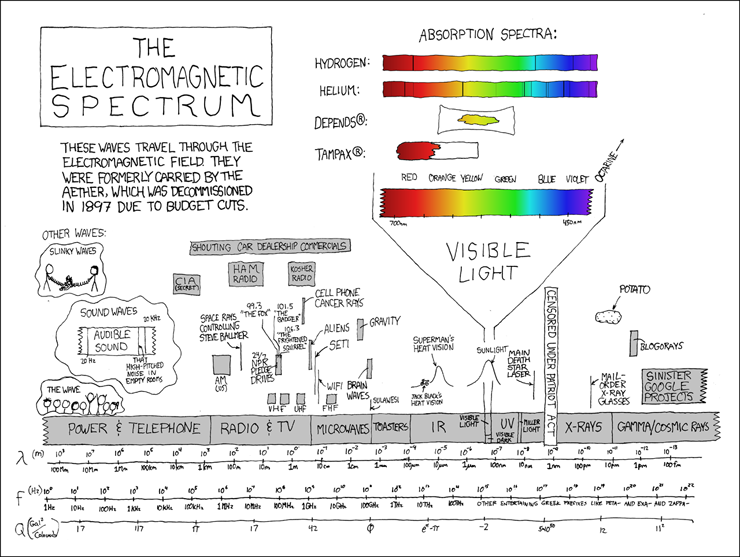
Let’s start with a quick primer. When we talk about radio waves, we are really talking about a small part of the electromagnetic spectrum - the range of all types of electromagnetic radiation (EMR). EMR is classified by wavelength into radio wave, microwave, terahertz (or sub-millimeter) radiation, infrared, the visible region that we perceive as light, ultraviolet, X-rays and gamma rays.
Our transmitters are talking from eagles on the ground to satellites in space using radio waves with a frequency of 401.664 MHz.  As the chart above shows, the higher the frequency, the shorter the wavelength. The shorter the wavelength, the smaller the antenna. So if a higher frequency means a smaller antenna, why aren’t we broadcasting at, say, 30GHz – the top end of the radio spectrum? An organization called the International Telecommunication Union coordinates the shared global use of the radio spectrum, which includes assigning radio frequency allocations for space communication. 399.9 - 403 MHz is the band that ITU has allocated for navigation, positioning, time and frequency standard, mobile communication, and meteorological satellites. Geo-Trak’s satellite tracking products use the Argos satellite network, which transmits and receives data at 401.650 MHz (± 30 kHz). Argos is using the highest frequency available to them.

So why does frequency impact antenna size? The wavelength of a frequency is the distance an electromagnetic wave travels to complete one cycle. As the image at right shows, a 401.664 MegaHertz signal (a signal that oscillates, or moves through a complete cycle 401.664 million times in one second) has a full wave length of 29.38 inches, a half wave length of 14.69 inches, and a quarter wave of 7.34 inches.

For the antenna to radiate properly, it needs to match either the full wave or one of its major harmonics. Therefore, 7.34 inches – a quarter wave - is as short as the antenna can be and still function. Perhaps improvements in materials, circuitry, and/or manufacturing will someday allow smaller antennae to be used in satellite tracking, but for now, a whip antenna is our only choice for robust ground to space communication.

The image at left shows an electrical wave oscillating through a full wave antenna, where the antenna is the same size as the wavelength. If the antenna were longer or shorter than the wavelength it is propagating, it would work less efficiently or not at all. A dipole antenna breaks the wave into two pieces, so it can be half as long as a full wave antenna. A quarter wave antenna - the kind used on our PTTs - breaks the wave into four pieces and can be a quarter the length.

I found the distance traveled to be quite fascinating. If you do the math, 29.38 inches (the distance it takes for our signal to complete one cycle) multiplied by 401,664,000 cycles per second equals roughly 186,000 miles per second. It takes a lot less than a second for messages to travel from the Dynamic Duo (D24 and D25) to the Argos satellite system 528 miles overhead.

Will electromagnetic radiation of an antenna hurt the eagles?
No. Terms like electromagnetic radiation are frightening, but not all electromagnetic radiation is harmful. Innately dangerous electromagnetic radiation is found in the high-frequency end of the spectrum, since high frequency waves are a lot more energetic than low frequency waves.  Think of it this way:  gamma rays have frequencies of 1 x 10²¹ Hertz, which means that the wavelength crests, or hits its highest potential energy point, 1 sextillion times or cycles per second. That packs a punch! By contrast, visible light has a frequency of around 5 x 10¹⁴ (500 trillion cycles per second), microwaves have a frequency of 1 x 10¹⁰ Hertz (ten billion cycles per second), and our radio waves have a frequency of 4 x 10⁶ (400 million cycles per second).

Power is also a factor. I have a 1500-watt microwave oven that can damage living tissue. However, it is literally almost 7000 times more powerful than the 225mW solar units that power the transmitter. Even cellphones produce radio waves that are more powerful and energetic than ours.

What about insect studies? Those antennae are really small!
A lot of really cool work is being done with insects. While some of the technologies involve active transmitters, which require batteries, others use passive devices like RFID tags and geolocators. Passive devices don’t require much power and can be made extremely small. A couple of links:
Unfortunately, passive devices can’t transmit. Researchers don’t get data unless the animals move in close proximity to a reader (think of a feeding station where animals might gather), or they are recaptured for a data download. Geolocators could be used to track migratory peregrine falcons that return to the same nest box year after year, but they aren’t a good fit for tracking juvenile or sub-adult eagles that wander unpredictably and often widely.

The tiny little transmitters used in tracking insects are very cool – check out that tiny backpack! – but they have short battery lives (7-21 days) and a limited tracking range on the ground only (100-500m). As neat as they are, they aren’t suitable for tracking juvenile and sub-adult eagles either.

In short…
We can’t get rid of the antenna, which is as short as it can be given the frequency of our ground to space transmission. Argos did a great job designing a package that is light, safe, reliable, and trackable almost anywhere on earth, especially given the physical requirements of the transmission system. The transmitters do not harm bald eagles or impact their social or reproductive interactions with eagles that aren’t wearing transmitters. Passive devices aren’t a good option since juvenile and sub-adult eagles range unpredictably and often widely before settling down to nest, while tiny active devices have short battery lives and a limited ground-only tracking range – something that won’t work for animals that can fly hundreds of miles and live relatively long lives.

However, research into insects and small birds is driving tracking devices to become even smaller.  If at some point appropriate tracking hardware becomes available with a smaller antenna, we will use it.

Did you know?
The wavelength and frequency of electromagnetic waves are closely related. If you have a frequency, you can get the wavelength, and if you have a wavelength, you can get a frequency. With the wavelength, you can determine the length of the antenna you need to transmit or receive radio waves at a given frequency. The formula looks like this:  Wavelength = Wave speed/Frequency.

Let's say that I have a frequency of 401.664 MHz, or 401,664,000 cycles per second. The wave speed is the speed of light, which can be expressed as 3x10⁸ m/s or 300,000,000. If I divide 300,000,000 by 401,664,000, I get .7468 meters. Since I was raised in the English system, I immediately convert it to inches or feet, which gives me an antenna length of 29.38 inches. This was very helpful when trying to determine why the antennae on our PPT systems are the length they were. This web calculator provides lengths for half and quarter wave antennas if you want to play around with making them: http://www.csgnetwork.com/antennagenericfreqlencalc.html

What could you do with an antenna? There is a community of people that listen to the earth via homemade VLF radios. This website provides an introduction to the concept and some online streams: http://abelian.org/vlf/

Resources that helped me learn and write about this:
Since you made it to the bottom, I hope you enjoy this bonus image. XKCD explains the spectrum as only they can!


Friday, July 08, 2016

DN2 Autopsy Report

We received a final autopsy report on DN2. The eaglet died as a result of Methomyl toxicity, although caffeine was also present. An analysis of DN2’s liver ruled out lead and mercury as the cause of death. It did not include information on the sex of the eaglet.

What is Methomyl?
Methomyl is a broad spectrum insecticide introduced in 1966 to kill a variety of insect pests. It is registered for commercial/professional use on sites including field, vegetable, and orchard crops; sod farms; livestock quarters; commercial premises; and refuse containers. It is toxic enough that products containing more than 1% Methomyl are not available for homeowner or non-professional application.

How were DN2 and Mom North poisoned?
While we don’t know for sure, Methomyl is sometimes used off-label to kill wildlife species that become problematic. 1% Methomyl products including Golden Malrin, Lurectron Scatterbait, and Stimukil are placed in sweet solutions, including caffeinated colas, to poison animals like raccoon that some consider pests and can cause damage to buildings and farm animals. Given the presence of both Methomyl and caffeine, it seems likely that Mom North found a Methomyl-poisoned dying or dead mammal and brought it to the nest to eat. It wouldn’t have taken much to kill DN2 or Mom North, since Methomyl is highly toxic.  Based on what we observed, Mom North was able to metabolize and recover from what she ate, but DN2 was not. While it is possible that the poisoning was the unintended consequence of a legal use of Methomyl, the caffeine suggests it was not.

For more about the problems of baiting wildlife with Methomyl, follow this link: http://www.sciencemag.org/news/2016/02/regulators-move-limit-wildlife-deaths-misuse-deadly-fly-killer

Is this legal?
It is not. While Methomyl and many other pesticides and insecticides are legal when used in a manner consistent with labeling, it is illegal to go off-label and use them in a manner for which they are not intended. Fly bait is legal when used according to direction and illegal used in any other way. There may be state and federal penalties for people caught misusing it, depending on state and federal law, and what species are killed.

What are you going to do about it?
We have already reported the incident to the Iowa State DNR and the US Fish and Wildlife Service, and will report it to the EPA and the manufacturer of the most likely culprit, Golden Malrin. We will also use our RRP website, Facebook and Twitter audience to help spread the message about misuse of Methomyl and let people know that they can petition their states to reclassify Methomyl fly baits as restricted products should they choose to do so. We would love to say that this was an isolated incident, but a quick search for “golden malrin raccoon” reveals just how widespread the practice is. Google it and join the discussion!

Do you know who did it?
No. There is a lot of variability in eagle home ranges. While immediate nest defense/core territories tend to occur within 100 square meters or so of the nest, hunting territories vary considerably.  One study documented bald eagle summer home ranges that varied from 3 square miles to 18 square miles depending on age, nesting status, and available resources. But other studies have found even wider ranges in nesting bald eagles, including 37 square miles for a pair in Louisiana. The landowners in the immediate vicinity of the nest have expressed their commitment to conservation.  With bald eagles searching and scavenging for food over a large area, there is no way to know exactly where it cam from. We are not an enforcement agency, but we have reported what we know to enforcement agencies.

We don’t believe that anyone meant DN2 or Mom North any harm. But people need to know that off-label poisoning kills unintended targets and can have serious legal consequences. We don’t believe that anyone meant DN2 or Mom North any harm. But people need to know that off-label poisoning kills unintended targets and can have serious legal consequences. This may also be a good day to check garages, basements, and storage sheds to see what noxious and toxic herbicides, rodenticides, and insecticides are on hand that have tragic consequences for wildlife, pets, and humans. Want something to replace those highly toxic chemicals? Check out the Bio-Integral Resource Center (http://www.birc.org/) and their list of least-toxic pest control products: http://www.birc.org/2012Directory.pdf. Even if you can't go completely toxin-free, you can reduce harmful consequences by using products correctly and choosing the least toxic option. You can help by sharing and spreading the word to prevent the unintentional killings of bald eagles and other animals.

Note that Methomyl is toxic enough that the Environmental Protection Agency (EPA) and Methomyl manufacturers have agreed to limit use on certain crops to reduce risks to drinking water: http://bit.ly/29yhNcY. EPA and manufacturers have also reached an agreement to stop making and selling some fly bait products and to add information to the label that clarifies the approved uses. EPA believes that these changes will reduce the illegal use of methomyl fly bait products which can kill wildlife, an issue that was reported to EPA by a number of states.

Are you an academic studying this issue? Please contact us by emailing amy@raptorresource.org.

Friday, May 27, 2016

Intervention at Decorah North Nest

As watchers at the Decorah North Nest know, female eagle Mom North brought some tainted prey into the nest on the afternoon of May 25th. She fed DN2, who promptly died, and ate some herself. Until we shut the cams off, horrified watchers saw a very sick Mom North struggling in the nest.

Neil Rettig and veterinarian Laura Johnson monitored the nest through a private channel. As the night passed, Mom North began to recover from whatever the prey had been tainted with. After she flew off the nest on the morning of May 26th, we knew we needed to make a plan to recover DN2. We wanted to autopsy the eaglet to determine the poisoning agent and prevent Mom from feeding DN2 to DN1 and killing DN1 as well.

The morning started with a call to Kike Arnal, who had climbed into the north nest last fall. Like Neil, he expressed some concern about going into the nest itself and recommended that we try to recover DN2's body with a hook or catchpole. Fortunately, Neil was available to climb. Several of us are versed in rope technique, but the North Nest is very tricky to access and Neil is the only one of us with tree spike experience, which he used to avoid potentially injuring the eagles with a crossbow bolt or line. While Neil, Laura, and Dave Kester made a plan, Amy Ries got busy working on the permit side of things.

Bald eagles are protected by a number of laws, including the Bald and Golden Eagle Act, the Migratory Bird Treaty Act, and the Lacey Act (introduced in 1900 by an Iowa congressman). It is highly illegal to trespass on an active bald or golden eagle nest or take, possess, sell, purchase, barter, transport, or export or import any bald or golden eagle, alive or dead, including any part, nest, or egg. The penalties are severe and may include a fine of $250,000 or two years of imprisonment, which is doubled for an organization. Should we be found to have broken the Bald and Golden Eagle Act, we could also lose our banding permits, which would end our banding program. While these laws may seem harsh, they have been an important part of returning the bald eagle to the American landscape, and we had no intention whatsoever of running afoul of them.

Amy contacted Deanne Endrizzi from the US Fish and Wildlife Service, and Pat Schlarbaum and Bruce Ehresman from the Iowa DNR. She explained the situation and outlined our plan. We would recover DN2 without going into the nest and take the body to Iowa State University's College of Veterinary Medicine for autopsy. The Iowa State DNR and the US Fish and Wildlife Service approved our plan very quickly and we were able to recover DN2's body yesterday afternoon. It is on its way to Iowa State University now. We don't know how long it will take for the results to come back.

Parent in tree
Dave retrieving DN2 from the catchpole
Why did you intervene?
We usually don't intervene in nest life. Wild birds survive and thrive in the presence of things that seem frightening and even awful to human watchers, including bad weather, predators, injuries, and aggression. Although humans found the death of DN3 appalling, it was completely normal eagle behavior. But poisoning is not nature taking its course and all parties agreed that intervention was appropriate and allowable in this case.

What happens next?
We are continuing to monitor the nest remotely, but the camera will remain off for live viewing for the time being. Mom has been in the nest with DN1, who has been fed and looks like a healthy, alert young eagle.

DN1 in the nest on the morning of May 27, 2016. 

Thanks to Neil Rettig, Dr. Laura Johnson, Dave Kester, Kike Arnal, John Howe, Deanne Endrizzi, Bruce Ehresman, Pat Schlarbaum, Allamakee county conservation officer Burt Walters, the US Fish and Wildlife Service, the Iowa Department of Natural Resources, Dr. Steve Ensley, and Iowa State University's College of Veterinary Medicine for their quick action and help. Your advice and experience were invaluable!

We've had some requests for the last video shot from the nest before we turned it off. This video shows an ill Mom in the nest, as well as DN2. If you find it disturbing to watch, please do not follow the link. I witnessed the event and found it very disturbing: https://youtu.be/g4ZC72FurzE


Monday, May 23, 2016

Proposed 30-year take of bald and golden eagles

As a lot of eagle fans are aware, the Fish and Wildlife Service recently announced a plan that would allow companies to kill federally protected bald and golden eagles for up to 30 years. The draft rule will extend the current permit duration of five years to up to 30 years, giving wind farms, power lines and other large projects license to injure, disturb or kill a limited number of eagles in exchange for commitments to avoid and mitigate harm.

The proposed rule has positives and negatives. Before we discuss them further, the public is able to comment on the rule until July 5th, 2016, although comments on the information collection aspects of this rule must be received on or before June 6, 2016. You can comment by going here: https://federalregister.gov/a/2016-10542 and pressing the green 'submit a comment' button on the top right of the page. We encourage people to read through some of the public comments prior to submitting their own.  The Fish and Wildlife Service also has comments and responses available on its website.
Please read the rest of this blog for more information prior to commenting. 

History
The US Fish and Wildlife Service initially introduced a 30-year take rule in 2009. After reviewing the proposal, the American Bird Conservancy took the US Department of the Interior to court in 2014, stating that the Department of the Interior violated federal laws when it created a regulation allowing wind energy and other companies to obtain 30-year permits to kill protected Bald and Golden Eagles without prosecution by the federal government. The court agreed and the rule was invalidated in 2015. The Fish and Wildlife Service introduced a new rule in 2016, although it did not remove the 30-year take.

The current permitting program is voluntary: that is, companies can choose whether or not to join. The Fish and Wildlife Service hopes to bring a greater number of utility companies into the permitting program by changing the mix of penalties and incentives. Although the plan is not without negatives, more participation will yield more data about best practices for wind power and help determine how many birds and bats are killed by turbines.

Negatives
  • The plan seems heavily predicated on mitigation, and there are only a few mitigation methods for wind energy that have been verified to reduce bird kills.
  • Post-construction eagle mortality data is collected by paid consultants to industry instead of third-party experts, which is a conflict of interest.
  • 30 years is a very long time to allow take of bald and golden eagles. Technology and bird populations can change much more rapidly than the proposed take period. 
  • Permits remain voluntary. Companies can chose not to participate at all, although they will suffer legal penalties under the Bald and Golden Eagle Act and the Migratory Bird Treaty Act if they are found to have killed eagles. 
Positives
  • The proposed regulations require applicants for permits with durations of longer than 5 years to conduct a minimum of 2 years of pre-application surveys. Surveys are currently voluntary. 
  • Participation is voluntary and many companies currently opt out. Companies that join the permitting program will be under additional government scrutiny and are required to submit to a five-year review by the FWS, even though the 30-year take permit still stands overall. Companies found to be exceeding their take limits will be subject to additional penalties.
  • The new rule allows for more flexibility in responding to local conditions and adopting new technologies. 
A permitted bald eagle take is problematic to most of us and, as the American Bird Conservancy stated,  "...‘green energy' isn't green if it is killing thousands of eagles and tens of thousands of other birds annually." [link to statement]. However, no form of energy is free of cost to wildlife and wildlands. Coal mining is environmentally destructive in many ways, nuclear energy has a waste disposal problem, birds and bats hit turbines, and electricity produced by all three is transmitted over hundreds of thousands of miles of electrical lines that come with their own collision and electrocution risks. At this time, the Raptor Resource Project supports properly sited wind power as a renewable energy source that helps reduce the threats posed to birds and people by climate change. But we also believe that wind farms can and should be properly sited and operated in ways that minimize harm to federally-protected species.  We will be following the American Bird Conservancy very closely on this issue and encourage those of you who are concerned about the issue to submit comments. Please remember to write clearly and constructively if you do. I have participated in public comment meetings, and incoherent or inaccurate comments are not taken seriously by rule makers.

I was just emailed this link yesterday: http://www.postbulletin.com/news/local/eagle-nest-puts-brakes-on-xcel-energy-wind-turbines/article_d9026393-996a-53f0-9b1b-3e4cef7310c5.html. The article is about an Xcel Energy wind project. Xcel Energy was the first company to sign a Memorandum of Understanding (MOU) with the Fish and Wildlife Service, which Bob was always very proud of. It shows the benefits that participating in these kinds of programs can yield, as well as the challenges of accommodating a bald eagle population with some very different behaviors and territories than those of America's historic bald eagles.

Resources

Thursday, May 12, 2016

Decorah North News: DN3 has died

Eaglet DN3 died sometime yesterday. Why did DN3 die? While it didn't get nearly as much food as its larger siblings, it was still shooting poop yesterday, indicating that it had enough in its system to be pooping and excreting urates normally. However, DN3 may not have eaten yesterday and didn't eat much the day before that. It also didn't help that the weather was cold and damp. Mom and Dad North are brooding based on the older nestlings, who no longer require daylight brooding unless it is raining, snowing, or unusually cold. DN1 and DN2 have thermal down, but DN3's thermal down was just beginning to come in and it would have benefited from brooding.

We suspect there is no one cause for DN3's death. The six-day difference between DN3 and its oldest sibling resulted in insurmountable developmental differences, including dominance interactions that DN3 always lost given its much smaller size, a resulting lack of food, and a lack of brooding before it was really able to thermoregulate on its own. Had the weather been warmer, DN3 might have been able to survive even given the shortage of food and dominance interactions with the older two, but all three together were too much.

Are Mom and Dad North bad parents? No. Eagles don't fit neatly into our human ideas about what good parents are. The older two have been thriving under their care. From an eagle point of view, there is no purpose in caring for weaker young that are less likely to survive than healthy young. Personally, I would love to have seen DN3 survive and I was very hopeful up until yesterday afternoon. But as someone who loves and watches birds, I also need to accept that this is what they do. Humans don't make good parents for birds.

Why didn't we intervene? What happened at the North Nest is completely normal from an eagle perspective. It is well-documented that the youngest member of a three-nestling clutch can die, even though we haven't seen it in Decorah or Fort St. Vrain (eaglets have died because of hypothermia and illness at FSV, but those were very straightforward deaths and didn't involve just the youngest sibling). We haven't intervened in these situations in the past and will not moving forward.

Watching wild creatures doesn't give us ownership over them. The lives of 'our eagles' are truly their own and this was yet another example of how we differ from them. Juliet Lamb has some excellent perspective on the relationship between watchers and watched here: http://daily.jstor.org/wildlife-cams/


.


Tuesday, May 10, 2016

What is going on at the Decorah North Nest?

What is going on at Decorah North? The oldest eaglet, DN1, is displaying far more aggression than we are used to towards its siblings. It is upsetting to human watchers, especially since little DN3 takes much of DN1's biting, yanking, and twisting. However, we have also seen DN1 and even DN3 attack DN2. In most cases, the aggressive behavior ceases once the target submits, but we have seen biting and bonking continue past submission at least twice.

Why is this happening?
We don't know. Food certainly seems to be part of the puzzle, since we've often seen the eaglets act aggressively towards one another as they establish a feeding-related pecking order. However, we've also seen aggression break out in circumstances seemingly unrelated to food. For example, DN3 attacked DN2 at around 2pm this afternoon, giving it multiple bites, yanks and twists before DN2 submitted. The eaglets had all been fed well earlier today, so why the aggression? Perhaps differences in age and size also contribute to aggression. I would tend to believe that aggressive behavior is hard to stop once it starts, and I'm very curious whether we will see the drop-off in aggression here that we have seen in Decorah.

While siblicide is rare, aggressive behavior is common. It ranges from the relatively mild aggression seen in Decorah and at Fort St. Vrain to the biting, twisting, and yanking seen at Decorah North, Southwest Florida, and several other nests. I think this looks odd and frightening at least in part because Decorah has tended to lack extreme aggression. But Decorah and Fort St. Vrain could very well be outliers when it comes to eagle behavior. At this point, only the eagles know for sure.

Is DN3 growing normally?
It is very tough to tell with nothing but the two 'Cropzillas' to compare it to. DN3 is growing in thermal down to replace natal down, has gotten larger relative to the other two (seemingly overnight!), and is growing footpads. What we've been able to see of its beak has indicated a fairly regular size and shape in accordance with eaglet growth curves, and its talons are appropriately changing to black.

DN3 is just moving into the steepest part of its growth curve. The next five to seven days will give us a look at whether or not it is growing normally. We'll also look for developmental changes like nest wandering, attempting to stand, and tracking Mom and Dad outside the nest. DN3 has already been observed doing some of those things on warm days and we should see them more often as its thermal down grows in.

Is DN2 growing normally?
Yes, DN2 is growing and behaving normally.

Will DN3 survive?
DN3 is strong, gets fed, participates in nest aggression, and submits appropriately. The eaglets tend to fight with their beaks instead of their talons and, while the aggression looks frightening, DN3 hasn't been badly injured. It is rapidly growing in thermal down, which will help protect it from cold weather and aid nest exploration. Fighting is very hard to watch, but generally rare when one compares the time spent fighting with the time spent laying around the nest and eating.

There are no guarantees, but siblicide is uncommon and DN3 is much stronger than it seems. It often comes back with its own beaking, displaying its own fierceness, or can be seen afterward cuddling up to a former aggressor. We are hopeful it will survive and even thrive as it grows...but again, there are no guarantees with wildlife.

Will you intervene?
Absolutely not. We might consider interfering if the situation were human-caused, but these behaviors are completely normal from an eagle perspective. If we rescued every eaglet we were concerned about, there would be no wild eaglets left to watch. It is very important to keep eaglet behavior in perspective. For the most part, the parents have acted according to our expectations: feeding, interacting, brooding, and in general caring for their family. While the eaglets fight with one another, they spend more time cuddling, eating, and sleeping. While the fighting is upsetting to watchers, none of it is out of line or outside the parameters of normal eagle behavior.

In summary, the worst may happen but we are not giving up on DN3. The next five to seven days will tell us a lot more about its growth. It looks like we are starting to get pinfeathers on DN1, which means its growth will start slowing as feathers take over. While we have never seen this level of aggressive interaction in Decorah, eagles have survived it at other nests. We remain hopeful.

Kay from SOAR also provided some feedback after she was approached about the situation. She agrees that the situation "looks" terrible but that at this developmental stage of the eaglets they don't have a huge amount of strength in their beak.  Right now, those beaks are something like pointy salad tongs. Hopefully all three eaglets will grow well and this will not be a concern for much longer.  


Tuesday, May 03, 2016

Decorah North: DN1, DN3, and today on the nest

Watchers of the Decorah North Nest got quite a shock today after DN1 went after DN3 with a ferocity we haven't seen at any of the bald eagle nests we watch. It looked liked this:
  • Mom North lands on the nest, chasing away a sparrow that was stealing straw from the nest. DN1 and DN2 are huddled together at about 7:00 on the left side of the nest, while DN3 is laying at about 4:00 on the right side of the nest.
  • Both eaglets rise to a sitting position.
  • DN1 dominates DN2, pecking and pulling on DN2's left wing. DN2 submits and DN1 stops.
  • DN1 shoots poop, staying at roughly 7:00..
  • DN3 sits up and walks over to the turkey wing at about 3:00, where it appears to be look up at Mom. Keep in mind that the eaglets are walking on their tarsi, not their feet.
  • DN1 walks from 7:00 to 3:00 and begins a dominance interaction with DN3. In addition to pecking, DN1 bites and pulls on DN3, who submits. 
  • As DN3 submits, it rolls against DN1, scraping DN1 with its talons in what appears to be an accident.
  • DN1 resumes the dominance interaction, pulling and biting at DN3's wing and body and flipping DN3 over. DN3 remains in a submissive posture.
  • DN1 pulls DN3 up by the 'scruff' of its neck four times
  • Mom North, who has been watching the entire interaction, walks over and looks at DN1.
  • DN1 ceases the interaction, although we don't know to what degree Mom North interfered with it. Was DN1 ready to quit given the lack of a response from DN3, or did Mom's arrival distract DN1?


Following this event and subsequent battles, the ugly specter of siblicide - one sibling killing another - leapt to everyone's mind. So how common is siblicide in bald eagles? Sources disagree, with some referring to it as relatively common (University of Nebraska, American Eagle Foundation) and others calling it fairly rare (Hornsby). It hasn't yet occurred at any of our cams - not in Decorah (since 2008), not at Decorah North (since 2016), not in Fort St. Vrain (since 2003), and not during the one year we were able to watch Eagle Valley (2013). Our nests have different parenting 'styles', levels of food availability, surrounding environments, and nest invaders, but to date all eaglet fatalities have been caused by hypothermia, predators, and suspected disease. Why did DN1 take after DN3 and (to a lesser degree) DN2 today? We don't know, but as tough as it was to watch, it wasn't especially prolonged and didn't lead to death.

People also worried about a lack of food deliveries to the nest. While we don't know why parents don't pile up the pantree here as they do in Decorah, birds of prey (even young ones) can go a long time between meals. The eaglets remain healthy, alert, and pooping, which tells us that their digestive systems are working just fine. They are moving around the nest, interacting with one another and with parents, and showing interest in their surroundings. I'm sure they would like a meal, but they aren't starving yet and won't be for some time.

Several people referred to Dad and Mom as 'bad' parents. Again, different nests have different parenting styles, but eagles don't divide neatly into human narratives of good and bad behavior. It is a warm day, the young don't need brooding, and either Mom or Dad have been perched nearby much of the day. They are taking care of their young as they see fit, and we know from studies on human-raised birds that young birds have very different needs than young humans.

We've also been asked if we will rescue DN3. Absolutely not. We might consider interfering if the situation were human-caused, but what happened today was completely normal from an eagle perspective. If we rescued every eaglet we were concerned about, there would be no wild eaglets left to watch. It is very important to keep today in perspective. This is one of the first days we have seen a lot of concern about Decorah North. For the most part, the parents have acted according to our expectations: feeding, interacting, brooding, and in general caring for their family. It is also the first day - the first time - we have seen that level of aggressive interaction in one of the bald eagle nests we watch. But none of it was out of line or outside the parameters of normal eagle behavior. If eaglets died after a warm day with just one meal, we wouldn't have eagles to admire and worry about.

In 2011, a follower sent me a lovely watercolor painting of the fledglings at the Decorah nest. It said "You are braver than you believe, stronger than you seem, and smarter than you know." It remains a favorite artwork of mine and I often think of it when I am concerned about the eagles. As anthropomorphic as the painting may be, eagles are truly stronger than we think and often smarter than we know. As much as we love them, they are only their own and what we saw today was simply part of the way they live their lives.

Note: Hornsby follower gzebear compiled observations from 147 nests checked in an 8 year period and found only a 2% incidence of siblicde in hatches of 2, and 3.8% in hatches with 3. Follow the link to read gze's data, references, and additional comments from contributors to the thread. I think it might be time to revisit the whole subject of three-egg versus two-egg clutches. How common is one versus another? Are there regional differences? Is it an inheritable trait? Do we have more three egg clutches than we used to? It's off-topic here, but I subject that interests me quite a bit.