Wednesday, April 13, 2016

Eaglet Growth and Development: Week Two

D24 and D25: 04/04/16
D24 and D25: 04/12/16

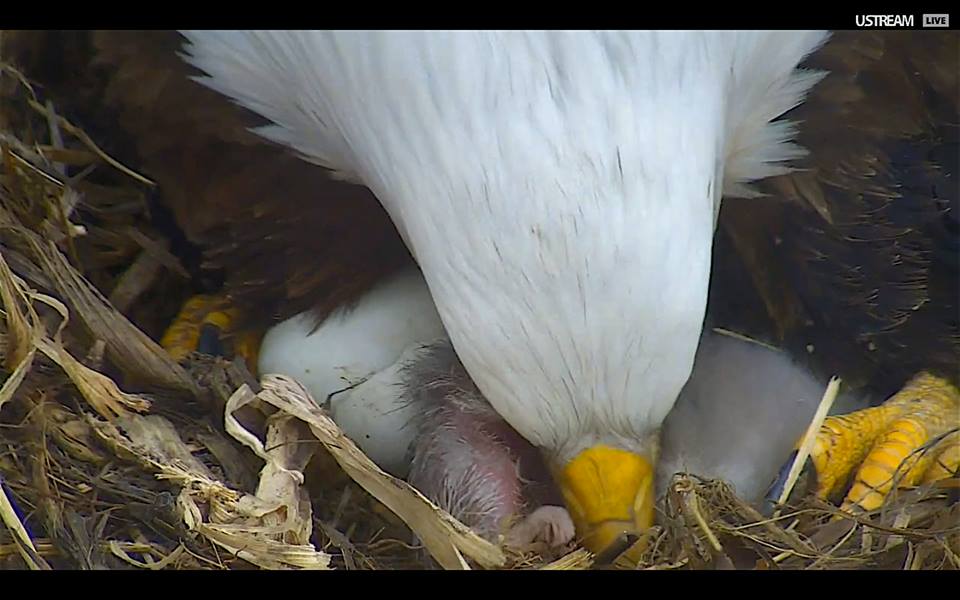
D24 is 15 days old today, while D25 turns 13 days old. The week-old difference between these two photos is striking. In their second week of development, the eaglets grew larger, gaining roughly two pounds between April 4th and April 12th. They experienced rapid growth in features like beaks, culmens, and footpads, replaced their white natal down with thicker grey thermal down, and began exploring the nest. Although they aren't yet standing on their toes, they are able to sit up - way up! - for feeding and shuffle around on their metatarsi.  Their eyes are wide open and fit more comfortably in their eyesockets, features like brow ridges are beginning to appear, and their legs and footpads are yellow, not pink. 

Gary Bortolotti wrote that bald eagles might gain more weight per day than any other north American bird, although the majority of their weight gain occurs within the first 30-40 days. This rapid weight growth is fueled by their nutrient-rich diet of meat. Over the past week or so, we watched the eaglets chow down on fish, roe (fish eggs), venison (aborted fetal deer), rabbit, squirrel, something that might have been a muskrat, waterfowl, and several other birds. D24 became proficient enough at shooting poop to christen the Poopcasso tree on April 5th, while both eaglets got in plenty of tussling and bonking play, alternately hitting, submitting, and quitting to cuddle in the nest cup, grow, and wait for more food to arrive.

Watchers have been asking why the Fort St. Vrain eaglets began wandering the nest so much earlier than the Decorah eaglets. While we don't know for sure, we suspect that temperature played an important role. Fort St. Vrain experienced unusually warm temperatures in late March and early April, and the leaves hadn't unfurled to provide shade for the nest. Cold is a challenge to eaglets under 10-15 days of age, but so is heat! With little ability to control body temperature and no way to lose heat except by panting, the eaglets did their best to retire to what little shade tree limbs and the nest itself offered. Once in the shade, they sprawled out as much as they could. Mom did her best to provide shade for the eaglets, moving from one to another and standing between them and the sun.  As alarming as it was to viewers, Mom's ploy worked and we didn't see quite as much wandering, at least for a few days, after the weather cooled down. 

In the week to come, we can expect (continued) rapid growth in footpads, talons, and legs. Beak growth will rapidly slow as the eaglets' beaks approach adult size and we may see dark juvenile feathers start to sprout from their grey down. Overall weight and height gain will continue, most  likely reaching their steepest curves some time this week. By the end of the week, our little bobbleheads at Decorah and Fort St. Vrain will be almost a foot tall, while the eggs at Decorah North should begin hatching! 

Watchers have observed that different nests seem to have different 'parenting' styles: i.e., Dad may be more present at one nest than another, food may come in more or less regularly, and eaglets might spend more time alone. Many things influence nest life, including weather, temperature, food availability, predators, and the presence of other adult, sub-adult, and juvenile bald eagles. While eaglet growth and development occurs along a fairly predictable trajectory, local conditions can change the timing of events - something we've seen in Decorah, Fort St. Vrain, and the year we watched Eagle Valley. We are looking forward to hatch at Decorah North!


The general stages of eagle development are:

Stage 1 - Structural growth. In their first thirty-five to forty days of life, eagles grow very rapidly, gaining weight and building bones, muscles, tissue, and features like tarsi, footpads, toes, and claws. This phase of development slows down about halfway through an eaglet's time in the nest, even though individual features might continue some level of growth.

Stage 2 - Feather and flight-related growth. Eagles grow four sets of feathers - natal down inside the egg, thermal down, juvenile feathers, and adult feathers. Thermal down starts growing at about ten days, juvenile deck feathers at about 20-23 days and juvenile flight feathers at about 27 days, but feather growth doesn't overtake structural growth until thirty-five to forty days after hatch. Flight muscles also begin growing as eaglets wingercize, flap, hover, and eventually branch and fledge.

Stage 3 - Neurological Coordination. Eagle watchers know how ungainly eaglets can seem! As they grow, they become more adept at controlling beaks, legs, wings, and feet. They learn to stand on their own feet, tear food, self-feed, and flap their wings, going from cute but clumsy clown clompers to graceful young eaglets poised at the edge of fledge.

I'm not sure how familiar many of you are with the cortical homunculus, an image-based tool that maps tactility. We discussed it very briefly in this blog and I'll include links below. While useful and extremely cool, most cortical homunculii are static - that is, they reflect just one phase (usually adult) of an organism's life. But an eaglet's cortical homunculus will differ from an adult's as body parts and associated skills are gained and neural pathways developed. Our eaglets' brains and bodies are rapidly growing and changing as they gain the skills they need for life outside the egg! I'd tend to think that visual acuity suddenly 'lit up' this week, leading changes in coordination as the eaglets began sitting up and moving around.

Things that helped me write this blog, with a few considerations:

Thursday, April 07, 2016

Is the last egg going to hatch?

The last egg in the Original Decorah nest
As of this morning, the unhatched egg in Decorah is somewhere between 49 and 42 days old. Can it still hatch? Eagle eggs have hatched as late as 44 days after they were laid. If this is the last egg, we still have roughly two days in which hatch could occur. However, eggs have never hatched this far apart in Decorah before. Given the dates, it is possible that we've seen the hatch of eggs number two and three instead of eggs number one and two as we initially assumed. Roughly 3% to 12% of bald eagle eggs fail to hatch based on the studies I read, although some sources put the number a little higher, at 10% to 25%.

So why wouldn't the egg hatch? Eggs fail to hatch because they are either infertile or nonviable. Infertile eggs occur when the ovum is not fertilized before it begins its journey down the female's oviduct. We know that bald eagles copulate frequently before and during egg laying, which helps assure that sperm is present in the right place (the infundibulum) at the right time (when the ovum arrives).  Since female birds don't have a way to reject or stop the egg-laying process once it begins, incomplete, poorly timed, or insufficient copulation can result in unfertilized eggs.

A nonviable egg occurs when an embryo fails to develop properly and dies. This is mostly likely to happen within the first three days of incubation (embryonic organs fail to develop) or the last three days immediately prior to hatch (major organ failure becomes apparent or hatch starts but cannot be completed). Non-viability can happen for a number of reasons, including:
  • Insufficient incubation. Incubation is fairly complex! Eggs must be kept at the proper temperature and humidity and turned regularly. Freshly laid eggs can spend time in the zone of suspended development (roughly 28.4 to 80.6°F) with no harm to the egg or embryo, but eggs must remain between about 99 and 104°F once development starts. Time off the eggs regulates humidity and helps keep pores from clogging. Turning or rolling the eggs prevents the developing embryo from sticking to the side of the egg, brings it into contact with fresh 'food' and important nutrients supplied by the yolk and white, and assures proper development of the membranes that exchange gas and protect the embryo from contaminants. 
  • Piercing or cracking of the shell. If the egg shell is pierced or cracked before the embryo is fully developed, it will die. This can happen if the egg is jostled too vigorously, stepped on, or damaged or destroyed by an intruder - something that has been documented in many species of birds. 
  • Insufficient nutrition. Given all that we've seen the eagles eat, this doesn't seem to be especially likely in Decorah. But if a female bird is insufficiently nourished before she begins laying eggs, her eggs won't have the nutrients needed to nourish the developing embryo. 
  • Bacterial or chemical contamination. Although the embryo is protected by a shell and layers of membrane, contaminants can sometimes make their way into an egg and impede or kill the embryo inside it. 
We aren't going to attempt to retrieve the egg if it doesn't hatch - at least not while the birds are in the nest. Without opening the egg, we have no way of knowing why it failed. On one hand, the eagles spent a surprising amount of time off the first two eggs. On the other, studies in some species of birds indicate that infertility is more common than non-viability. Infertility is also more likely to prevail in first and last-laid eggs, which is unsurprising given the importance that timing plays in fertilization. 

What will happen to the egg? Different species do different things, but bald eagle eggs are commonly buried under layers in the nest, where they presumably break and decompose. Eggs may also be pierced or trampled as siblings grow and become more active. We will look for the egg if we go into the nest this fall. If we find it intact, we will turn it over to the USFWS for study. 

Will the next eaglet to hatch be called D26 or D27? This is confusing to followers who have seen nothing but production success. However, peregrine falcons aren't always successful and we don't count production until after banding. A falcon that makes it to fledge but dies soon after is still considered in production counts, but a falcon that dies before banding is not. If this egg doesn't hatch, the next living eaglet will be called D26. 

It's hard to believe that we could have an unhatched egg after so many years of success. How many times have we been worried about something only to have it all turn out right? But eggs don't always hatch and even excellent parents like our Mom and Dad experience failure. I'm glad we have D24 and D25 to watch this year and I look forward to studying the dynamics and rearing of two siblings, even though I wish there were three.  If we have a chance, we'll retrieve the egg for inspection and we will also review the video record to determine how much time was spent off the first egg.

Note: While I included contaminants on the list of things that can cause eggs to fail, my guess would be that this egg failed due to infertility (statistically more likely according to what I could find) or incubatory failure due to cold exposure.

Friday, April 01, 2016

Eaglet Growth and Development: Week One

Newly hatched D25, March 31st 2016
D24 is three days old today, sibling D25 is not quite a day old as I write, and D26 is still inside the egg. What can we expect in the first week of watching?

Weight Gain!
Like humans and other animals, growing nestlings have developmental milestones. The eaglets spend roughly the first week of their life gaining weight. They aren't able to thermoregulate yet, so depending on the weather and temperature, they may spend a lot of time under Mom and Dad. We'll see them eat, sleep, scuffle, and grow stronger as they interact with one another.  They will go from roughly 3.2 ounces - about the weight of 18 nickels - to roughly 16 ounces or one pound, increasing their weight five times over in just seven days.

Many structural features, including foot pads, tarsi, and hallux claws, won't start rapid growth until 10-15 days after hatch. But the hatchlings' mid-toes and culmen - the dorsal ridge of the upper mandible - are already growing longer! Food is the root of all else besides, so it isn't surprising that the culmen achieves maximum growth in the first ten days. I suspect that the mid-toe aids balance, a crucial element of sitting up and exploring the nest. While our eaglets won't truly stand on their feet until they are roughly four weeks old, they will begin to shuffle around the nest on their tarsi long before that.

Enjoy the downy bobbleheads this week! By next week, they will already be growing their longer 'wooly' second or thermal down and alternately worrying and thrilling us with their interactions and sojourns around N2B.


The general stages of eagle development are:

Stage 1 - Structural growth. In their first thirty-five to forty days of life, eagles grow very rapidly, gaining weight and building bones, muscles, tissue, and features like tarsi, footpads, toes, and claws. This phase of development slows down about halfway through an eaglet's time in the nest, even though individual features might continue some level of growth.

Stage 2 - Feather and flight-related growth. Eagles grow four sets of feathers - natal down inside the egg, thermal down, juvenile feathers, and adult feathers. While thermal down starts growing at about ten days and juvenile flight feathers at about 27 days, feather growth doesn't overtake structural growth until thirty-five to forty days after hatch. Flight muscles also begin growing as eaglets wingercize, flap, hover, and eventually branch and fledge.

Stage 3 - Neurological Coordination. Eagle watchers know how ungainly eaglets can seem! As they grow, they become more adept at controlling beaks, legs, wings, and feet. They learn to stand on their own feet, tear food, self-feed, and flap their wings, going from cute but clumsy clown clompers to graceful young eaglets poised at the edge of fledge.

I'm not sure how familiar many of you are with the cortical homunculus, an image-based tool that maps tactility. We discussed it very briefly in this blog and I'll include links below. While useful and extremely cool, most cortical homunculii are static - that is, they reflect just one phase (usually adult) of an organism's life. But an eaglet's cortical homunculus will differ from an adult's as body parts and associated skills are gained and neural pathways developed. Our eaglets' brains and bodies are rapidly growing and changing as they gain the skills they need for life outside the egg!

Things that helped me write this blog, with a few considerations:

Wednesday, March 30, 2016

How and Why to Donate to the Raptor Resource Project!

What does the Raptor Resource Project do? We are a 501c3 that specializes in the preservation of falcons, eagles, ospreys, hawks, and owls. In addition to bringing you the Decorah Eagles, Great Spirit Bluff Falcons, and other birds of prey, we create, improve, and directly maintain over 50 nests and nest sites, provide training in nest site creation and management, and develop innovations in nest site management and viewing that bring people closer to the natural world. Our mission is to preserve and strengthen raptor populations, expand participation in raptor preservation, and help foster the next generation of preservationists. We are asking for donations today to support our work. You can donate online at PayPal by following this link, or you can mail a check to:

The Raptor Resource Project
PO Box 16
Decorah, IA 52101

As a nonprofit environmental organization, we depend on donors, research, and our other programs for our entire budget.  In the upcoming year, we plan to:
  • Establish a wild Philippine eagle camera. We are waiting for a report from Cornell on how to proceed. At this point, our costs are unknown.
  • Continue our collaborative raptor nest-box, trapping, and monitoring programs, including banding at all of our peregrine falcon sites in Minnesota, Wisconsin, and Iowa. If the weather holds, this will be a banner year for us. I believe we could end up banding 70 or more falcons!
  • Upgrade at least three more sites to high definition digital cameras. We would like to do more if we can! 
  • Continue to provide one of the world’s largest public wildlife education programs to countless classrooms through our unequaled Ustream channels, interactive chats, facebook page, and blog.
  • Hire a full-time director. Our current director is volunteering all of his time to lead the Raptor Resource Project. He’s done a wonderful job and we would like him to work for us full-time. He was selected by Bob and has been absolutely critical in carrying Bob's legacy and plans forward. 
  • Explore partnerships with schools and other organizations to benefit wildlife and land preservation in the Driftless Area. At present time, we are working with Hoo’s Woods Raptor Education and Rehabilitation Center and several other partners on a kestrel poster project.  Bob had become very interested in kestrels and we are interested in re-launching that project.
  • Build and deploy online tools to develop appropriate tools to easily capture and share data from our sites and other sites.
With our volunteer director, our current costs hover around $118,700…but we will need to raise more money to bring our director on full time. In 2015, our expenses looked like this:
  • $55,000 for staff and contracts. In 2015, we incurred extra expenses for our N2B build and two camera installs: one at N2B and one at Decorah North Nest. These were intensive projects that required a lot of help. The N2B camera installation alone took nine people five full days of work from dawn past dusk. Five or six volunteers also showed up to help at will.
  • Camera installations – a computer and peripherals, cameras and peripherals, labor and materials, high speed internet, caretaker/rental costs, and audio systems - cost $17,500 per site, for a total of $52,500 in 2015.
  • Supplies – primarily cable, tools, climbing equipment, banding equipment, bands, installation hardware, maintenance equipment, and lumber – cost around $2200 annually.
  • Other/Miscellaneous costs around $9,000 annually. This category includes gasoline, electricity, travel-related costs, equipment fabrication, and propane so we can heat the shed!
Our income is generated entirely by donations from viewers of our various cams, and we sincerely appreciate your generosity and support of the Raptor Resource Project mission. Would you please help us make a difference with your donation?

Thank you so much for your support and we hope you enjoy watching in 2016! Go eagles and falcons! As we celebrated D24 yesterday, I couldn't help but think of Bob, the person who started it all. A few links:


Tuesday, March 29, 2016

Do bald eagles delay incubation?

2014, Egg #2. Temp with windchill: -40F.
Do bald eagles delay incubation? It wasn't an a question we've thought about much, since bald eagles in Iowa usually lay eggs in temperatures under - sometimes well under - freezing! However, this year was quite a bit warmer, and the eagles in Decorah and Fort St. Vrain seemed to spend more time off the first two eggs than we are used to.

The question seems pretty cut and dried. After all, peregrine falcons delay full incubation very consistently until the third egg in a four-egg clutch, and the fourth egg in a five-egg clutch. In cold years (2013, 2014), we tend to experience higher losses than in warm years, since eggs one and two can freeze and die prior to the beginning of full incubation. However, it isn't that simple with bald eagles and many other birds.

2016, Egg#2: Temp no windchill: between 25-40F.
According to Professor Jim Grier, birds often start incubation slowly or gradually when temperatures aren't in the freezing range. Freshly laid eggs can spend a lot of time in the zone of suspended development (roughly 28.4 to 80.6°F or -2°C to 27°C) with no harm to the egg or embryo. While I don't have storage times for bald eagle eggs, Wikipedia tells me that the freshly laid eggs of domestic fowl, ostrich, and several other species can be stored for about two weeks when maintained under 5 C. That is quite a bit longer than the time between eggs one and two in a bald eagle nest!

Temperature aside, why do some birds begin incubating immediately? In a blog on the subject, David Hancock discussed two theories of immediate incubation: one, to protect eggs from marauding ravens and other predators, and two, to assure the survival of at least some young during periods of food scarcity. In the last case, the 'strategy' assumes that it is better to have one or two surviving children than no surviving children at all.

However, there are more benefits to delaying incubation so eggs hatch closer together: indeed, the survival of many waterfowl depends on it since adults leave the nest 24-48 hours after hatch begins, whether all of the eggs are hatched or not. Perhaps most importantly, delaying incubation helps assure that rapidly growing young are in the same stages of development. In the presence of an abundant food supply, more young will likely survive when incubation is delayed, since there will be less variation in size and ability between older and younger siblings, and food should be shared more equitably as a result.

Professor Grier pointed out that the nature (if not essence!) of biology is variation. This caused me to think back on eagles and monogamy. When we first started this adventure, everyone 'knew' that eagles were monogamous and mated for life. A new mate would be taken only if the old mate died. Remember when that was true? But once we really started looking, eagle relationships turned out to be more complicated. While many eagle couples appear to be monogamous, we've also documented extra-pair copulations, eagle 'divorce', polygyny, and polyandry.

The same is undoubtedly true for incubation. Professor Grier wrote that he would expect variation among different pairs of bald (and other eagles) in how much time they spent off the egg(s) both at the start and as incubation proceeded, as well as under different conditions such as temperature, humidity, and precipitation. We've certainly seen that in Decorah. In 2014, February's mean temperature was 9.4F - the coldest in 20 years of recording! Under those conditions, Mom and Dad incubated almost constantly. But in 2012, February's mean temperature was 27.8F - not the warmest ever recorded, but quite close to it. As indicated by video footage and all of the blogs and posts we did on the subject, Mom and Dad spent much more time off the eggs in 2012 than they did in 2014. While weather is clearly a factor, David Hancock noted timing variability between rural and urban bald eagles, and speculated that the presence of predators might make a difference in whether incubation was delayed.

The world is not a static place. Animal populations fluctuate as food supply, weather, and disease cause cycles of booms and busts. High populations and/or low food supplies can result in massive dispersals or irruptions as birds compete for territory and food. Populations may adopt different behaviors at different levels of density and food abundance, perhaps becoming less aggressive in a situation where neighbors and food are both in high supply. Everything changes over time: given a large enough timescale, the continents themselves flow like water. In that light, it is no surprise that eagle incubatory behavior might vary, or that eagles might adopt different behaviors as their population and/or the world around them changes.

So philosophy aside, can we really answer the question of delayed incubation in bald eagles and other birds? That's a tough one. The onset of incubation doesn't seem to involve timing in most species of birds, since they appear to be responding more to external factors than to an internal clock. This makes it hard to define what exactly 'delay' is for most birds. If I'm staying off my eggs because it is warm out, am I really a delayed incubator? If I almost always incubate right away because I lay eggs in sub-zero temperatures, am I really an immediate incubator?

Short answers are often necessary in our instantaneous and highly-connected world, so here is mine: "Bald eagles may or may not begin incubation immediately after the first egg is laid, depending at least in part on local factors that include temperature, humidity, precipitation, and predators. Apart from that, bald eagles exhibit variability: that is, not all pairs act the same way, even given the same or similar situations. There is more to learn, so keep watching, keep documenting, and trust the eagles!"

I'm going to close by quoting Professor Grier again: "The nature (if not essence!) of biology is variation." In my experience, almost every time we say a species always does this, or never does that, the species proves us wrong! Onset of incubation and mating systems are just two more examples of that.


Our ideas about birds have been shaped by how we observe them. Professor Grier pointed out that in the past, normal incubation details for various birds were studied from blinds, long-term and time-lapse photography, and with electronically telemetered artificial eggs, nest thermometers, treadles or scales to measure adult presence on the eggs. He wrote: "Eagle cams provide a whole new opportunity to observe and study traits such as incubation behavior (by individual parent, gender, total time, and under various environmental conditions) on increasing sample sizes of birds under undisturbed conditions." In other words, nest cams give us an unparalleled opportunity to observe large populations of birds in the wild, relatively free from human interference. Who knows what we will find, or what theories and beliefs will be challenged? We've got the cameras in the field. The next step is to develop appropriate methodologies and tools to enable large scale data collection across species and populations.

Thanks to the following for helping me learn about this subject.
  • Personal communication, Professor James Grier. Any mistakes I made in interpreting his email are my own. 
  • Personal communication, Bob Anderson. Bob used to tell us that eagles were pretty smart, but peregrine falcons were only about as smart as garter snakes. Even though he loved falcons, he believed that their lower intelligence made them less variable in their response to external stimuli. While that was outside the scope of this blog, I will return it later on.
  • David Hancock's blog on Bald Eagle Laying and Hatching Sequences

Tuesday, March 22, 2016

Thoughts on the sub-adult nest-intruder

We had an intruder at the Decorah North Nest on March 13th. While Dad was in the nest incubating the pair's single egg, a roughly four-year old female eagle perched on a limb right next to the nest tree. He responded by covering the egg, softly vocalizing, and ruffling his feathers. The whole encounter lasted about fourteen minutes.


I was intrigued by Dad's soft vocalizations. Why didn't he call a little louder? I went to our panel of eagle experts for an answer. Jim Grier and Brett Mandernack both provided insights into Dad's behavior. Note that neither Jim nor Brett referred to the eagles by title (Dad) or sex. Those additions are my own.

Jim has extensively studied eagles in Ontario and along the Mississippi River Valley. He noted that the density of eagles is getting so high that it might be changing eagle "society" and interactions, or bringing out behaviors that don't occur in lower density [and perhaps limited food-base] situations.While we don't think of the Decorah North Nest as urban, bald eagles along the Mississippi river and its environs are urbanizing as the population density grows. Our initial ideas about the lonely majesty of the bald eagle may have come from observing lower-density populations in a landscape much less impacted by human beings.

Jim explained that the soft vocalizations sound more like typical young- or mate- calls made at close range between young and parents or between mates (as in food-begging by young toward adults or females toward males). He also pointed out the direction of Dad North's gaze. Dad North didn't spend much time looking at the eagle on the branch, almost as it he was familiar with her. To quote:

"Direct" gaze can include both truly direct, focused straight at -- with both eyes and holding the gaze -- or what I call indirect-direct, mostly a side-ways look with occasional looking away and often with raised hackles, all of which is the prelude to an attack if an intruder doesn't back off. When an eagle is presented with a new individual that it doesn't know but which it is not particularly concerned about, it will "study" the new individual, looking directly at it and looking at different parts of its body. Then it will look away briefly, then look back and study it some more, and alternate with increasing lengths of time looking away and shorter periods of gazes ... until it becomes "familiar" with the new individual and then, subsequently, usually only glance occasionally at the individual but mostly seeming to ignore the familiar bird nearby. 

As upset as Dad might look to us, his indirect gaze indicates he might not have been especially concerned with the intruder. There was just one brief threat-bout toward the bird on the branch when he stood up to bring in his wings and change position. Jim suggested that there could be some mutual extra-pair mate attraction going on between Dad and the bird on the branch, creating an interesting mixture of aggressive and compatibility behaviors (soft vocalizing=compatibility, while threat-bout=aggressiveness). While it had never occurred to me that the two eagles might be familiar to one another, Brett also pointed out the possible familiarity of the intruder with the incubating adult. A quick search of documented nest intrusions makes it obvious that this is far from a full-metal response. Here are three aggressive reactions for comparison. Bob was quite fascinated by the second one:

Jim went on to provide an alternative interpretation of the interaction.

"An alternative interpretation might be that there is a conflict between opposing behaviors, such as aggression toward the intruder in conflict with, or inhibited by, a higher drive that results in priority on protecting the egg (against either the outsider or accidental damage by the parent itself if it were to move around too much near the egg, as in the behavior of balling of the feet when moving around the egg). All of this is stereotyped action patterning that has been shaped by eons of evolution. The interactions have likely happened many times ancestrally with selection of survival and reproduction producing the optimal solution of trade-offs.

Contributing to all of this is the fact that the perched outsider, younger bird, isn't making moves toward the incubating adult and also not staring at it, but just mostly looking away ... as if they're familiar with each other, or that any serious interaction occurred earlier and have now run their course so we're just seeing the end of it.

All in all, it somewhat reminds of the reduced level (to my Ontario and previous MN experience) of aggressive interactions that I observed among close nests when we were doing the FWS aerial monitoring surveys along the Mississippi River in 2009. We might be seeing a new social order in eagles! (Or, at least new to us, behaviors that are more likely elicited in a new [to us] high-density eagle population [and high productivity of prey base, so food shortage is not a factor].)"

In short, what looked to our eyes like an aggressive interaction was not really very aggressive. Dad didn't challenge the intruder with a direct gaze, loud vocalizations, or an attack. He might be familiar with her (and possibly even attracted to her), or an aggressive response might have been inhibited by a higher priority to protect the egg. The intruder also wasn't aggressive. While she remained near the nest, she didn't try to enter it or engage Dad directly, and Mom displaced but didn't seriously attack her when Mom arrived at the nest. While we think of bald eagles as being non-social on their breeding territories, their interactions with and signaling towards visitors and 'neighbors' may be more complex than we initially thought, especially as the population becomes more dense and interactions become more common.

Many thanks to Jim and Brett for sharing their experience, wisdom, and insight!


I became curious about eagle-to-eagle interactions after reading Jim and Brett's comments. A few videos:
  • Sub-adult chased off by juvenile. This is an aggressive interaction, although no physical contact occurs. Note the loud vocalizing and direct attack: https://youtu.be/vnu0ZEJEAJw
  • Adult to sub-adult interaction. Another aggressive interaction. Note that eagle on the nest doesn't stand up to defend until physical contact is imminent, perhaps lending support for Jim's idea that aggressive responses might be inhibited by a higher priority to protect eggs.
    https://youtu.be/9VdEmxLgPGo
  • Adult to sub-adult interaction. This is interesting and not especially aggressive, although it includes physical contact. The adult (the video identifies it as male Romeo) is watching something outside the nest. At 3:34, a sub-adult eagle lands in the nest. Romeo flaps at it, but it looks down and away without responding directly to him. For the most part, the two eagles avoid direct eye contact. At 5:31, the sub-adult appears to check out the adults talons. The sub-adult nips at the adult at 5:34 and the adult flies off. https://youtu.be/_7BssmkllQY
We are sure people are curious about whether or not the intruder could be offspring from a previous year. We can't dismiss it, since eagles are philopatric, but we also can't confirm it. Perhaps further research will shed light on the relationships between bald eagles and sub-adult offspring. 


Sunday, March 20, 2016

A report: The DNR's proposed ban on non-toxic shot in Farmland WMA's

I attended the Minnesota DNR's non-toxic shot informational meeting last week and heard testimony supporting and opposing the DNR's ban on non-toxic shot in Farmland WMA's in Western Minnesota. I provided my own testimony supporting the ban as a private citizen, although in the interest of full disclosure, I identified myself as working for the Raptor Resource Project. It was a fascinating meeting! The people who supported the ban were a very diverse group that included hunters, biologists, representatives from conservation and hunting-positive organizations, private citizens, and a gun range owner. An opinion piece on the issue by long-time supervisor of the DNR's non-game wildlife program Carroll Henderson can be found here: http://soarraptors.org/2016/03/op-ed-piece-from-carroll-henderson/.

While the DNR received many more letters supporting than opposing the ban, the issue is far from settled. Minnesotans, you can email comments to steve.merchant@state.mn.us.  You may also submit written comments to the Minnesota Department of Natural Resources by mailing a letter/statement to:

Minnesota Department of Natural Resources
Non-Toxic Shot Comments
500 Lafayette Road, Box 20
St. Paul, MN 55155-4020

Be sure to reference the March 10, 2016 non-toxic shot informational meeting.

Lead is toxic
Over and over during the process, I heard that the argument against lead shot was based on faulty science. That is not the case. A few links:
We have safe alternatives
We have affordable, safe alternatives to lead shot and tackle.  In 1991, the US Fish and Wildlife Service banned lead shot in waterfowl hunting. A survey of ducks on the Mississippi Flyway found that the ban on lead shot reduced lead poisoning deaths of Mississippi Flyway mallards by 64 percent, while overall ingestion of toxic pellets declined by 78 percent over previous levels. By significantly reducing lead shot ingestion in waterfowl, the ban prevented the lead poisoning deaths of approximately 1.4 million ducks in the 1997 fall flight of 90 million ducks. 

Did the ban on lead shot prevent successful waterfowl hunting? No. The total number of geese and ducks harvested nationwide declined steeply beginning in about 1984, but started rising again in roughly 1992, as shown by this chart: http://flyways.us/regulations-and-harvest/harvest-trends. Save our Avian Resources has an excellent page on the issue: http://soarraptors.org/hunt-and-fish-lead-free/

Can you buy non-lead shot affordably? Absolutely. Cabela's has a non-toxic catalog, Clark Armory sells non-toxic alternatives only, and California has a long list of certified non-lead ammunition: https://www.wildlife.ca.gov/Hunting/Nonlead-Ammunition/Certified.

What about population impacts?
Why wait for population impacts? We know lead is toxic to us and to wildlife, and it is far more expensive to return and restore species than to provide them protection in the first place. It is something we can and should do. We would have saved a lot of time, money, and wildlife if we had tackled DDT earlier.

This is not about controlling guns or gun ownership. We aren't anti-gun, anti-sporting, or anti-hunting. Just anti-lead.

Thanks to Kay Neumann from Save Our Avian Resources and Dr. Pat Redig for all their work and research on this issue. They are truly leaders in this area! Thanks to the late Bob Anderson for doing so much to raise awareness of this issue among his friends and fans. 


Saturday, March 12, 2016

Will the nest trees hold N2B and the Decorah North Nest?

We're getting some concerned questions about the strength of the trees that N2B and especially the Decorah North Nest are sitting in. The North eagles have an extremely large nest by any measure, with an estimated total area of 49 feet and and an estimated weight of around 2100 pounds. Will the trees be able to handle it?

The likelihood of any given tree or branch to break depends on its strength, its size, its shape, its health, and its location, all which affect its capacity to withstand loading by things like wind, ice, and bald eagle nests. In general, thicker trees are stronger than thinner trees, balanced trees are stronger than top or side heavy trees, healthy trees are stronger than sick or dead trees, and trees composed of dense or heavier wood are stronger than trees composed of lighter wood. Location can impact a tree's exposure to lightning and affect how it grows in the presence or absence of light and prevailing winds.

Let's take a look at the strength of five trees: a white oak (the Decorah North Nest), an eastern cottonwood (the Decorah Original Nest), a loblolly pine (bald eagles nest in lobolly pines), a sugar maple, and a shagbark hickory. A few terms before we get started:
  • Specific Gravity: Specific gravity measures the density of a material. In general, the higher the specific gravity, the denser and stronger an object is. However, other mechanical properties also influence a tree's strength.
  • Modulus of Rupture, or MOR: MOR is a measure of the maximum bending load in a material just before it yields or ruptures. 
  • Modulus of Elasticity, or MOE: MOE is a measurement of stiffness that determines a material's deflection from a load.
  • Toughness and Hardness: Toughness is the ability of a material to absorb energy and plastically deform without fracturing, while hardness measures the force required to embed an 11.28 mm (.444 in) steel ball into wood to half the ball's diameter. These two characteristics are often inversely correlated in trees: that is, a hard tree can be less tough than a weak tree. However, toughness is often proportional with density, and trees create areas of denser wood where needed. More on that later! 
Wood Species
Specific Gravity*
Bending Strength (MOR) 
Stiffness
(MOE)
Hardness

kg/m3
MPa
GPa
 lbf
Shagbark Hickory
0.72
139.3
14.90
1,880
Oak, White
0.70
102.3
12.15
1360
Sugar Maple
0.63
109.0
12.62
1450
Loblolly Pine
0.47
88.3
12.30
690
Cottonwood
0.36
58.6
9.45
430

Trees experience dynamic and static loading. Static loads are long-term and don't change quickly. Think of growing limbs or a bald eagle nest. Both of these things place a load on a tree, but they happen slowly and the tree has time to respond to them. Dynamic loads like wind gusts occur immediately and unpredictably, giving a tree no time to respond. Think of N2 - a healthy tree! - snapping during a storm in July 2015.

MOR describes the maximum amount of load that can be placed on a tree before it breaks, while MOE measures its resistance to being deformed elastically. Think of climbing a tree. When you step on a branch, it might bend, but unless you exceed MOE, it will snap back into place once you take your weight off. If you exceed MOE but not MOR, the branch will stay bent once the weight is removed. If you exceed MOR, the branch will break. I hope you are holding on tightly to something else!

Also keep in mind that the measurements for MOR and MOE are mega- and giga- pascals respectively. A pascal is one newton per square metre, or the force needed to accelerate one kilogram of mass at the rate of one metre per second squared. While some of these trees are stronger than others, a lot of force is needed to rupture or displace any of them! A cottonwood has the lowest MOR, but it would still take 58.6 million pascals to break it. That's a lot of static force! The DNN nest might be large, but a sturdy white oak is more than capable of supporting it. If I'm doing the calculation correctly, the weight of a roughly 2000 pound nest converts to 8825 newtons, or .008 MPa, which is nowhere near the weight or force needed to cause static rupture in any of these trees, assuming that they are healthy and the nest is relatively well balanced.

Like people, trees grow and change throughout their lives. Stress effects wood growth or build up: the more stress or compression there is on an area of a tree, the more wood will build up there to counterbalance it, toughening that area of the tree and expanding and pushing back in the opposite direction of the compressive force. You can sometimes see this on the underside of large tree limbs and you can clearly see it in cut wood. Naturalist Bernd Heinrich writes: "In tree limbs the greatest stress occurs in the “hinge” area, at the attachment to the tree. It is here that the growth rings of limbs are thicker on the bottom than on the top. A mechanism of selective wood deposition could help to brace the limbs up laterally." If we sawed through the limbs that supported N2, we might find that they were thicker and had a different pattern of deposition than similar limbs that did not support bald eagle nests. As the tree grows, it responds to the weight of nests and branches by piling on more wood where it is needed - and trees overbuild to begin with!

Of course, limbs and trees do sometimes break. However, bald eagles have a remarkable record of success when it comes to choosing trees.  One study found that, of more than 10,000 bald eagle breeding attempts that were monitored in Virginia since 1962, only one in 850 failed due to tree loss. Nearly half of these losses were due to violent storms that snapped off live trees during the nesting period.  Of the remaining losses, nearly all were in trees that had been dead only one year.

So do eagles somehow know where to place a nest for strength and balance, or is it not possible to begin a nest anywhere that isn't well balanced already? The more questions I ask, the more questions I have! But either way, bald eagles are master builders and the trees we have nests in are more than strong enough to hold them!

Bald Eagle nest in East Central Minnesota
This bald eagle nest is located in a tree about 12 miles from my house. As you can see, it is a big nest in a small tree! Bald eagles have occupied it for roughly four years. During that time, the tree has responded to the weight by deforming and thickening. I suspect this tree will go down some day in a storm, since it is more prone to succumbing to dynamic loading given its top heaviness. However, this photo gives us a great look at just how strong trees really are.


Things that helped me learn and write about this topic:
This was the most technically difficult subject that I have ever written about. Wood strength and qualities are measured in many different ways, boards are not the same as live trees, and even arborists and horticulturalists think about and measure trees in various ways. Since trees are alive, they also aren't as uniform as, say, a nice pine 2x4. I found all of the articles I read to be fascinating (except the ones I couldn't understand at all) and they helped me to garner a whole new measure of respect and appreciation for the trees that surround us.

Sunday, February 21, 2016

Is N2B big enough? Where are Mom and Dad? Answers to your questions!

Is N2B big enough?
This is probably the number one question we've fielded this week. A lot of people have expressed concerns that N2B isn't big enough for the eagles. However, the nest was already roughly 4.5 feet high by 5 feet wide when we left it in August - big enough for Neil to sit comfortably inside it! The eagles have built it up substantially since then, as the image below shows.

Image courtesy Sherri Elliott. The red line by Neil's head shows the location of the
diamond shaped bark on August 20th.
So why does the nest look small to us? Camera angles can easily fool the eye. The nest is foreshortened by the angle of our camera and appears smaller than it actually is. Wikipedia defines foreshortening as "The visual effect or optical illusion that causes an object or distance to appear shorter (or smaller) than it actually is because it is angled toward the viewer."  The nest is also not scaled evenly, further distorting its true size and shape.  If you would like to take a look at more perspective illusions, follow this link: https://youtu.be/Pl9Npmtj_18. You might be surprised at how easy it is to fool the eye!

Is the nest smaller than N1 and N2? It could be...but remember, we haven't seen a nest in year zero before. We watched N2 from the ground in 2012/2013 courtesy Jim Womeldorf, and we didn't film live from N1 until its third year. We don't really have an adequate basis for a first-year comparison.

Is the nest too small? Mom is about three feet long, while slightly smaller Dad is about 2.5 to 2.6 feet long. Both of them are able to comfortably fit into the nest and incubate eggs, even if they can't back their tails up to the tree limb. The nest has plenty of room now and it should only get bigger as they haul in more branches and grasses. Nest work is never done!

Why didn't Mom and Dad put the egg cup in the center of the nest?
We can only speculate about the location they chose, but we suspect that the tree limb provides them with some protection from wind, weather, and bright sunlight. If Mom and Dad sit between the eaglets and the rails, as we think they will do, the eaglets will have a lot of room when they begin to explore the nest. Looking at the nest cup now - that not-so little egg nestled in a deep pile of fluffy grass - I think they couldn't have done a better job building it.

Why are Mom and Dad spending so much time off the egg?
This has dovetailed with another question: do eagles delay incubation? Peregrine falcons don't begin full incubation until after the third egg is laid in a four-egg clutch, but bald eagles begin incubating immediately because they usually lay eggs (at least in this part of the country) in weather at or well-below freezing. If they didn't incubate, the eggs would freeze and die. It's pretty well-accepted that bald eagles don't delay incubation because they can't.

Having said that, the weather is extremely warm this year and egg number one is still very early in embryonic development. Mom and Dad don't need to incubate it constantly to keep it from freezing and Mom may not yet be deep in what Bob used to call the 'incubation doldrums'. Eagles are relatively intelligent birds with very plastic behaviors, so it makes sense that they might spend less time on a newly-laid first egg in warm weather, even if they don't delay incubation like peregrine falcons do. Remember, eggs have optimum incubation temps (about 99 degrees for an eagle egg) and humidity. Mom and Dad control temperature and humidity by getting on or off the eggs as needed, and they haven't lost one yet.

It also helps to know that 2014 and 2015 were both much colder and snowier than 2016 (knock on wood). In 2014, Mom laid her second egg in wind chills reaching -50F and we really didn't see much of the eggs that year at all! While eagles are well-adapted to cold weather, I hope it stays on the warmer side this spring.

When will the next egg or eggs be laid?
If history is any guide, Mom will lay the next egg this afternoon or evening (February 21), and the third, if there is one, might come on Thursday, February 25.  Despite what we see in Decorah and at Fort St. Vrain, three-egg clutches aren't especially common. The breakdown looks like this, although the study cautions that results could change over time:
  • 79% of clutches have two eggs
  • 17% of clutches have one egg
  • 4% of clutches have three eggs
When will the eggs start to hatch?
Bald eagle eggs hatch 35-37 days after they are laid, so hatch could start as early as March 25. However, I'm going to go with a longer forecast given that the first egg started hatch last year on March 27! Look for Mom and Dad to start vocalizing and chirping at the eggs as they go through the process of hatching. Altricial birds hatch blind, so vocalizing is an important part of the filial imprinting process - and a lovely thing to hear!

Read this blog for more information on embryonic development and hatching:
http://raptorresource.blogspot.com/2012/03/we-are-getting-lot-of-questions-about.html. At roughly 63 hours from lay time, D24's legs should be beginning to form.

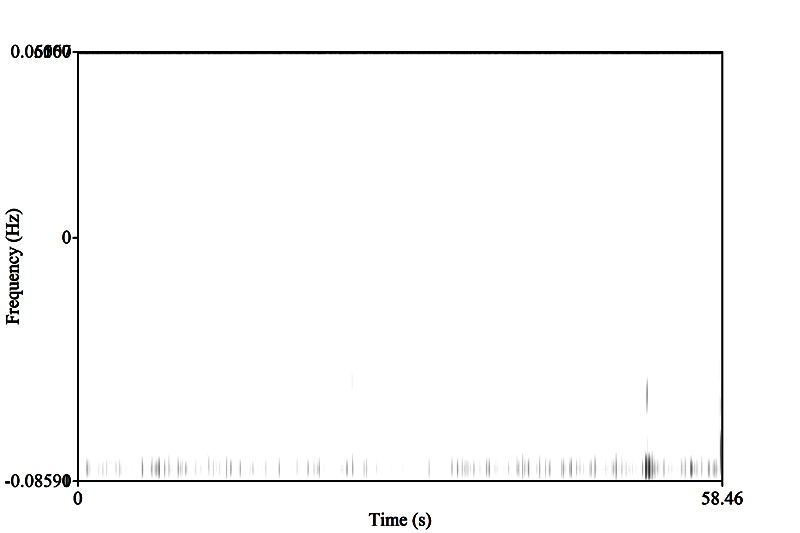
Bonus spectrogram
Mom chirps as she lays the egg. I'm not real happy with this spectrogram because there was
a lot of noise versus signal, but her soft chirps can still be seen.


Wednesday, February 17, 2016

First Egg of 2016 for Fort St. Vrain Eagles

Congratulations to the Fort St. Vrain bald eagles on their first egg of 2016! The egg was laid last night around 9:22pm Mountain Time. This marks the 31st egg laid since we began keeping track in 2003!

What does the Fort St. Vrain site look like? The nest (FSV-N0) is located in a cottonwood on the banks of the St. Vrain River near Platteville, CO, on property owned by Xcel Energy.  We’re not sure how old it is, but Bob Anderson and Rob MacIntyre put the first cam system up in 2003, when the nest was already well established. FSV-N0 is built primarily of cottonwood branches (the dominant tree in many river systems out west) and lined with prairie grass.

As the eagles look out of their nest, they might view the foothills of the Rocky Mountains, roughly 15 miles west of the nest, or the junction of the St. Vrain and south Platte rivers roughly 2 miles north. The land can be broadly characterized as sweeping and open – beautiful, but very different from the folded hills and forests of Decorah and Eagle Valley. Primary food sources include the river systems (fish and turtles) and a nearby prairie dog colony that was just re-established after serious flooding two years ago.

While a two-egg clutch is more common among bald eagles, the Fort St. Vrain pair has (like Decorah) tended to lay three eggs. We can expect the eagles to begin incubating immediately to prevent their eggs from freezing. However, if the weather is relatively warm, we may see them spend a surprising amount of time off the eggs. Eggs need both an appropriate temperature (around 99 degrees) and appropriate humidity, so Mom and Dad will get up and down as necessary to control them. Adult eagles have body temperatures of 104 to 105 degrees, so they have heat to spare when it comes to incubation. Eagle eggs hatch roughly 35 to 37 days after they are laid – so we are hoping for eaglets around March 19th at Fort St. Vrain!

The Fort St. Vrain nest can be watched live at Xcel Energy’s site at http://birdcam.xcelenergy.com/Cams/Eagle_Side/Xcel_Energy_Eagle_Cams or on our site at http://www.raptorresource.org/birdcams/xcel-energy-cams/. Both cams can be watched at the same time here: http://farmyou.com/falcon_cams/dualeagle.html

Wednesday, February 10, 2016

We are Eggs-pecting!

Sherri Elliott got some great vocals and video this morning at Ustream! After a few beaky 'kisses', Mom and Dad were heard copulating not far from the nest. While we don't have recorded video from Fort St. Vrain, the eagles there have been copulating as well. It looks like eggs are on the way in both places! Ustream highlight: http://bit.ly/1T7E81y. We'll add a youtube video as soon as we have one for those of you on devices.

While we don't know when the eagles are going to lay eggs, we are entering the time period in which laying has historically started. In Decorah, the first egg has been laid as follows:

  • February 18, 2015 - first egg in 2015
  • February 23, 2014 - first egg in 2014
  • February 17, 2012 - first egg in 2012
  • February 23, 2011 - first egg in 2011

Note that 2011 and 2014 were very similar. All three eggs were laid on the same date those two years. 2012 and 2015 were both a little milder than 2014 (the Winter that Wouldn't Die) and Mom was just beginning to lay eggs in 2011. Personally, I'm thinking sooner rather than later...but even February 23 is just thirteen days away. While it is rare for bald eagles to lay three eggs, Mom has a history of doing just that! The breakdown is as follows:

  • 79% of clutches have two eggs
  • 17% of clutches have one egg
  • 4% of clutches have three eggs

In Fort St. Vrain, the first egg has been laid as follows:

  • February 14, 2015 - a first Valentine's day egg for 2015!
  • February 21, 2014 - first egg in 2014
  • February 17, 2013 - first egg in 2013
  • February 16, 2012 - first egg in 2012
  • February 16, 2011 - first egg in 2011

Although Fort St. Vrain is about 714 miles from Decorah as the bald eagle flies, the two sites have very similar nesting chronologies, with the Fort St. Vrain eagles usually leading Decorah by a few days and both females tending to lay three eggs. This is an interesting contrast with the Eagle Valley site, which is only about 50 miles from Decorah but was roughly a month behind the year our cammed nest was active. The female there only laid two eggs.

So what can we expect once the first egg is laid? The eagles will begin incubating immediately to prevent it from freezing. However, if the weather is relatively warm, we may see them spend a surprising amount of time off the eggs. Eggs need both an appropriate temperature (around 99 degrees) and appropriate humidity, so Mom and Dad will get up and down as necessary to control them. Adult eagles have body temperatures of 104 to 105 degrees, so they have heat to spare when it comes to incubation. We can expect the eggs to hatch in both places roughly 35 to 37 days after they are laid. If the past is anything to go by, the Moms will spend more time incubating than the Dads, although the division of labor varies from nest to nest.

Eagles are well-prepared to handle snow and cold, but weather has sometimes been an issue at the Fort St. Vrain site. While Fort St. Vrain is slightly warmer than Decorah in March (26-53F versus 25-46F), it gets an average of ten to eleven inches of snow as compared to Decorah's five and a half. Wet, heavy snow can provide a serious challenge to eaglets not old enough to thermoregulate, although the re-establishment of a prairie dog colony not far from the Fort St. Vrain nest means that hunting can be done a little closer to home.

We wish all of the eagle families well and are very much looking forward to the coming season! Bob would be so pleased with the success of N2B and our new camera systems! I'd like to think he approves.

Saturday, February 06, 2016

Philippine Eagle Puppet Feeding

How do we learn to become human? From fellow humans, of course! We are raised by humans, fed and cared for by humans, and taught language by humans. Parents, relatives, friends, teachers, and other people around us teach us language, cultural norms and values, and the ins and outs of social interaction. From them, we learn the information and skills we need to function as members of our society at any given time in our lives. As we grow, we gain companions, friends, enemies, co-workers, rivals, and perhaps mates who will shape our lives and help us raise the next generation of children to instill with our cultural norms and values. 

The same is true of animals. Peregrine falcon and bald eagle parents spend a lot of time interacting with their young: brooding them before they old enough to thermoregulate, stuffing them with food at every opportunity, vocalizing (think of a peregrine falcon chupping encouragingly at a hatchling), and playing post-fledging chase and hunt games in the first few weeks of flight development. Birds learn to be birds from other birds: the vocalizations, songs, or calls of their species, flight skills (think of fledgling peregrine falcons chasing one another, or a flighted predator chasing down flighted prey) and, among birds that are social, the intricacies of social interaction. As they grow, they learn how to acquire food, avoid danger, find mates, and raise the next generation of young. 

In birds and mammals, this process starts with imprinting, defined as "Rapid learning that occurs during a brief receptive period, typically soon after birth or hatching, that establishes a long-lasting behavioral response to a specific individual or object, as attachment to parent, offspring, or site". In short, we first recognize our parents, which lays the groundwork needed for us to recognize and interact with our species and eventually find mates. This type of imprinting is referred to as "filial imprinting". 

But what happens when a human is responsible for raising a bird? If humans are a bird's only role models and source of food or protection, than it will imprint on humans for species recognition. As a sexually mature adult, it will reject its own species and seek the attention of humans. People raising birds for release in the wild take steps to prevent human imprinting from happening, including foster-parenting and puppet-feeding.

When Bob was raising falcons for release, he turned young birds over to a female 'foster-falcon' at around 10 to 12 days of age. By feeding and caring for them, "Freddy" imprinted the young falcons with a falcon model. As juveniles and adults, they sought a bond with their own kind rather than with us.
Philippine Eaglet feeding. Photo by Kike Arnal.
However, foster parenting isn't always an option, especially among critically endangered birds. Kike's photo shows Philippine Eagle Center staff puppet-feeding a Philippine eagle nestling. The person behind the mask imitates a Philippine Eagle parent: vocalizing, interacting with the eyass, feeding it, and providing protection. The eaglet's room is painted to look like the forest it will eventually live in and contains the sounds that will surround it as an adult. These steps imprint the young eaglet on a Philippine Eagle model, establishing a behavioral response to other eagles and forest habitat, rather than human beings and an urban habitat. The puppet is our way to teach a Philippine eagle that it is an eagle, not a human.

Imprinting is a fascinating topic and we'll write more about it later this year. There is a reason that adult eagles chirp to hatching eggs! 


Things that helped me learn and write about this topic:

Learn more about the "Father of imprinting", Konrad Zacharias Lorenz. 

Monday, February 01, 2016

Sounds of the Eagles

I just finished the book Birdsong by Don Stap, a book which seeks to answer the question Why do birds sing and what do their songs mean? Most studies of bird song have been done on oscine birds, which are a subset of passeriformes with a complex voicebox. Many oscine birds such as chestnut-sided warbler, brown thrashers, hermit thrushes, and starlings sing complex sounds that might include, depending on the bird, buzzing, clicking, trilling, and warbling. Non-oscine birds like bald eagles (an accipitriform) might fascinate us with their striking colors, amazing flights, and sheer size, but their vocalizations don't tend to overwhelm us with their beauty or musicality.

After reading Birdsong, I decided to download some spectrogram software and run a few eagle vocalizations through it. The software I chose was Praat, a powerful free acoustical analysis program available from the University of Amsterdam. I wanted to see how 'questionable' copulatory vocals (are they mating?) appeared next to known copulatory vocals (they are mating!).

This was the sort of thing I tended to see. Copulation followed a pretty clear pattern, and Dad also tends to have a higher voice than Mom as shown by the sonograms above. 'Was that copulation?' is Mom alone and was not, in fact, copulation: the bars are low (signaling Mom's deeper voice), thick, and pretty distinct. 'That was copulation!' starts with a brief vocal by Mom at left, and continues into Dad's copulatory vocals - high, quick, and a little complex.

Did all eagle vocals look somewhat like copulation? While Dad's copulatory vocals tend to have a unique sound (I listen for a little warble or chirp and count to seven), eagles don't have complex voiceboxes, and the top vocal isn't that different from the bottom vocal. I decided to compare known non-copulatory vocals next.


Look at 'Mom with a Fish'. It was a cool sounding vocalization and doesn't really look much like copulation. If anything, her initial vocalizations look a lot like Dad's in the 'Sound a Warning' spectrogram , although they are lower. She was mantling a fish after what sounded like a couple of warning vocalizations before she came to the nest, and concentrated energy in high and low pitches, just like Dad did with his initial warning to an unknown neighborhood intruder. The second part of 'Sound a Warning' features Mom and Dad rapidly vocalizing together. While this somewhat resembles the 'solicitation' spectrogram, the vocal pulses are a little farther apart and higher. Personally, I think that 'Mom solicits Dad' most closely resembles copulation. Is she vocalizing the 'music of love' to indicate receptivity? Note that the unknown noise in the spectrogram figure prior to this one really closely resembles her solicitation.

Of course, I also had to compare known copulations. Keep in mind that we used different microphones in 2012 than we do now, and they were located in a slightly different position relative to the nest.


Even given the changes since 2012, these spectrograms look quite similar! It appears that copulatory vocalizations are quite distinct, and spectrograms could be used to help determine whether those early to mid-January vocals are copulatory in nature. After all, we can't always see what Mom and Dad are doing in the upper branches!

While this was more of a thought experiment than anything else, it looks like bald eagles have a little more to say than we realize, even if they aren't singing when they do it. I am looking forward to recording their interactions with eaglets later this year.


I am not a sound recordist. I am sure these spectrograms would benefit from professional equipment, but I have a 64-bit ASUS PC laptop with no special audio equipment whatsoever. The spectrograms were made recording youtube videos via praat in the quietest room of my house, with no one home except myself and two dogs. They were taken from the following videos (note: I can't find the 'was that copulation?' from 2016):

Praat audio software: http://www.fon.hum.uva.nl/praat/