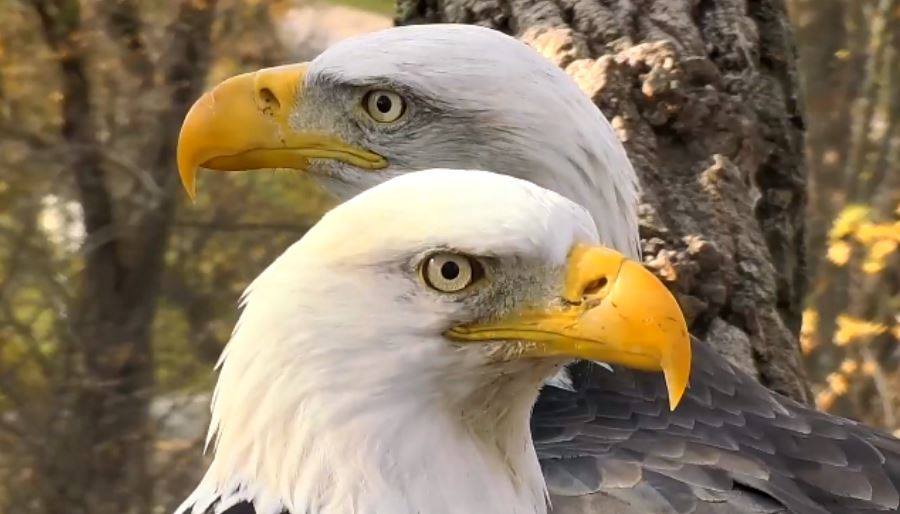
We asked our panel of eagle experts about the broken egg at the Decorah North nest. Could egg viability be determined from the video? Did they have any ideas about egg breakage? Was Mrs. North likely to produce more eggs?
In general, the panel believed that the egg’s viability couldn’t be determined from the video, although two of them commented that a darker patch in the draining egg fluid could have been an embryo. At 19 days old, an embryo would still have been quite small and not especially easy to see given the circumstances. Since we couldn’t come to a definite conclusion, our answer is “No” – we don’t know whether the egg was viable or not. We have some information about embryonic developmental stages here: https://raptorresource.blogspot.com/2017/03/whats-inside-those-bald-eagle-eggs.html
So why did the egg break? Female eagles lay down calcium in their shell gland/uterus, and their large eggs take a lot of calcium. Was she not able to lay down enough calcium to protect her egg from breaking, and if so, why? She may not have had enough calcium available during that stage of egg formation, or something else could be going on with her reproductive system. One member of the panel asked about her age. Female bald eagles and peregrine falcons can experience reduced fertility as they age. They might lay fewer eggs, strangely colored eggs, oddly shaped eggs, ‘smooshy’ eggs, thinly-shelled eggs, or infertile eggs that never hatch. It’s too early to know whether that’s the case, but we will be watching to see if any of those things happen moving forward.
Was she poisoned again? We saw no sign that she was poisoned this year, and the poison from two years ago would not affect her shell deposition now.
Is Mrs. North likely to produce more eggs? The answers were mixed. If she does, it should happen around March 30, or about 14 days after she lost the first one. Other birds of prey, including gyrfalcons and barn owls, take 14 days to recycle after losing a clutch. I really went back and forth about this (19 days is a long time to incubate an egg!) but the answer gave me some hope, especially given that Mr. and Mrs. North are still copulating. We’re crossing our talons, hoping for the best, and keeping a very sharp eye on Mrs. North!
We've been getting questions about egg timing. Why did Mom and Dad lay eggs later this year? Overall, avian egg-timing in the temperate zone is heavily regulated by the light cycle. As the days begin to lengthen, birds' gonads swell and produce sex hormones. Around the end of January, our bald eagle pairs switch from infrequent copulation to frequent, highly enthusiastic copulation, putting us on notice for egg watch! Females chase males, males entice females, copulation takes place on a regular basis, and our eagles start laying eggs in mid-February. We have a general egg outline, but what factors correlate to the onset of egg-laying in any given year? New mates can equal later eggs
While it doesn't always happen, a new mate (male or female) often pushes egg-laying a little later in the eagles and falcons we watch. Sometimes it happens for very obvious reasons, like mid-season mate replacement. Let's say that female falcon A and male falcon B are nesting together on a cliff in mid-March. Falcon A has begun the process of egg production: her egg follicles are swelling, she's gaining weight, and she's copulating like crazy! Unfortunately, she's killed or displaced by female falcon C, who is producing plenty of sex hormones, but no eggs. B doesn't waste any time courting C. His bowing, gifts of food, and copulation will trigger her to begin egg production, but their egg-laying schedule will be pushed back by as much as or more than ten days. Absent other factors, it should float earlier in the years to come.
Later egg-laying can also happen in new couples that don't experience mid-season mate replacement. Both Mom Decorah and Ma FSV laid the first eggs of their lives in early March (March 2, 2009 for Mom Decorah and March 3, 2007 for Ma FSV) but moved earlier as the years progressed. Mom had just achieved sexual maturity when she bonded with Dad, but we don't know if the same is true of Ma FSV. Is initial egg production - an eagle's first egg - a factor in egg timing? How about receptivity in a new pair versus an already bonded pair? We don't know, but it's something we'll be looking at.
Cold dry weather? Predict eggs on the later side!
Having said that, we didn't have a new eagle in Decorah or at Fort St. Vrain this year. So what happened? We decided to look at weather. Using the nearest weather stations we could find to each nest (especially important in Colorado with its altitude-based weather patterns), we obtained historical figures for temperature and dewpoint from January 30 to February 10. There isn't a long time period between the onset of egg-laying and egg-laying itself, so we started around the time that both sets of eagles usually ramp up copulation and ranked our results from latest to earliest laying date.
FSV: January 30 to February 10
1st Egg Date
High Temp
Mean Temp
Low Temp
Dewpoint
2/21/14
31 F
19 F
6 F
12 F
2/17/13
48 F
32 F
17 F
15 F
2/16/16
46 F
31 F
17 F
17 F
2/14/15
60 F
44 F
28 F
21 F
2/14/17
56 F
45 F
33 F
21 F
2/12/18
51 F
37 F
22 F
22 F
Decorah Eagles: January 30 to February 10
1st Egg Date
High Temp
Mean Temp
Low Temp
Dewpoint
2/23/14
12 F
4 F
-3 F
-3 F
2/21/18
37 F
20 F
8 F
4 F
2/20/17
30 F
21 F
12 F
15 F
2/18/16
29 F
22 F
16 F
19 F
2/18/15
24 F
16 F
9 F
12 F
2/17/12
34 F
28 F
22 F
23 F
In general, both sets of eagles laid eggs slightly earlier during periods of unusual warmth and slightly later during periods of unusual cold. But much to my surprise, humidity (as measured by dewpoint) turned out to be a slightly better predictor of egg-timing than temperature! What was going on with that - and with the one interesting exception in Decorah in 2015? Time to do a little reading!
It is widely believed that breeding female raptors gain weight by building fat and storing minerals to provide the energy reserves needed for egg-laying and incubation. But a study of female barn owls found that almost all of their pre-laying weight gain was due to water accumulation! From the study's discussion: "To conclude, the gain in body mass observed in breeding barn owls is not due to an accumulation of energy reserves but of an accumulation of water." Incubating female barn owls undergo a more complete molt than incubating bald eagles, but egg production mechanisms are very similar and it seems reasonable to believe that water retention would be similar in both species. The nutrients required for egg formation can be obtained by routine food intake during egg formation, but if the weather is extremely dry, it might take longer for female bald eagles to accumulate the water reserves they need for egg production, especially give that drier weather results in higher levels of evaporative and cutaneous water loss. It wouldn't make a few weeks difference in any given year, but it might make a few days!
I couldn't find an explanation for the anomaly in Decorah in 2015, but this is a relatively small dataset. As we keep records longer, we may learn more about trends in egg-laying. It also might be worth getting weather stations down below our nests to collect local data about temperature, humidity, and wind at each nest. We still have a lot to learn about the ways in which weather and climate affect the birds we watch.
Did you know?
The barn owl study also had some interesting information about fat/lipid dispersal in a breeding female barn owl's body. Although breeding females had fewer body lipids than non-breeding females, they had more subcutaneous fat in the area of their brood patch. The accumulated fat caused their brood patches to increase in size! So Mom's more visible brood patch and slightly larger appearance aren't just our imaginations. She has gained water weight and shifted fat to her brood patch in preparation for egg-laying and incubation. I'm sure that more than a few of us can relate to that!
While we aren't sure why Midwest peregrine falcons are laying eggs earlier, they are laying significantly earlier than they did at the beginning of falcon recovery in our area. Interested in the topic? Check out Average Nesting Trends!
Why didn't you use data from the North pair?
This was a tough one to leave out, especially given that many watchers think Mr. North was a new mate in 2016 - a year of later egg production. However, we only have three years of production here, the eagles have not established a regular laying pattern (2018 was also late), and we have no weather history anywhere near the nest, so I'm not comfortable including their data. We'll see what happens in the years to come.
Paper: Cutaneous water loss in small birds. I need to do a lot more reading about this, since bald eagles have more inside to outside than the birds in this study, and would presumably experience lower cutaneous water loss.
We've talked about how long it takes bald eagle eggs to hatch after they are laid (an average of 38 days from first egg to first hatch in Decorah), how long hatch takes once pip starts (it can take upwards of 24 hours), and how long it takes Mom to lay each egg (she usually lays the second egg about two to three days after the first, and the third egg roughly four days after the second egg). But how long does it take Mom to make and lay an egg?
We'll start with copulation. It is believed that female bald eagles begin laying eggs five to ten days after productive mating begins. Mom laid her first egg at 7:28PM CT on February 21st, or about eleven days after copulation went from casual to frequent...and very determined on Mom's part. Between February 10th and February 18th, Mom and Dad copulated nine times that we saw and had an additional 2 failed attempts. Mom took the lead five times - beak biting Dad, footing him, loudly vocalizing her intentions, and mounting him while wagging her tail (https://youtu.be/I4xlu9IEItY). You didn't need to be a male bald eagle to know that Mom meant business!
So we know that bald eagles ensure fertile eggs by copulating regularly, storing sperm in storage tubules, and concentrating sperm at the infundibulum, or site of fertility. But how long does it take Mom to lay an egg once her first yolk has been fertilized? The short answer: approximately two days (48-50 hours). It goes through a lot of changes along the way! Note that our oviduct times were derived using the ratio between bald eagles (~48 hours) and domestic chickens (~25 hours). The actual times could be slightly different. Step one: I'm ready!
Diagram of the egg-laying process
According to Tim Birkhead, there are no known cases of copulation-induced ovulation in birds. As we've seen in Decorah, female birds signal their fertile status by their interest in (or their insistence on) copulation. In response to an internal clock and the presence of a male - say, Dad - one of Mom's yolks swells until it ruptures the follicle that produced it, releasing a ripe yolk into her oviduct.
How long does it take for her yolk to swell? Our observations suggest about eight to ten days. For comparison, it takes four to five days in small birds like great tits and white-crowned sparrows, six to eight days in larger birds like ducks and pigeons, 10-13 days for large gulls, and up to 16 days in some penguins.
How many follicles are swelling inside Mom each season? In domestic hens, each follicular cohort (follicles that will become eggs) numbers six to twelve follicles, and follicles are selected roughly every 24 hours. We know that Mom's annual cohort measures at least three. Since it takes roughly 48 hours for her to lay an egg, follicle number two must rupture about the time egg number one is laid. Follicle number three experiences a delay of about 48 hours, giving Mom's 'egg-machine' a chance to rest and resupply!
Step two: The infundibulum! Length of stay: ~15 minutes (T - 47+ hours)
While the name infundibulum (funnel) suggests a passive process, the microscopic yolk stays in one place while the infundibulum flows around it. Since Mom and Dad have been copulating regularly and Mom has been storing sperm, hundreds or thousands of Dad's sperm are waiting inside to fertilize it! Fertilized or not, the infundibulum seals the yolk after 15 minutes, and it proceeds on its journey down her oviduct.
How does the yolk stay in the center of the egg? The infundibulum's seal, or chalaza layer, forms the egg's first layer of albumen, aka egg white. The ends of this dense chalaziferous zone twist with other proteins to create two filaments as the egg spirals through the magnum. These filaments will eventually anchor the yolk to the egg's hard calcareous shell, keeping it in place.
Step three: The magnum! Length of stay: ~5 hours (T - 42.5 hours)
Her yolk makes its next stop in the magnum, where it receives another coating of albumen. The albumen is secreted by special cells in the magnum wall that absorb water and proteins from Mom's bloodstream. The albumen will cushion the developing embryo and provide much of the protein needed for its development. Remember Dad's food gifts? Mom needs all the protein and calcium she can get to produce viable eggs!
Step four: The isthmus! Length of stay: ~3 hours (T - 39.5 hours)
The yolk moves into the isthmus next. It receives a little more albumen and its inner and outer soft shell membranes, which (like Mom's feathers, beak, and talons) are made of keratin - another protein! The inner shell membrane provides a point of contact for the chorioallantoic membrane that develops in the first three to four days of an embryonic eagle's life. Both membranes help protect the porous egg from bacterial contamination and keep water from escaping too quickly. The membranes sit closely together during the egg's trip through the oviduct, but separate after the egg has been laid.
An egg in cross section, modified from Romanoff and Romanoff, 1949
Step five: The shell gland! Length of stay: ~39 hours (T - 15 minutes)
Mom's yolk, wrapped snugly in its jacket of albumen and shell membranes, moves into her shell gland or uterus. Water and minerals are pumped into the developing egg and a hard calcareous shell is formed around it. Mom is removing a lot of calcium from her body to produce the egg shell. While I couldn't find figures for bald eagles, hen chickens remove about 25 mg of calcium from their blood every 12 minutes during active egg shell formation. Since bald eagle eggs are significantly larger than chicken eggs, it seems very likely that she is removing more calcium than that. Anything that can't be derived from dietary sources will be obtained from her skeleton - another reason that food is extremely important right now! Step six: The vagina and egg labor! Length of stay: roughly 15 minutes! We finally have an egg! Mom's initially microscopic yolk has been wrapped in membranes, plumped up, and surrounded by a hard shell. While we don't know whether Mom was aware of the egg before, she is certainly aware of it now! Contraction of a powerful sphincter muscle causes the egg to rotate in her muscular vagina and enter her cloaca pointed-end first. Mom's powerful vaginal muscles and full-body contractions eject the egg through her cloaca and into the waiting egg cup. Two days after Mom's first egg was started, it emerges after her brief egg labor and she lays down for a well-deserved rest! Her second egg is just beginning its journey! Does Mom feel pain during egg labor? We often get asked whether Mom experiences pain or discomfort, especially in the final phase of laying. Whether or not she knows her follicle burst, egg laying is an energetically expensive process and her behavior changed substantially since she started chasing Dad around the nest! Two or three days before she laid egg number one, we started seeing her on and around the nest more. Dad brought several meals to her, and she spent a long period of time in the nest the morning before the egg was laid. While her soft chirps were lovely to hear, she was obviously experiencing some discomfort. It was a relief to all of us when she finally laid the egg! Mom will incubate her first egg between 35 to 37 days before it hatches. While Dad does his share of incubation, incubation gives Mom the time she needs to rest and build up her reserves. Sweet eagle dreams, Mom - you've earned them! What happens when a bird loses its nest and mate with an egg in the pipeline? We also get asked what happens when a bird's season is interrupted. We haven't seen it at any of our bald eagle nests, but we have seen it in several peregrine falcons. Last year, an interloper laid an egg in the nest box at Dairyland Alma before the returning female ousted her, and Newman spent a lot of time courting and copulating with St. Louis Girl before Michelle showed up and kicked her out. While there isn't much information about it, I would guess that any eggs in the pipeline get laid somewhere. But if follicle stimulation is about more than just lengthening daylight hours - which it appears to be, at least in wild birds, which don't tend to lay eggs absent a male, copulation, and a nest - losing a mate and territory may shut follicle stimulation and yolk production down. This would prevent additional eggs from forming: a wise strategy given how energy intensive egg production is! Does it feel like the parts of a female bird's reproductive system were named by committee? Technical language is daunting enough when it fits together nicely! But people have studied birds, especially domestic chickens, for a long time. Not everything we are describing now was named at the same time by the same people, which can lead to an odd combination of words.
Infundibulum is derived from a16th century Latin word for "pour in" (or funnel): infundere.
Chalaza is derived from a Greek word that means "small knot": Khalaza
Magnus is a Latin word that means "great". The magnus is the largest part of the oviduct.
Isthmus is derived from a Greek word that means narrow neck of land: isthmos.
Things that helped me learn and write about this topic!
The 'Guide to Bald Eagles' produced by our mod team
Egg cross section derived from The Avian Egg: Alexis L. Romanoff, A.J. Romanoff, 1949. Image credit poultryhub, although it appears in other places as well: http://www.poultryhub.org/physiology/the-avian-egg/. If you own this image and do not want it posted or need the credits changed, please contact me: ries93@gmail.com.
When we think about feathers, we tend to think about their qualities (light, soft, fluffy, hard, flat, and horny are all included in dictionary definitions) and how they help birds fly, stay warm, shed or retain water, build nests, and so much more! (See this blog, for example.) But what are feathers? It sounds like a silly question. We all know what feathers are, right? And we all know what a bird's nest looks like, how to describe the color and shape of an egg, and when bald eagles lay their eggs. Maybe we don't know as much as we think.
So again, what are feathers? Like hair, fingernails, and scales, feathers are growths produced by epidermal cells in the outer layer of a bird's skin, which makes them part of the largest organ system in a bird's body. Derived from the Latin integumentum, which means “covering”, a bird's integumentary system includes its skin, feathers, scales, feet, beak, and the glands in its outer ear canal and at the base of its tail. Mom's integument keeps her insides in and protects her from pathogens while allowing her to exchange wastes, react to stimuli (think of how she fluffs her feathers in the cold), and produce important organic compounds like uropygial (preen) oil.
Feather follicle. Click to enlarge
Where do feathers come from, and how do birds grow them? Birds grow feathers throughout their lives, but feather development begins in the egg. Seventeen to eighteen days after Mom lays an egg, interactions between the embryonic bald eagle's outer and middle layers of skin form feather buds - columns of epidermal cells that dimple its developing body. The cells differentiate into three layers as they grow downward into its skin to create a tiny feather-producing organ that resembles a small pit or tube - the feather follicle. The cells at the base of this tube grow, divide, and die, leaving behind small masses of keratin that are pushed upward through the tube to form a feather. The outermost layer of cells form a temporary sheath that protects developing feathers, while the middle and inner layers form the feather's rachis and barbs. The developing feather has a blood supply that extends through its central pulp to nourish it as it grows - hence the name 'bloodfeather' to describe a feather still connected to its blood supply. When the feather is mature, the blood supply recedes.
Feather follicles, which are nourished by blood and grow via the division and enlargement of cells, are alive and will continue to produce feathers throughout a bird's life. But non-living things like feathers, crystals, icicles, and bald eagle nests grow via accretion: the addition of new material on top of old. Remember N1? Once Mom and Dad stopped replenishing it with branches, it began to disintegrate. The same is true of feathers. They have no blood supply, no cells, and no way to repair or replenish themselves. So how do birds replace feathers, especially flight feathers, without impacting flight? Hormones regulate molt cycles, periods when older feathers are pushed out of their follicles by newer feathers in a genetically programmed, orderly replacement that can take years to complete in larger birds of prey such as bald eagles.
Like so much else in a bird's life, the cue for molt initiation is day length, which effects the hormone levels that control molt progression. In the temperate zone - the part of the earth's surface lying between the tropics and arctic and sub-arctic circles - most breeding birds of prey molt in the summer, after they have finished raising young; and in winter or early spring, as the breeding season begins. Producing new feathers is a costly affair. Molting birds replace 20-40% of their mass through the molt, drawing on protein and energy reserves to create new feathers and offset the effects of reduced insulation and flight ability. Their 'down time' - the space between laying eggs, endlessly feeding hungry nestlings, and migrating or enduring the winter cold - is a good time to engage in the energetically expensive task of producing new feathers. Molt is suspended during periods of intense flight activity (say, when Mom and Dad are feeding young, or falcons are migrating) and food scarcity.
Annual light cycles and rate of change in Decorah
In short, day length (or changes in day length, or the rate of change of day length) initiates hormone production. Among many other things, these hormones trigger the cells at the base of the feather follicle to start growing, dividing, and dying. New feathers are produced and old feathers are pushed out. The molt cycle does not take feather condition into consideration - feathers are replaced whether they need it or not. While this might seem wasteful given the amount of energy that molt takes, it is better to replace feathers automatically during 'down time' than to develop a replacement on demand system that could leave a molting bird vulnerable to the weather or impair its flight during nesting season.
Components of a bird's wing
In birds of prey like bald eagles and peregrine falcons, molt progresses from the front to the rear of the bird. Unsurprisingly, flight feathers molt symmetrically. In falcons, primary feather molt begins with the fourth innermost primary (P4) and works its way inward and outward, but in bald eagles and most other birds of prey, the innermost primary (P1) is molted first and molt proceeds outward. Tail molt (bald eagles have 12 tail feathers) usually begins with the third and fourth feathers on either side of the bird's central tail feathers and proceeds simultaneously outward and inward. The growth of individual flight feathers takes 2-3 weeks in a smaller bird like a kestrel, and 2-3 months in a larger bird like a bald eagle.
Sharp-eyed watchers have recently noticed Mom and Dad shedding adult down and body feathers. The production of sex hormones triggered body feather molt at a time when we might expect birds to be conserving insulation, not regrowing it! However, this is a very good time for them to replace feathers. They aren't as active during incubation, which requires long periods of sitting on eggs - a great time to replace feathers. They also need to transfer body heat to their eggs, which is done through bare or mostly featherless skin. I wasn't able to find much about an eagle's brood patch and molt, but we know that hormones cause breast feathers to loosen and fall out, creating the brood patch. Like flight feather molt, brood patch molt is optimized to perform a specific task.
In his book Raptors, the curious nature of diurnal birds of prey, Keith Bildstein concludes his section on molt by stating "We still know little about feather molt in the overwhelming majority of diurnal birds of prey, including that of many abundant and widespread species." Reading and writing about feather growth and molt left me with more questions than answers. Do sex hormones influence sub-adult plumage patterns and colors? How do hormones change plumage signaling at maturity? Do regional populations of birds experience different molt patterns? Specifically, how might the nearly tropical bald eagles at Fort Myers experience molt when compared to deeply temperate Mom and Dad, or to nearly arctic eagles in northern Canada? Do long-time territorial birds experience different molting patterns than birds that migrate every year - say, Mom and Dad versus Brett's migratory Canadian eagles? If sex hormones help regulate molt and feather production, why don't bald eagles and peregrine falcons have sexually dimorphic plumage? For that matter, why do American kestrels have sexually dimorphic plumage? The more I learn about birds, the more questions I have!
Things that helped me learn and write about this topic:
Aging, Sexing, and Molt: http://www.life.illinois.edu/ib/461/Molt_Anatomy.pdf. From "Birds of the World". This is also very helpful for anyone who wants a general understanding of how bird banders sex and age wild birds.
Why is molt so energy intensive? After all, feathers are made of dead material and don't weigh very much, right? Feathers don't weigh much collectively, but the entire plumage of a bald eagle makes up about a sixth of its total weight, or roughly three times that of its skeleton. Molt involves the replacement of a huge area of a bird's body, and the plurality of its mass. Altogether, a bird's plumage weighs more than any other part of its body.
Birds replace their feathers more or less annually, depending on the bird. Do humans really replace their cells every seven years? Nope - it is a lot more complicated than that! Watch this video to learn more (and check out the awesome skunkbear science tumblr here: http://skunkbear.tumblr.com/)
R.B Ewing was a science illustrator who drew the awesomely detailed feather follicle that I found all over the place, although I was not able to source the publication. It may have come from Ornithology in Laboratory and Field by Burgess Publishing, edition unknown. Here is a link to just one place I found it: http://ncsce.org/pages/home.html
It's time for a look back at 2017! We asked the Decorah North Mods for some favorite moments from Decorah North. We hope you enjoy a trip down memory lane!
2017 marked the 8th year that eagles have nested in the valley of the Norths! We don't know whether the same eagles have been here all along. The first nest (DNN0) was built in a pine tree. The branches collapsed after the second nesting season and the eagles moved to a dead elm tree. They nested there for just one year before moving to their current location in late 2013. 2017 will mark their fourth season in the nest we are watching them in now! Although we refer to it as DNN, it is technically DNN2.
Sherri Elliott said: "Seeing Mr. North's new maturity and almost 50/50 partnership in purveying provisions this year. Hearing Mrs. North 'teakettle' for the first time this year with new mic, and knowing she can easily set it to 'steam' like Mom Decorah. Observing both parents in a deep dream state, vocalizing, jolting, and in the case of Mr. North drowsy scolding at night. The North's dexterity in footing to roll their eggs."
Her favorite videos included:
12/21/17: Coyote Howling & Chorus - https://youtu.be/tB_TU-hFuIE It's not eagles, but it is very cool! The chorus made the hair on the back of my neck stand up!
12/03/17: Perch party! Not 1, not 2, but 7 Eagles - https://youtu.be/q7P00h8vJ6o. Sherri said: To me this ranks as one of the top observations of BE sociability and reminds me of last seasons “Pool Party” with multiple BE’s bathing in the stream.
11/30/17: Struggling to Lift Stick from stream pasture - https://youtu.be/_61VDr4OqJc
Sherri: This was Mrs, who later brought the stick to the nest, but to me the observation seems a lot more like stick play rather than attempts to lift and carry.
11/29/17: Keep Off Our Nest - Dad attacks J/SA - https://youtu.be/19hhzDKRgLA If you watch the North Nest, you know all about the Super Flyway. The North's accept visitors across the field, but don't tend to appreciate them at the nest tree. It isn't uncommon to see hungry juveniles and subadults attempting to steal a little breakfish during peak migration.
11/24/17: Splashdown, Parent Catches a Fish - https://youtu.be/txA1XfSmHqc
Sherri: I love to see them fish!
10/11/17: GHO Visits - https://youtu.be/cpE63ODKquw. We've heard GHO at Decorah North, but we've never seen them nest shopping like this before!
7/26/17: Sighting of DN4 and DN5 - https://youtu.be/Jto4hhl-eDg. We believe this was the last sighting of both caught on cam.
7/22/17: 2:35 p.m. CDT: Round the Pasture We Go - https://youtu.be/IBXVO-2FQJU. Two fledglings/juvies and both parents seen flying in the pasture.
6/15/17: DN4 & DN5 Rumble in the Nest - https://youtu.be/qMxXrznXJsM. A lot of you watched and commented on this. DN5 had a very strong response to DN4's return, although they quickly accepted one another once the initial surprise wore off.
6/11/17 - DN4 Accidental Fledge (knocked off by DN5) - https://youtu.be/SsY0WYgqM7E. What do you mean? I didn't notice my sibling was there! We got a lot of email and comments about this as well.
5/30/17: Small owl attack on DN4 - https://youtu.be/rkvCp8XyVpQ. I initially thought this might have been a barred owl, but it is really small! We're going to share this video with Karla Bloem of The International Owl Center and see what she thinks!
4/17/17: Dad North's cowghetti delivery gets hung up on the rails, and Mrs fetches it. Hmmmm....cowghetti!https://youtu.be/apRlJEl84uk
4/08/17: Dad North Alerts & Defends from Intruder (with DN4 copycatting Dad's wingspread) - https://youtu.be/IQAAZi7Tu4g. I saw this exact same behavior when we banded falcons at MPL's Cohasset plant this year. It was charming and fascinating to see "Big Sis" copying Mom's defensive behavior!
River Eagle also liked Mom's late evening arrival. I had completely forgotten about "Stranger Danger". Mrs North's late arrival startled Mr. North but scared chatters who thought a stranger was invading. The "Juvie in Pasture Runs Parent off of Prey" video was another favorite. I think I'd rather face a hangry human than a juvenile bald eagle intent on eating, and I can't tell you how much I enjoyed seeing the green pasture again!
ModV brought up many of the same moments, but added two new ones:
5/08/17: Goose at the nest - https://youtu.be/cDv_sBFwyyQ One of the most interesting sights was early one morning when a goose landed on the babysitting branch.
Mod7 said: "Of course the OOPS PS (there's always a few!) of DN5 on Mrs. North. it's almost like DN5 aimed at her. lol Don't PS on the eagle that feeds you!" https://youtu.be/9sCoTpJpK2g
"And watching Mr. North feed the little ones...you can really see the change in him and he's grown so much. It melts my heart when he takes care of his eaglets." This video is really lovely: https://youtu.be/JIRm2Oh6qjE
Thank you so much for the trip down memory lane!<3 p="">
It's time for a look back at 2017! We asked the mods for some favorite moments from Decorah and Decorah North. We'll feature Decorah today and Decorah North tomorrow. We hope you enjoy a trip down memory lane! 2017 marked the 9th year that Mom and Dad have nested together in a cottonwood tree! They produced fourteen eaglets at N1, nine eaglets at N2, and five eaglets at N2B, the nest we started for them in August of 2015. We don't know how old Dad is, but he is older than Mom, who turned fourteen this year.
Mom back, Dad front
We'll start with the eaglets. All of the eaglets were somebody's favorite! You liked (or were distressed by) D26's fierce behavior and insistence on being first to the dinner table, especially in the first few weeks. You cheered for D28 when he bonked back at the older and larger D26, and groaned, worried, or emailed when D27 took the brunt of D26's bonkings. While any given eaglet was someone's favorite, many of you were captivated by D27! Whether she was screeing for food, acting the Diva, lounging about in the nest, or beginning her first tentative explorations during fledge, you watched her, compared to her to D1, and weren't especially surprised to find out that it was a she once Brett, John, and company fitted her for a transmitter! Jfrancl wrote:
"One of my favorite memories from the 2017 season was watching D27's behaviors as she grew and how different she was from D26 and D28. She seemed to follow the pattern I have often read about on eaglet gender behavior and growth patterns. In my mind I knew she had to be female!" You can continue to follow D27 here: https://www.raptorresource.org/learning-tools/eagle-map/
JFrancl also mentioned: "Three eggs and three hatches, again! D28 attempting to eat its first meal on hatch day! Tandem feedings. Giggling at the Tree Amigos! Observing all three throughout the season and guessing genders based on behaviors. The hatchery cam. Watching all participating classroom students excited to learn about eagles! Working closely with John, Amy, the Ustream chat room mods and the Facebook mods in helping to continue Bob's mission. Once again, watching Mom and Dad's attentiveness and devotion to their young. Last but not least, a great After the Fledge Celebration!" I thought this video of a feeding from April 4th was a lot of fun. Remember D28's dark head? https://youtu.be/dCEA2bmxxeo. And it was a greatATF! We all loved seeing Mr. Decorah (widely believed to be D20 from 2014): https://youtu.be/6qdfIFaodYM. Our mods gave everyone a nice goodbye, too: https://youtu.be/ja6zI3BARfM.
D26, D28, and D27 (I think) on April 08, 2017
Since everyone loves hatch and first glimpse videos, I included them as well:
Glogdog wrote: "One of my favorite videos that sticks in my mind this season was on 1/2/17 when Dad brings in a long stick and gets stuck between 2 trees in mid-air. Mom realizes it and steps up to help bring it down! I also liked the times that Mom and Dad protected the eaglets during bad weather."
Mom and Dad working together as a team to protect the eaglets on April 3rd, 2017
Tulsa Ducati: "Lightning show!" Tulsa joined the ranks of our videomakers this year and we featured many of her videos. One of her favorites was the incredible storm that rolled in on June 28. https://youtu.be/NioY3r87S_I
Faith: "A tandem evening feeding". This video was also one of my favorites. Mom and Dad feed the eaglets together on the evening of April 2nd. https://youtu.be/F44Z9aQ2gS0
Mom and Dad tandem feeding on April 2nd, 2017
Oregonian: "D27 gets back to nest!" I had completely forgotten about this, so I really appreciated the reminder! Oregonian wrote: "Without a doubt watching D27 work her way back to the nest after she tumbled out. I was riveted watching her figure how to get back." https://youtu.be/DB7KW-huwsI
Pyrmum wrote: "My favorite moments are when Dad is feeding the eaglets and he keeps looking around to see if Mom is on her way to kick him off the nest. I get a real kick out of it!" All of us get a kick out of Mom and Dad's antics! I was not able to find a specific video for this behavior (although I remember it), so I substituted another favorite - Mom gently nudging Dad off the nest! https://youtu.be/7hzb2hrzbzc
Robin Brumm had several favorites!
4-3-17 "When both parents were trying to protect the eaglets from the rain. Dad didn't want to leave, but finally Mom pushed him out. When he got up, I believe he knocked D27 on her back, so she was laying their with her little feet flailing, lol!" https://youtu.be/7hzb2hrzbzc
4-13-17 "...And you can't forget when D26 went for a little ride on the clump of grass mom was trying to pull out of the nest cup!" https://youtu.be/7tXua2nBQ6I
5-6-17 "Not that it was a favorite, but it was memorable when Mom got knocked off the skywalk by the owl." https://youtu.be/JFYCYLvHvVE
7-16-17 "All three juvies hanging out in N1 and the Y branch." (This was also a favorite of mine): https://youtu.be/8wPjIp3Lqak
Fledged eaglet, 07/01/17. I'm sure Robin knows eggsaxctly who this is!
I had a number of favorites, but these really stood out for me!
Lunch feeding - close zoom and wide angle: https://youtu.be/JeGhVefSoIM. I loved the view of all three eaglets and this is one of the first times we saw D28 show its fierce! While D27 submitted to D26's bonking behavior, D28 tended to bonk back.
Incredible portrait close-ups of D26 and D27 - close zoom. I mentioned I was a sucker for the downy stage, right? https://youtu.be/jnCpx-fR8zQ. In the same vein - Dad allows nestlings out to enjoy warm day: https://youtu.be/7qxy8fpAabo.
Three-way mantle: https://youtu.be/eBe_IOL9lTM. All three eaglets show off their excellent grasp of eaglet table manners. The winner takes all!
Judging by readership, your five favorite blogs in 2017 were:
Endangered Species Act Under Threat From Congress (13,511) The Act itself hasn't been overturned, but Congress consistently introduced bills and amendments to weaken it, including five that we blogged about here. All of them passed committee and Congress didn't adjourn this year, so those bills may still move forward in 2018. In late December, the Trump administration declared that they would not be enforcing the Migratory Bird Act.
Eagle Eyes! (6233) This was fun to write about. I'm a little jealous of bald eagle eyes - human eyes don't see as well or in as many colors!
What's inside those bald eagle eggs? (4954) This blog discussed embryonic development inside the egg. Some of you really liked it...but some of you were totally weirded out by the illustrations of embryonic stages! Remember to set your clocks for 72 hours once an egg is laid. At that point, the developing eaglet's heart starts beating!
Eaglet growth and development, week two (4523) This was the most popular of three development blogs. We talked about the stages of development in all three of our nests, as well as the general structure of eaglet development. We'll do more of these next year!
Have a very happy new year and thanks for watching with us in 2017! We're looking forward to watching with you again in 2018 - and don't forget to check out our new ads-free Decorah Eagles stream at https://www.raptorresource.org/birdcams/decorah-eagles/.
A Conservation Education Program grant from the Iowa Department of Natural Resources allowed Luther College and the Decorah Raptor Resource Project to build an autumn migration banding station on campus, giving students unprecedented direct access to wildlife and conversation research. The banding station, located on Hawk Hill on the northeast edge of the Luther campus, is large enough for classes to observe wild birds, band them and gather data before releasing them back into the wild.
Falconer Dave Noble designed and built the station with the help of Dave Kester, John Howe, and Amy Ries. In addition to master banders John Stravers (Hawk) and Kester, we hired six Luther interns to help staff the blind from September 15 to November 15. In total, they caught 36 hawks: Red-tailed Hawks, Sharp-shinned Hawks, Coopers Hawks, a Northern Goshawk, and a Rough-legged Hawk. 20 of the hawks were hatch year birds and 16 were adults, with 18 females, 12 males, and six of unknown sex. It was a wonderful field research experience for the interns, who became proficient at trapping, handling, ID’ing, sexing, aging, and banding wild hawks. 18 additional students from the University of Upper Iowa visited the blind with ornithologist and assistant Biology Professor Paul Skrade, who was thrilled to trap and band a Red-tailed Hawk during one of his visits.
Once they are caught, birds need to be ID'd, sexed, aged, and assessed. We weigh them, measure them, look for external parasites, and check their overall body condition before releasing them as quickly as we can. The data is recorded and given to the Bird Banding Lab. You can read more about banding here: https://raptorresource.blogspot.com/2013/02/banding-birds-part-i-brief-history.html
Emily and Dave also worked with Decorah’s schools to introduce younger students to birds of prey. 70 first and second grade students participated in our Introduction to Raptors module, 135 first through seventh grade students got to meet and greet a red-tailed hawk and/or a sharp-shinned hawk, and 8 homeschool students took a field trip to the station, where they were introduced to banding and field research.
Students from the Decorah School System meeting a Red-tailed Hawk
"The awe of being up close and personal with wildlife is a unique and rare opportunity," said Emily Neal, Luther College assistant director for the Center for Sustainable Communities and environmental studies staff instructor. "It's bringing people close to the natural world. Holding a bird in your hand and feeling something that's so free and powerful, yet at the same time fragile in a world where humans have such an impact on our environment is an amazing experience."
Releasing a hawk after processing
While technology has added a vital dimension to bird studies, there is nothing like a hands-on field program to bring us face to face with the lives and deaths of the birds we study. We are thrilled to have launched a collaborative environmental education and research program with Luther College, the Upper Iowa University, and Decorah schools. The banding station is increasing the body of scientific knowledge about raptors and other birds in Iowa, giving a science-based environmental education to Iowa students, and creating effective conservation volunteers for birds of prey. RRP's mission calls on us to preserve and strengthen raptor populations and foster the next generation of preservationists. Our banding station is an essential part of that charge.
An amendment from the House Committee on Natural Resources to House Energy Bill H.R. 4239 effectively guts the Migratory Bird Treaty Act by absolving oil and gas companies from responsibility for bird deaths in oil pits, on power lines, and from other energy-related infrastructure, including wind power projects. Are energy-related deaths really a problem for birds? Well, four of the Decorah eaglets that we know have been electrocuted and electrocution was the biggest source of mortality in Golden Eagles in a multi-year study recently published by the National Wildlife Health Institute, so we certainly think so. But beyond that, Audubon put together these figures:
Who needs a 30-year take permit under this law? NO ONE. Remember how angry everyone was about the 30-year take permit on bald and golden eagles? THIS IS WORSE. Phone your representative and add your voice to Audubon and the American Bird Conservancy's protests. You can use this tool to get contact information based on your zip code: https://callyourrep.co/. Do it now!
While we're on the dismal topic of legislation that is bad for birds, here's a list of bills aimed at the Endangered Species Act:
H.R. 717 by Rep. Pete Olson (R-Texas) would require consideration of the economic costs of protecting an animal or plant on the endangered species list and remove deadlines for completing the listing process. Deadlines assure completion of a process: removing them does the opposite.
The Endangered Species Act provides many exceptions and alternatives to allow economic growth within the framework of environmental protection. Between 1998 and 2004, less than one percent of the 429,533 development projects that underwent Section 7 consultation were temporarily put on hold. Only one project could not proceed; the rest were implemented after modification. Removing the deadlines for completing the listing process will allow opponents of listing to prevent it through endless rounds of comment submissions and information stonewalling.
H.R. 1274 by Rep. Dan Newhouse (R-Wash.) would automatically deem any information submitted by a state or local government to be the “best available” science even if such information were contradictory, out-of-date or fraudulent, weakening the listing process for endangered species. Your voices will become less significant than the voice of state and local governments in decisions involving the listing of endangered species.
Under present law, the service considers any information submitted on the biology, distribution, or threats to the species when making their decisions. When we asked you to comment on the 30-year take proposal in 2016, we did our best to provide you with scientifically accurate information - the same information that we used in our own comments. Although their decision wasn't perfect, your input helped to improve it. Under the proposed law, your comments won't be weighted as heavily as the comments of state and local governments, whether those comments are accurate and truthful or not.
H.R. 3131 by Rep. Bill Huizenga (R-Mich.) would hamper citizen enforcement and participation in the implementation of the Act’s provisions. Undercutting the ability of citizens to bring lawsuits would make the agency more prone to improperly consider politics in its listing decisions and prevent imperiled species from receiving protections in a timely manner. Citizen suits are the primary mechanism by which the ESA is enforced against government agencies and private entities.
Another real-life example: In Beech Ridge, the Animal Welfare Institute and other environmental groups brought an ESA citizen suit against Beech Ridge Energy LLC, a wind project developer in West Virginia. The project was found to violate the
“take” prohibition in ESA section 9 with respect to an endangered
bat, resulting in restrictions on the timing and duration of
the wind turbine operation. Their actions helped protect an endangered bat and the project was still able to move forward, albeit with some restrictions. https://awionline.org/cases/protection-indiana-bats.
Speaking of wind turbines, the American Bird Conservancy and the Black Swamp Bird Observatory filed a citizen suit regarding the installation and operation of a wind turbine at Camp Perry, which is sited in a major bird migration corridor, is located in close proximity to numerous bald eagle nests, and is likely to kill species protected under the Endangered Species Act. Construction on the project was halted (and yes, we signed their petition): https://abcbirds.org/article/bird-conservation-groups-win-fight-great-lakes-wind-project/
H.R. 2603 by Rep. Louie Gohmert (R-Texas) attempts to limit the Endangered Species Act’s provisions for exotic game species that have been imported into the United States for trophy hunting. If taken literally, this legislation would remove the need for conservation permits of exotic game species, eliminating a critical funding source for overseas conservation of those very species. Removing or limiting oversight for the importation of live exotic animals is a bad idea given how easily exotics can become invasives.
This bill addresses the importing of live exotic game species into the United States for hunting. For example, zebras are imported into the United States for hunting in Texas, Mr. Gohmert's home state. You can also hunt the scimitar-horned oryx, gemsbock, kudu, bongo antelope, addax, wildbeest, and so on. While some people find trophy hunting distasteful, it is legal, the ranches have helped conserve very rare species (some of them claim to have the only populations of these species in the world), and the required conservation permits help fund overseas conservation. However, H.R. 2603 removes the need for conservation permits, taking away funding and oversight. Given how rare some of these species are, and how easily exotic species become invasive species - take a look at the "Snow Monkeys of Texas" for an example - both things are needed. I recommend starting with this article to learn more about exotic animal hunting in the United States.
H.R. 424 by Rep. Collin Peterson (D-Minn.) would reinstate a 2011 decision by the U.S. Fish and Wildlife Service to remove federal protections for gray wolves in the western Great Lakes states. In 2014 a federal judge found numerous scientific and legal deficiencies with that 2011 decision and brought back protections for gray wolves. The legislation would invalidate the court opinion and preclude all judicial review into the future.
Why does this have to do with birds, or anything other than gray wolves? H.R. 424 is seeking to overturn a federal judge's ruling that the original 2011 decision was flawed legally and scientifically. But nothing precludes anyone from calling for removal of the gray wolf again - it isn't a system where listing or delisting can only be required once. This bill sets a process for completely ignoring standards by overturning decisions through the legislative process. If it wins, the process - which circumvents the Endangered Species Act - will be applied in other laws to other species.
Again, we encourage everyone to call their representatives and stand up for the Endangered Species Act! You can use this tool to get contact information based on your zip code: https://callyourrep.co/. The American Bird Conservancy also has an ESA petition tool here: https://abcbirds.org/action/petition-esa/
To help kick-off Giving Tuesday on Tuesday, November 28, we wanted to talk about what got done this year. Here are the things your donations helped us get done! Please donate to the Raptor Resource Project to help us continue our work in 2017 and beyond!
New Projects
In 2017, we expanded our educational partnerships with Luther College and the Fish and Wildlife Service, kicked off the Robert Anderson Memorial Scholarship Fund, and began working on short videos to expand our online educational program. We:
Began a banding station in collaboration with Luther College. We were awarded a grant by the Iowa Department of Natural Resources’ Conservation Education Program to develop a collaborative educational partnership with the Luther College Center for Sustainable Communities and Environmental Studies. The proposal included the construction of a raptor banding station at Hawk Hill on the NW corner of the Luther campus. The station was masterminded by Dave Noble, who built it with the help of Dave Kester, John Howe, and amy Ries. It is managed by RRP’s board member and master bander permit holder Dave Kester, who is working closely with Emily Neal of the Luther College Center for Sustainable Communities and Environmental Studies. The partnership strengthens the connection between academia and non-profit conservation to provide students with unprecedented direct access to conservation research. Our first year is almost done and we are excited to continue this valuable program in 2018 and beyond! You can read more about it here! http://www.kwwl.com/story/36319000/2017/09/Friday/new-partnership-allows-luther-students-to-get-out-of-the-classroom-into-the-field
Kicked off an educational endowment in Bob Anderson's name. The Robert Anderson Memorial Scholarship Fund is managed through the NE Iowa Community Foundation and we have a running start at funding it to the goal of reaching a sustaining level of $25K. When we reach that goal, we will offer our first scholarship at Luther College in his honor. We have witnessed the type of students we envisioned during the first year of our raptor banding station at Hawk Hill. With good momentum and visibility of the fund, we may reach that goal by the end of 2018! If you are interested in donating to the endowment, please visit https://cfneia.org/giving/contribute/712-as.
Filmed with Sustainable Driftless Inc and Untamed Science to collect footage of falcon banding and create some educational short videos, including a video about Bob's falcon recovery. We also collected data about how peregrine falcons react to the presence of drones, which was shared with other banders and members of the North American Flyway Council. you can read our report and observations here: https://www.raptorresource.org/pdf/falconsanddrones2017.pdf
Embarked on a collaborative project to create a live cam with the US Fish & Wildlife Service that will help educate people about the importance of the Mississippi River Flyway to raptors and other birds. Imagine a live display where field trip classrooms and home viewers can observe bald eagles, pelicans, tundra swans, passerines, and countless varieties of ducks and waterfowl!
Online Interaction and Education
We also kept busy with our online interaction and education program! Since January 1, 2017, we have:
Provided 1,785 hours of chat on the Decorah eagles channel, including 449 hours of dedicated educational chat. Our Decorah North group provided 576 hours of moderated chat.
Posted 368 times on Facebook. Topics and photos included the Decorah Eagles, the Decorah North Eagles, the GSB Peregrine falcons, the Fort St. Vrain eagles, tracking D27, Robin Brumm's trips to Decorah, peregrine falcon banding, nest box work, and many other topics related to our nests and birds. Posts were shared from Neil Rettig Productions, SOAR, the Cornell Laboratory of Ornithology, and Jim Brandenberg's 365 Nature project.
Wrote 31 blogs. We addressed questions about the eagles, the nests, nest intruders, eaglet growth and development, eagle vision, eagle dreams, hunting and fishing lead free, prey remains in the nest and much more!
Started an ad-free stream in partnership with Explore.org. We now offer ad-free streams of the Decorah Eagles, the Decorah North Eagles, and the Great Spirit Bluff falcons! Those can be watched at Explore or on our website at www.raptorresource.org.
I need to give a shoutout to our amazing volunteer moderators. I have said it before and I will say it again - our volunteers make our pages the best on the web and we could not provide our online educational program without their help!
Monitoring, Banding, and Recovery
Our peregrine falcon program is key part of who we are and what we do! In 2017, we:
Monitored over 50 peregrine falcon and bald eagle nest sites and potential territories in Minnesota, Wisconsin, Iowa, Illinois, and Colorado.
Banded 58 falcons at 22 sites in Minnesota, Wisconsin, Iowa, and Illinois between May 25 and July 5th! Our northernmost territory was in Cohasset, Minnesota and our southernmost territory was in Peoria, Illinois. As always, we reported all banding and follow up data to the Bird Banding Lab and the Midwest Peregrine Society.
Installed a tracking platform on D27, who is still going strong near Strawberry Point in Iowa!
Retrieved the bodies of two falcons from the Great Spirit Bluff nest for autopsy. The Raptor Center concluded that they died from black fly bites.
Thanks to our utility, industrial, and landowner partners for all of their help and support! A huge thanks to Brett Mandernack for including 'our' eagles in his studies and for sharing all of the data about their whereabouts and fates. Thanks also to David and Ann Lynch and Brian Malaise for their help with the transmitter project. We couldn't do it without all of you!
Camera Research and Installation
John Howe, Kike Arnal, David Kester, Amy Ries, Richard Meredith, Bill Heston, Tina Lopez, John Kaczmarek, and Liam Grainger installed a total of fifteen new cameras and microphones at N1, N2B, Decorah North, Fort St. Vrain, GSB, and Xcel Energy's Sherco and Allen S. King plants this year. We did our three eagle cam sites between August 22 and September 29th, when the eagles are at their loosest point of attachment to their nests! It was a busy season but the upgrades in video and sound were well worth it! The installations took roughly 950 hours total.
We also replaced the Great Spirit Bluff nestbox! Our caring, dedicated livecam viewers helped greatly by raising funds to replace the original box installed by Bob Anderson and Dave Kester in 2003. It served fourteen productive years and produced 41 falcons, making it one of our most productive cliff sites. Rather than completely re-designing the box, we transitioned to a design built by John Howe that resembles a cliff eyrie. The lack of a back exposes the falcons to the bare rock of the cliff, and the added insulation allows it to better retain the temperatures of the massive rock face.
John Howe put in hundreds of hours researching, ordering, and testing cameras this year. While the majority of our installs are done in September and October, camera and streaming research take place year-round.
Other Stuff
We threw our annual After The Fledge party between July 13th and July 16th. Almost 100 eagle fans and volunteers had a blast celebrating the Decorah eagles and Decorah itself! Pagent Decorah added a very cool boat ride on Sunday this year, and we're looking forward to doing it again next year!
We upgraded our website and our live streams to give users a safer, easier, and faster way to watch our eagles and falcons on a variety of platforms, including mobile devices and tablets!
We added new remote volunteer camera operators to increase our coverage. This has given us new insights into the lives and habitat of the birds we watch!
Our Budget
In 2017, our annual expenses are hovering around $254,000 per year. They break down like this:
Staff and contractor compensation will cost an estimated $142,000 this year. We hired John on January 1st of 2017, paid two busy contractors (Amy and Dave), and incurred additional expenses hiring climbers and helpers for four camera projects and the new nest box installation at Great Spirit Bluff. These were extensive projects, with roughly 500 hours spent on the Decorah and Decorah North installs in September alone. Although Iowa’s Conservation Education Program helped pay for our banding station with Luther College, we still need to compensate master banders and our master builder! We are committed to paying a fair wage for work, which means that everyone we contract with is compensated at a living wage or better.
Camera equipment and IT expenses – cameras, microphones, cables, encoders, software, licensing fees, website costs, and so on – will come in at around $42,000. HD and 4K cameras are amazing, brilliant, and breathtaking…but they don’t come cheap.
Office and field supplies – paper, printer expenses, new ropes, slings, rappelling tools, hardware, zip ties, screws, silicon gel, rope bags, harnesses, lumber, paint, tape, bands, banding equipment, and trapping equipment – will cost about $7,500. Given all the trips we made to the hardware store this year, I think it’s a pretty good deal! Several of us also pay for our own climbing equipment instead of having RRP do it, which helps keep expenses lower and gives Amy a great excuse to go shopping!
Office and land rental fees cost $7,500.
We can’t work or drive the company vehicle without insurance! Although it isn’t nearly as exciting a topic as eagles or falcons, John did an excellent job negotiating insurance, which will cost us $1,300 this year. This was a decrease from last year, and we have better coverage, too! Other things I would put in the necessary-but-ho-hum category include vehicle expenses ($4,500), fundraising fees and gifts ($6,000), accounting ($4,000), postage and delivery ($5000 – and that’s with the non-profit rate!), and our endowment funding ($2,000 and please consider donating to the Bob Anderson Memorial Scholarship fund).
Travel and meetings cost us $8,000. While this might sound expensive, Amy alone put over 30,000 RRP-related miles on last year. This number would be much higher if Amy and John didn’t donate a significant amount of their travel. Although we don’t usually go too far from home, we put a lot of miles on during banding and camera season! Despite our mileage donations, I suspect that this number will be a little higher than projected.
Printing and copying isn’t cheap! We’re projecting a total of $12,000 for this year. That includes two large newsletter printings, all of our thank you letters and envelopes, and any printing related to talks, events, and presentations.
Speaking of events, After the Fledge will cost about $1,500 this year. You should come next year – it is a great celebration of our eagles!
And finally, grants to partner organizations will total $10,000.
Our income is generated by a combination of donations from viewers, grants from corporate partners, and (new this year!) a grant from the Iowa DNR’s Conservation Education program. But donations from viewers like you remain our biggest single source of income. We sincerely appreciate your generosity and support of the Raptor Resource Project mission. Would you please help us make a difference with your donation? Thank you so much for your support and we hope you enjoy watching in 2018!
November 23rd would have been Bob Anderson's birthday. I assume that our friend and founder would finally have achieved his dream of retirement - or at least semi-retirement - and be busy with his book by now. Given the thankful nature of the season, it seems like a good time to take stock of where the Raptor Resource Project has been, where it plans on going, and what I have to be thankful for.
For those of you who don't know, Bob founded the Raptor Resource Project to propagate and release peregrine falcons. He was the first person to successfully breed peregrine falcons in Minnesota. MF-1, one of the first falcons he produced and released, became the first returned falcon to breed in the mid-continent following the species' extirpation in the mid-1960's. It took an incredible amount of work to keep the peregrine falcon from joining the long list of species that will be mourned on the remembrance day for lost species. I am thankful that the peregrine falcon is still with us. Where we have a will, we have a way.
Falcon MF-1. Produced by Bob, she was the first falcon to return and breed in the wild mid-continent.
I am thankful to have met Bob. He responded to an ad my little writing business was running back in 1994. I began by writing grants, but very quickly moved into field work. Did I want to attend a banding and take pictures? Yes! Did I want to hold falcons? Yes! Did I want to rappel? Yes yes yes! The writer William Least Heat Moon said in the Wonsevu chapter of the book PrairyErth that "I'm not sure what to make of it, but I think a dream can set you on another path." Bob's dream of restoring the peregrine falcon set many people's lives on another path.
Most of the power plant people originally involved in our utility-peregrine program have retired, but a new generation of men and women have replaced them in this unique marriage of industry and conservation. The peregrine would not be where it is today without their help and whole-hearted involvement in the program. Together we've put up nest boxes and internet cameras, cared for falcons, eagles, and kestrels, and looked at ways to make generation and distribution safer for our birds. I am thankful to have worked with the fine men and women employed at America's power plants. The utility-peregrine program is an example of the ways in which humans can support wildlife even in the unlikeliest of areas. You guys are awesome...and great fun, too!
Banding at Xcel's Allen S. King plant in 2010
Bob was also working on his cliff release project. Back in 1994, he began to believe that nest-site imprinting was preventing the crossover of peregrines from power plants to cliffs. The Iowa DNR was very interested in working with Bob, so he picked up lock, stock, and barrel to move down to Bluffton, Iowa in 1996. He did a successful pilot release on the Upper Iowa river in 1997 and released a total of 19 falcons from Hanging Rock at Effigy Mounds National Monument in 1998 and 1999. The Upper Iowa hackbox can still be seen from the river, although the Effigy Mounds hackboxes are long gone. In 2000, our cliff-released falcons became the first falcons to return to the cliffs of the Mississippi. I remember going to see them quite well, since I was very pregnant with my last son. I did a lot of crazy things for and with Bob, but the only time I remember him being really worried about me was just after I huffed and puffed my way up the back of Queen's Bluff. Pat Schlarbaum's story about peregrine recovery includes information about our cliff releases. It can be read here: http://www.gladysblackeagle.org/project-ideas/longwings-return. I am thankful to have played a small piece in this story, and very grateful to the men and women of the Iowa DNR who supported Bob's work.
Falcons raised for cliff release, 1997
In 2006 and 2007, Bob was working with Neil Rettig on the movie American Bald Eagle. After the two wrapped up, Bob said "Wouldn't it be fun to put this nest on the internet?" We made Bob's dream a reality in 2009, when the Decorah Eagle Cam uploaded an image to Xcel Energy's website every two minutes. In 2010, Luther College hosted a live feed. In 2011, we moved to Ustream and the Decorah eagles became a worldwide sensation. While we celebrated the eagles, Bob also mourned the loss of his dear friend and fellow falconer Rob MacIntyre, the 'mad scientist' who was featured so prominently in the movie RaptorForce. Rob did a lot of the work on our earlier cam systems, and his death was a real blow both personally and professionally. I am thankful to have known him and his wonderful wife Jan. They brightened every room they entered.
Rob and Bob
While Bob never lost his drive to recover birds of prey, he suddenly had a new focus. He was deeply engaged in using our bird cams to reach learners and provide a palliative window to the outside for ill, injured, and bedridden people. Online education became a major focus, but cameras still needed to be researched and purchased, and HD was increasingly looking like the next step. Enter John Howe! John began working with Bob to research cameras and camera technologies, including solar/wireless technologies (Rob installed our first solar/wireless system back in 2003) and HD. The longer Bob worked with John, the more he was impressed. Shortly before Bob's death, he let us all know that John was to follow him as Director of the Raptor Resource Project.
John and Bob
This brings us up to the present. In the two years since Bob's death, John has worked diligently to keep up with camera and streaming technology, deploy cameras, expand our online educational offerings, honor Bob's legacy, and secure funding (an organization doesn't run very long without money). He has more than proven himself as a director and a leader. I am thankful for John Howe and only wish that Bob was here to see the positive change that John has brought to the Raptor Resource Project.
So where do we go from here? We are sustained by our mission: to preserve and strengthen raptor populations, expand participation in raptor preservation, and help foster the next generation of preservationists. We follow our vision: to deepen the connection between people and the natural world, bringing benefits to both.
Education: We served 1,270 educators through our educational video stream and chat in 2018. We also added a kestrel live stream in partnership with Neil Rettig Productions and Cornell University and completed the second fall of our research and educational banding station in partnership with Luther College. Teachers Deb Ripple and Lori Carnes have started to produce curriculum for our educational program and teachers are also sharing ideas on a platform started by Lori.
Preserving and Strengthening Raptor Populations: Despite the rain and lower hatching success this year, we banded 72 falcons in 2018. We will continue to monitor our nests, band falcons, consult on nestboxes and habitat for a variety of species, provide input on conservation issues, and work with federal and state wildlife agencies to benefit of birds of prey. We are also looking at ways to strengthen existing partnerships and build new ones. How can we connect our passionate followers with organizations looking for volunteers? How can we work closer with our utility and industry partners on providing or improving habitat for the many birds that nest on or use utility land and water in other ways? How can we advocate for birds of prey? We have done a lot, but we can do more. We stand on the shoulders of giants!
Fostering the Next Generation of Preservationists: We've begun an educational endowment in Bob's honor. Please follow this link to learn more and to donate! We hope to fund our first students next fall.
Connecting People with the Natural World: John upped the ante on our cameras! We are currently providing top-notch, HD, ads-free streams through Explore, and streams plus live chat at our website. John's current camera installations are also letting us take a look at life outside our nests - an important part of understanding and caring for the eagles and falcons we watch. A challenge for me: how do we develop quantifiable data from the thousands of hours of footage and anecdotes we've collected? Our knowledge has already changed since we first began watching the eagles (remember eagles are always monogamous?), but there is so much more to learn!
So what else am I thankful for?
I am thankful for our amazing volunteers. In addition to your incredible work, my life is better for having known you. I've said it before and I'll say it again...your work makes us the best site on the web!
I am thankful for fans of the Decorah eagles and our other birds. Please, keep emailing and mailing your stories and art. You have deepened our lives an immeasurable amount.
I am thankful to our Board for providing direction and guidance.
I am thankful for an unexpected and unlooked for gift: the honor to be part of the Raptor Resource Project's work. My 1994 self - I was 28 years old! - had no way of knowing what saying 'Yes' to Bob's first request would lead to. Bob, we will remember and celebrate you until we join you.
Thank you, everyone. I'm going to close with a link to a favorite blog I did on Bob back in 2012: Watching Bald Eagles. In re-reading it, I affirmed my own goal to help our eagles' futures stretch as long as their past. May Mom and Dad's progeny survive into a beautiful future, and may falcon MF-1 have thousands more descendants! Long may they all fly!
The Raptor Resource Project wishes you and yours a very Happy Thanksgiving!